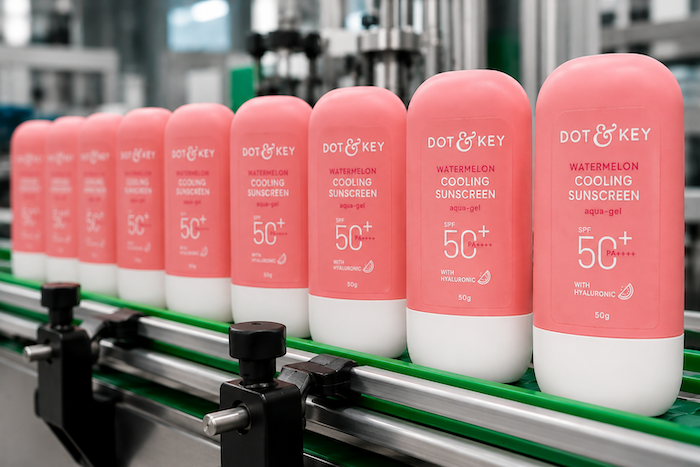
Packaging efficiency is now a priority for manufacturers of pharmaceuticals, FMCG, food, beverages, cosmetics, and chemicals. As production volumes rise, companies need faster, more accurate, and easier to control labeling and packaging lines.
Labels are key for carrying brand identity, product and compliance information such as batch details, barcodes, manufacturing dates, expiry dates, and safety instructions – important information for consumers, retailers, distributors, and regulators.
Even a small labeling mistake can lead to product rejection, rework, customer complaints, or compliance issues. Slow or inaccurate labeling can affect the full packaging line.
When labels are applied manually there is always the danger of misaligned, wrongly placed and missing labels. Manual labor also slows down the production speed while automated labeling provides consistency, repeatability, and speed.
One of the biggest benefits of labeling automation is improved line speed especially for high-volume production. With manual labeling workers may not be able to match the speed required in continuous packaging operations, which can slow down the overall line.
Automatic labeling machines can work in sync with conveyors and other packaging equipment, helping products move continuously through the line without unnecessary stoppages. For example, in a beverage plant, bottles may pass through filling, capping, inspection, labeling, and final packing within seconds. If labeling is slow, the entire line slows down.
Reducing errors, rework, and product waste
Labeling errors can be costly. A product with an incorrect or poorly placed label may need to be removed from the line, relabeled, or rejected. This increases material waste, labour time, and production cost. Automated labeling systems can reduce these issues using product sensors, label gap control, speed synchronization, and accurate dispensing mechanisms.
Many manufacturers handle multiple product sizes, shapes, and label formats. A food company may package bottles, jars, pouches, and containers. A cosmetic company may need labels for round bottles, flat containers, tubes, or cartons. Automated labeling systems can be designed to support a variety of packaging formats. With proper setup and changeover practices, manufacturers can shift from one product type to another with less downtime. This flexibility is especially useful for companies managing several SKUs in competitive markets.
In India’s growing packaging machinery sector, Hindustan Industries has played a key role in advancing labeling automation, with over 1,000 installations worldwide across diverse industries and applications. Its portfolio includes high-speed automatic labeling machines designed to handle pharmaceutical, FMCG, food, beverage, cosmetic, and chemical products.
With a focus on speed, accuracy, and adaptability across all types of containers and packaging formats, these solutions demonstrate how labeling automation is more than just a machine upgrade — it is a process improvement tool that enhances operational control, reduces rework, and ensures smoother production flow. Designed to meet diverse operational requirements these machines supporting scalability and reliability across industrial applications worldwide.
Compliance and traceability
In regulated industries, labeling accuracy is directly linked to compliance. Pharmaceutical, food, and chemical products often require clear information such as batch number, manufacturing date, expiry date, ingredients, warnings, dosage details, and barcodes.
Automated labeling can support compliance by helping maintain uniform placement and readability. When combined with coding, printing, serialization, or vision inspection systems, it also improves traceability across the production process.
Efficiency depends on how well each machine works with the rest of the packaging line. Labeling machines are often integrated with conveyors and other packaging equipment to maintain smooth product movement and reduce manual handling. Improved workflow allows better control over production speed and product movement. For example, if a container is not detected correctly, the labeling system can stop label dispensing, helping prevent label wastage and supporting better line control.
Automation does not remove the need for skilled operators. Instead, it allows operators to focus on supervision, quality checks, machine settings, and process improvement. In manual labeling, workers may spend long hours repeating the same task, portentially leading to fatigue and inconsistent results. Automated labeling reduces repetitive manual work and helps teams manage production more efficiently.
Future automation
The future of labeling technology is moving toward smarter and more connected systems. Developments include vision inspection systems, digital controls, serialization support, real-time production monitoring, Industry 4.0-ready machinery, and better compatibility with high-speed lines. These developments will help manufacturers identify errors earlier, improve maintenance planning, and make better production decisions. Continued improvements in automation of process steps and machine components will remain an important aspect of reliable and efficient packaging operations.
(Sagar Kapoor is the founder of Hindustan Industries)