
India’s PET packaging industry is entering a phase of sustained expansion, driven by rising consumption, urbanization and increasing demand from beverage, FMCG, personal care and pharmaceutical sectors.
According to Vikram Gulliani, business line manager – air & gas applications, compressor technique, at Atlas Copco India, the industry’s growth is creating new opportunities for advanced compressed air and gas technologies that improve productivity, reduce energy consumption and support sustainability goals.
Gulliani says PET continues to gain preference because of its lightweight properties, recyclability and cost efficiency. Growing regulatory emphasis on food safety and hygiene is encouraging manufacturers to adopt higher-quality packaging systems that rely on oil-free compressed air during bottle production.
“We see the Indian PET packaging industry on a strong and sustainable growth trajectory,” he says. “The growth is being supported by structural factors such as urbanization, rising disposable incomes and changing consumption patterns rather than short-term cyclical trends.”
Compressed air remains one of the most critical utilities in PET manufacturing. High-pressure air is used during stretch blow molding to form bottles from preforms, while low- and medium-pressure air supports material handling, cleaning, actuation and packaging operations. Since compressed air systems account for a significant share of plant energy consumption, their efficiency has a direct impact on operating costs and productivity.
Efficiency improving
Atlas Copco has focused its recent innovations on improving efficiency, reliability and system integration. Gulliani highlights the company’s long-standing ZD range, which combines screw and reciprocating compression technologies, as well as its development of air-cooled piston systems designed specifically for PET bottle blowing applications.
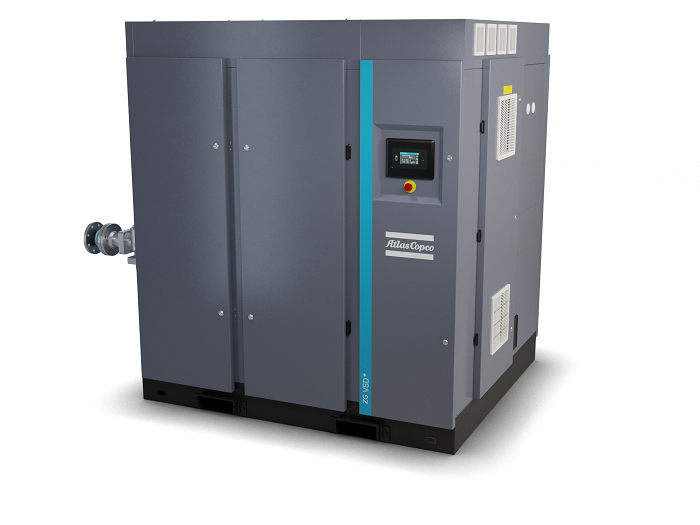
The company has introduced oil-free screw compressor technology capable of operating at pressures of up to 30 bar for PET blowing applications. According to Gulliani, the technology offers lower maintenance requirements, greater operational flexibility and reduced downtime compared with conventional systems.
“Digitalization is becoming a major differentiator,” he says. “Modern compressor systems are equipped with advanced controllers, sensors and connectivity that enable real-time monitoring, predictive maintenance and performance optimization.”
These digital capabilities allow manufacturers to monitor energy consumption, identify inefficiencies and improve reliability while reducing lifecycle costs.
Energy efficiency remains a primary concern for PET processors, particularly as electricity costs continue to rise. Gulliani says manufacturers are increasingly looking beyond individual pieces of equipment and focusing on optimizing the entire compressed air system.
Atlas Copco’s approach includes variable-speed drive (VSD) technology, leak reduction measures, heat recovery systems and distribution network optimization. The company has also developed a “Flex” concept that centralizes medium-pressure air generation in a compressor room while locating high-pressure boosters near blow molding machines.
According to Gulliani, this configuration reduces the need for high-pressure piping throughout the plant, lowering capital expenditure while improving efficiency and reducing leakage losses. Atlas Copco also conducts system audits and energy assessments to help customers identify opportunities for further savings.
High-pressure air systems tailored for PET applications are also helping improve production efficiency. By generating compressed air at the precise pressure and flow rates required by the process, manufacturers can minimize energy losses associated with pressure drops and air wastage.
Integrated systems that recover exhaust air from blow molding operations can further reduce power consumption while stabilizing pressure levels across production lines. This contributes to more consistent cycle times, lower rejection rates and improved product quality.
Sustainability is becoming an increasingly important factor in investment decisions across the PET packaging value chain. Manufacturers are placing greater emphasis on lifecycle performance, carbon footprint reduction and energy efficiency rather than focusing solely on initial capital costs.
“Energy-efficient, oil-free and low-emission technologies are gaining preference as companies align with sustainability targets and regulatory requirements,” Gulliani says.
Compressed air systems play an important role in this transition because improvements in energy efficiency directly reduce greenhouse gas emissions. At the same time, digital monitoring systems provide detailed reporting on energy usage and environmental performance, supporting both corporate sustainability programs and regulatory compliance.
Growing rPET demand
The growing adoption of recycled PET (rPET), lightweight bottle designs and automated production systems is also influencing equipment selection. Gulliani expects future PET manufacturing facilities in India to become larger, more automated and increasingly integrated with Industry 4.0 technologies.
He notes that manufacturers are under pressure to increase throughput while maintaining consistent quality and controlling costs. High-speed bottling lines are particularly sensitive to pressure fluctuations, contamination and unexpected downtime.
Advanced oil-free compressors, intelligent control systems and predictive maintenance tools are helping address these challenges. The increasing demand for production flexibility—such as the ability to manufacture bottles of different sizes on the same line—is also driving greater interest in variable-speed compressor technologies.
Looking ahead, Gulliani sees significant opportunities for innovation in heat recovery, artificial intelligence-driven demand forecasting and deeper integration between compressed air systems and production planning platforms. Modular and scalable compressor solutions could also allow manufacturers to expand capacity incrementally without sacrificing efficiency.
For PET manufacturers seeking to remain competitive, Gulliani believes the priorities are clear: energy efficiency, operational reliability, flexibility and data-driven decision-making.
“Manufacturers that focus on total cost of ownership rather than just upfront investment will be better positioned for long-term success,” he says. “Productivity and sustainability are no longer separate objectives—they are increasingly interconnected.”