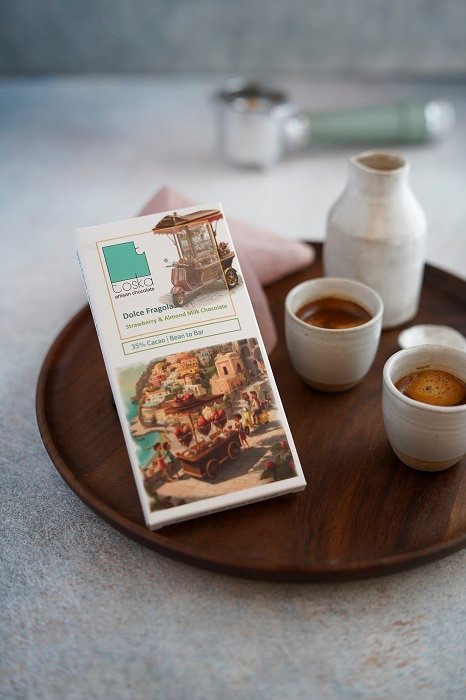
‘Toska’ is a Russian word evoking melancholy, longing, and yearning. Toska is also an Indian artisanal chocolate brand that crafts luxurious bean-to-bar creations, transforming the finest cacao into bold, indulgent flavors. Its founder, Ishan Pansuria, says, “We are a storytelling company that uses chocolate as its medium.”
According to the Ahmedabad chocolate company’s founder, Ishan Pansuria, the storytelling narrative drives every decision the brand makes from recipe development and sourcing to packaging design and customer experience. “While much of the craft chocolate industry focuses on flavor notes, cacao percentages, or origin stories, we focus on emotional experiences. Toska Chocolates is not a chocolate company that happens to tell stories – we are a storytelling company that uses chocolate as its medium.”

Apparently, Toska’s products are designed to transport consumers into a memory, a place, or a feeling. A bar such as Baithak Masala Chai evokes the warmth of conversations over chai, or an adda, while others draw inspiration from travel, seasons, and cultural experiences
As the Indian craft chocolate market becomes increasingly sophisticated, differentiation is no longer achieved through premium ingredients alone, Pansuria says, noting that consumers are looking for authenticity, emotional connection, and memorable brand experiences. According to him, Toska occupies that space where fine chocolate meets culture, storytelling, and design.
When he started Toska, many customers were merely looking for premium chocolate. Today, he sees a more informed consumer. “The modern premium consumer is interested in provenance, ingredient integrity, craftsmanship, sustainability, and brand values. They want to understand where ingredients come from, how products are made, and why certain flavors exist.”
Toska’s branding speaks to this consumer through intentionality – every visual element, flavor, and packaging decision has a reason behind it. The brand avoids trend-driven marketing and instead focuses on creating a sense of permanence and timelessness.
“The premium consumer today is not buying luxury solely for status. They are buying products that align with their identity and values. Toska appeals to consumers who appreciate craftsmanship, cultural narratives, design excellence, and sensory exploration,” adds Pansuria
Artisanal brand to scalable business
Pansuria speaks of his learning curves while transitioning Toska from a passionate startup idea into a scalable business. “The biggest challenge was realizing that scaling and craftsmanship are not mutually exclusive, but they require entirely different systems. When you’re small, quality depends largely on personal oversight. As you grow, quality must be built into processes, documentation, sourcing protocols, training systems, and supplier relationships.
“The risk for any craft food business is that growth can dilute authenticity. We consciously chose a slower and more disciplined growth path because protecting product integrity was more important than chasing volume.”
Another major learning curve was inventory and production planning, he says, adding that chocolate is highly sensitive to temperature, humidity, storage conditions, and ingredient variability. Scaling requires precision without losing creativity. “Today, our focus is scalable craftsmanship where systems support artisanal quality rather than replace it.”
Understanding cacao origins fundamentally changes how one views chocolate. “Most consumers have traditionally viewed chocolate as a confectionery product. However, cacao is an agricultural ingredient, much like coffee, tea, or wine grapes. The terroir, genetics, fermentation methods, drying practices, and post-harvest handling significantly influence flavor. Our role is to bridge the gap between producer and consumer.”
Through storytelling, packaging, social media, and customer interactions, Toska educates consumers about how origin affects flavor. The brand encourages people to appreciate chocolate not merely in terms of its sweetness but its complexity, aroma, acidity, fruitiness, floral characteristics, nuttiness, and texture. “As Indian consumers’ appreciation for specialty foods grows, we believe consumer education is essential for the long-term development of the craft chocolate industry,” he says.
Leveraging digital platforms
On leveraging digital platforms to build a community and retain loyal customers, Pansuria says digital platforms have become Toska’s primary storytelling channels. “Community building today is less about broadcasting messages and more about creating meaningful conversations. While Instagram allows us to communicate visually and emotionally. We use it not only to showcase products but also to share the inspiration behind each creation, our design philosophy, ingredient journeys, and behind-the-scenes craftsmanship. Our website, on the other hand, serves as an educational and experiential platform rather than simply an eCommerce destination. We aim to help consumers understand the stories, ingredients, and creative thinking behind every product.”
Pansuria explains that identifying which processes should scale and which should remain protected plays a big role in balancing the pressure of scaling production while strictly maintaining the artisanal integrity of Toska. While consistency, quality control, inventory management, and logistics can be systemized, creativity, recipe development, flavor balancing, and sensory evaluation cannot be fully automated, he added. Increasingly, customer feedback influences future product development, flavor exploration, and packaging refinements.
“At Toska, every product continues to undergo rigorous tasting and quality assessment. We maintain strict sourcing standards and prioritize ingredient quality over production convenience. Scaling should never mean standardization at the cost of character. Our goal is to preserve the soul of artisanal chocolate while improving operational efficiency.”
Experiential gift-worthy packaging
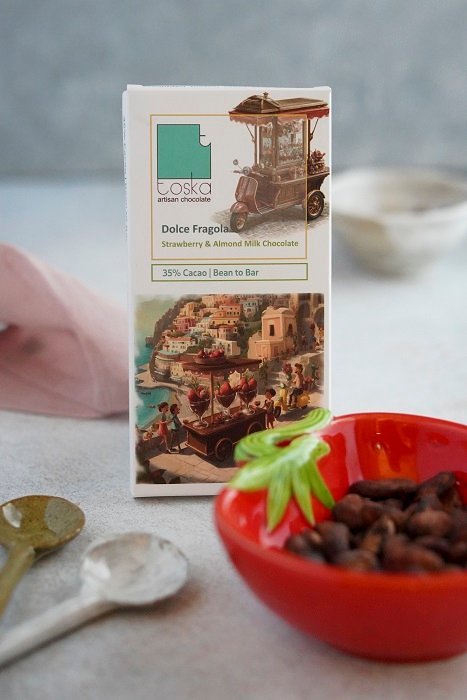
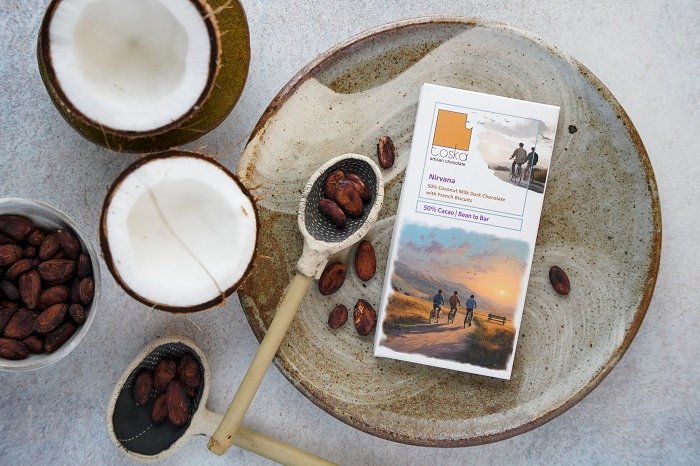
For Pansuria is the first chapter of the experience. “The moment a consumer picks up a Toska bar, we want them to feel curiosity, sophistication, and anticipation. The typography, illustrations, textures, colors, and finishing details are all carefully selected to create an emotional response. Each package serves as a visual interpretation of the story inside.
“We intentionally design our packaging to feel gift-worthy even when someone is purchasing it for themselves. In many cases, customers encounter the packaging before they encounter the chocolate, so it becomes a critical part of shaping expectations. Our objective is for consumers to feel that they are holding an experience rather than simply a product.”
Good packaging, he asserts, should perform three roles simultaneously – protection, communication, and experience. Chocolate is extremely sensitive to environmental conditions, particularly heat, humidity, light, and physical impact. Therefore, structural integrity and product protection are non-negotiable.
Every packaging decision, he said, is evaluated from both aesthetic and logistical perspectives. “We test how materials behave during transportation, storage, and handling before evaluating their visual appeal. Sustainability is integrated into this process by prioritizing recyclable and responsible materials wherever feasible, while ensuring they continue to meet performance requirements.
“Packaging often tells a story before a customer ever takes a bite. Packaging design should reflect the flavors and the origin of the ingredients inside. Taking packaging as visual flavor translation, each flavor profile contains a distinct emotional and sensory character. Our challenge is to express those characteristics through visual language.
“Rather than illustrating ingredients literally, we aim to capture the feeling associated with them,” he says. “With a richer and more immersive customer experience, packaging becomes an extension of the flavor narrative. For example, a flavor inspired by warmth and nostalgia may use softer visual elements and inviting color palettes, whereas a fruit-forward chocolate may employ brighter tones and dynamic compositions.”
Color psychology in packaging
According to Pansuria, color psychology plays a significant role in packaging. While warm tones often communicate comfort, spice, and richness, vibrant colors can suggest fruitiness and brightness, and deeper hues can indicate complexity, intensity, or indulgence.
Beyond color, typography, illustration styles, spacing, and tactile finishes create sensory expectations before consumption. “Research shows consumers begin forming flavor expectations within seconds of seeing the packaging. We consciously use design to create alignment between visual perception and actual tasting experience. The goal is that when consumers finally taste the chocolate, the experience feels coherent and complete.”
Packaging the narrative
“The role of design is not decoration; it is interpretation. We begin every project with the story, not the design. Before discussing colors, layouts, or illustrations, we define the emotional objective. What memory are we trying to evoke? What feeling should remain with the consumer? Once that narrative foundation is established, designers translate the story into visual form.
“Every creative decision is evaluated against a simple question – does this feel unmistakably Toska? If the design is beautiful but disconnected from the narrative, it doesn’t move forward. This process helps maintain consistency while allowing creative evolution,” he added.
Unique, luxury-level packaging has apparently impacted gifting and word-of-mouth marketing for Toska chocolates. Premium packaging amplifies shareability and gifting behavior, according to the chocolatier. He notes that consumers increasingly seek gifts that feel thoughtful, personal, and memorable. Packaging becomes an important part of that perceived value.
“We’ve observed that many customers first encounter Toska through gifts. In those situations, packaging acts as a silent brand ambassador. In today’s experience-driven economy, packaging has become one of the most powerful forms of marketing. Luxury packaging also naturally encourages social sharing. When people photograph, gift, or display a product, they extend the brand’s reach organically.”
While sustainability and premium aesthetics are often perceived as opposing goals, advances in material science are making it possible to achieve both, according to Panasuria. Consumers increasingly expect brands to demonstrate environmental responsibility, but they also enjoy premium experiences.
The challenge is to design solutions where sustainability itself becomes a hallmark of luxury. “Our approach focuses on reducing unnecessary material usage, selecting responsible substrates, improving recyclability, and continuously evaluating new packaging innovations. Brands that succeed in the coming decade will be those that create packaging that is beautiful, functional, emotionally engaging, and environmentally responsible all at the same time,” he concludes.