On a Saturday, amidst incessant rain, waterlogging and flooding of all road and rail routes to Ahmedabad, the Indusfood exhibition was held in Gandhinagar with a healthy turnout and a strong presentation of food brand owners and innovators from across the country, and particularly from Western India and Gujarat.
Particularly impressive were the many food processors and exporters producing innovative products aligned with the new-age trends of healthy, organic, natural food and beverage products for domestic and export consumption. While many stands showed a great variety of savory snacks, the full range of glass, metal, board and flexible packaging was displayed.
The overall impression is of innovation and agility – new products with the requisite attributes and sensibility, packaged with a quality and style that will attract both domestic and global customers. Small and medium-sized companies presented unique ingredients and products that the country can provide, processed and packaged with the integrity and compliance that the global market is looking for. At the same time, the exhibition and our FoodTekPack conference attracted a good audience of food export-import traders and experts.
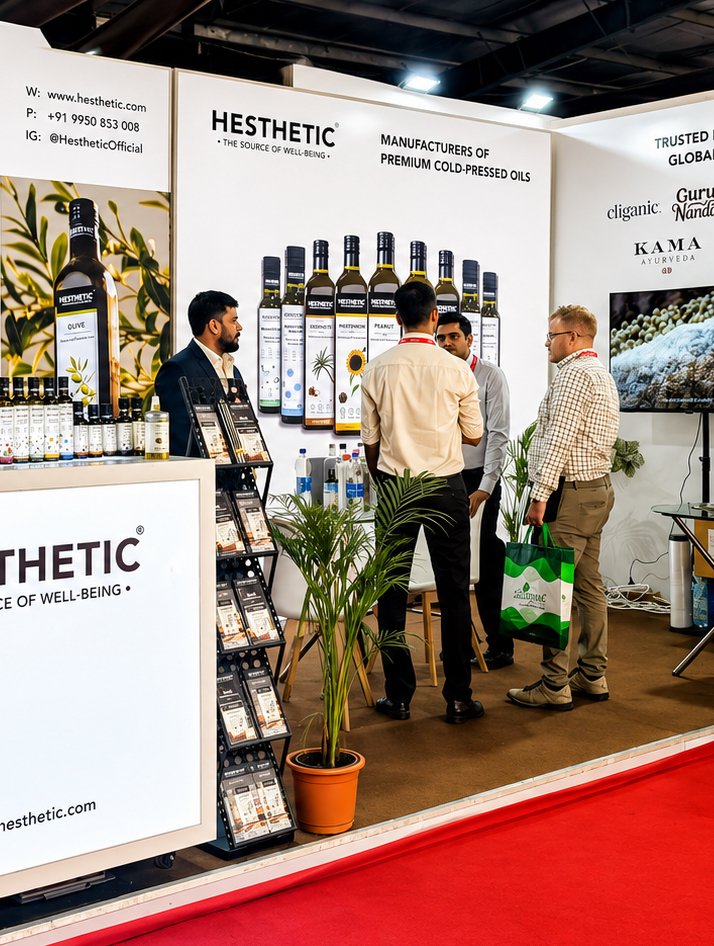
While several companies at Indusfood showed high-quality cold-press beverages and oils, one of the best presentations was that of Hesthetic from Surat, which displayed a wide range of cold-pressed oils for cooking, salads, and personal care. Hesthetic uses an innovative system of imported and locally developed components for pressing and extracting natural oils with a single screw process from seeds at temperatures below 40 degrees centigrade and without any dilution. Its products have a very high shelf life, and its excellent packaging in various SKU formats reflects its strong export clientele in discriminating and developed markets.
The FoodTekPack Conference, which is covered in this issue, was well received by the food brands and packaging converters who attended. Rasna director Arzad Khambatta’s keynote spoke about the industry’s opportunity to increasingly process and deliver food and beverage products to the world rather than merely providing raw materials and ingredients.
He also described some of the export challenges, with each SKU requiring appropriate design and information compliance with the rules of each destination. “In case a consignment does not arrive in time, or is not accepted for any reason, it cannot be repurposed since the packaging and labelling information have to be specific to each market.”
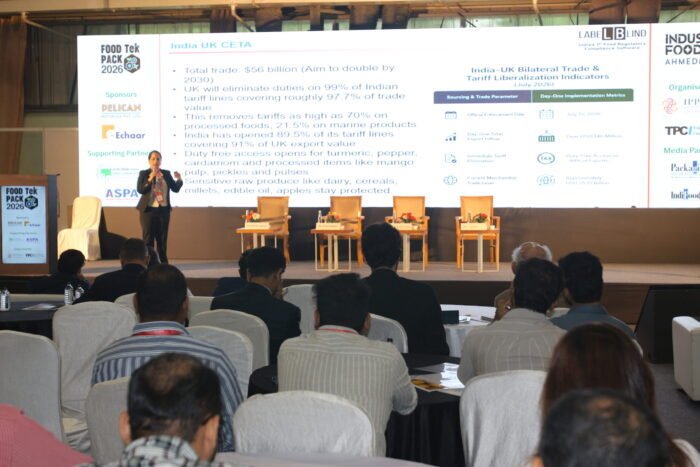
The Save Food and innovation session of the conference discussed the opportunities to create value and protein products rather than just ingredients and raw materials, following which Dr Rashida Vapiwala presented her automated software solution for producing FSSAI and export-compliant labels and packaging.
“India’s food exports are at a defining moment. Global demand for food is growing, India is signing Free Trade Agreements, and the opportunity has never been greater. But are we ready to seize it?” she asked. Demonstrating her software solution, she said, “For years, regulatory compliance has been viewed as a cost or a barrier. It is time to change that mindset. Regulatory compliance, when digitized, creates a level playing field. It empowers businesses, whether a fast-growing startup or a large enterprise, to confidently navigate multiple country regulations, accelerate market entry, minimize compliance risks and compete globally with speed and precision.”
The Packaging South Asia Conference in Mumbai on 9 October 2026
While events taking place in the next month are previewed in this issue, we are developing our second conference this year – The Packaging South Asia Conference in Mumbai on 9 October 2026. The theme of this year’s conference is ‘Packaging for Profit and Resilience’, in which we want to discover, deconstruct, and discuss why each segment of the consumer product and packaging supply chain complains about the squeeze on profits or low margins.
While there is constant talk about innovation and sustainability being inhibited by price sensitivity, we feel that the economic context and consequences of these need to be discussed somewhat holistically. For instance, what are the structural costs of compliance, and is there really a level playing field? How do or can innovations really lead to efficiencies, and can these be fairly spread across the supply chain?
This conference is already creating some excitement as an opportunity for meaningful interaction between brands, converters, copackers, and retailers. Apart from an initial group of more than a dozen panelists, we also have some early bird sponsors and participant registrations. Do have a look and give us your comments.