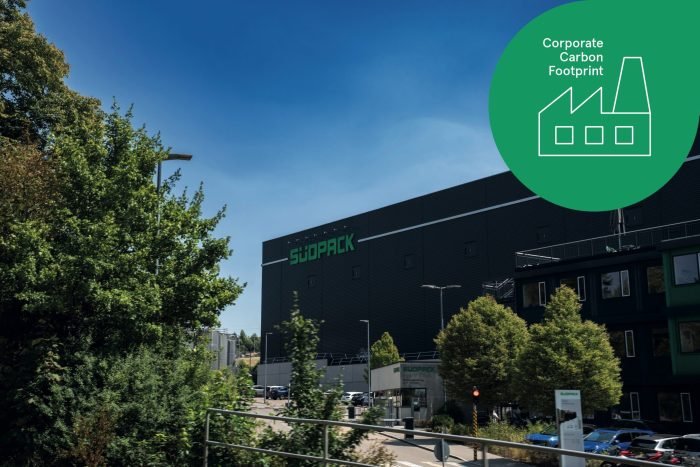
The Sudpack Group has once again significantly reduced its operational carbon footprint (Scopes 1 & 2) – and continues to pursue its ambitious Scope 3 targets with equal determination. A consistent, values-driven approach, technical innovation, collaboration across the value chain, and the integration of the Sustainability Strategy throughout the organization are all key pillars of this success.
As a manufacturer of plastic films and packaging concepts for food, non-food, pharmaceutical and medical products, as well as technical applications, Sudpack is fully aware of its responsibilities in the area of climate protection.

By committing to the Science Based Targets initiative (SBTi) – and therefore to the Paris Agreement’s 1.5°C target – and establishing validated near-term targets for Scopes 1, 2 and 3.1, the family-owned company has set clear goals for 2030 as part of its Sustainability Strategy. The Corporate Carbon Footprint (CCF) serves as both a key metric and a management tool, providing reliable emissions data for tracking progress toward these goals and systematically identifying further reduction potential.
Significant progress compared with the 2021 baseline
The latest CCF confirms that Sudpack is making good progress in implementing its climate strategy. Compared with the 2021 baseline year, total CO2e emissions were reduced by 21% in 2025. In Scopes 1 and 2 – covering direct emissions and purchased energy – Sudpack achieved a significant 73% reduction in emissions. The target for 2030 is a 76.3% reduction.
In Scope 3.1 (purchased goods and services), emissions were reduced by 16%, with a 25% reduction targeted by 2030. This category accounts for around two-thirds of Sudpack’s total emissions, meaning that even relatively small improvements can have a noticeable impact. Consistent action in this area is therefore of particular importance.
Compared with 2024, the Sudpack Group’s CCF increased slightly by 3.91%. Nevertheless, the annual target based on the SBTi targets was still met. Among the factors behind the slight increase was the welcome rise in sales volumes, which has a direct impact on Sudpack’s inherently high product-related Scope 3 carbon footprint – both for purchased goods and at end of life.
Another factor was the expansion of the plants in Erolzheim and Coulmer, France, in 2025. At the same time, these substantial investments have enabled Sudpack to significantly expand its capacity to produce packaging materials that are as lightweight as possible and designed in accordance with Design for Recycling guidelines – an important step toward greater sustainability and long-term viability, as well as further reductions in its CCF.
Focus on product design, circularity, and material efficiency
To meet its reduction targets despite plans for continued sales growth, Sudpack is focusing primarily on PP- and PE-based packaging concepts that are compatible with existing recycling streams. Another approach is to reduce the weight of its high-performance materials. Using less material per square meter of film conserves resources, reduces emissions throughout the logistics chain, and also offers benefits at end of life. In package printing, Sudpack is also seeing growing customer uptake of its SPQ technology, which enables a highly efficient printing process and helped reduce emissions associated with solvent consumption by around 9.5% compared with 2024.
Ultimately, however, the extent to which these new products contribute to climate protection depends largely on when customers are ready to switch to alternative packaging concepts.
Renewable energy and energy efficiency
Sudpack is also making steady progress in energy management. Since the beginning of 2025, the Coulmer site has also been supplied with green electricity backed by guarantees of origin, meaning that all EU production sites are now powered entirely by green electricity.
Across the Sudpack Group’s entire energy mix – which includes electricity as well as other energy sources – renewables currently account for 57%. This share is set to increase to 88% by 2030. Key measures identified to achieve this target include the use of sustainable energy sources and continued electrification – for example, by replacing gas with green electricity.
Encouragingly, energy efficiency measures have reduced total energy consumption by 19% since 2021. Transport-related emissions have also been reduced through ongoing optimization efforts, despite higher purchasing and sales volumes.
Greater transparency through digital climate management
A new software solution is helping Sudpack manage the growing complexity of sustainability issues across its international operations more effectively, while also giving the company greater oversight and control. The platform consolidates emissions data, targets, and progress in a single dashboard, making it easier to identify decarbonization opportunities, meet reporting requirements efficiently, and further standardize digital processes for data collection and analysis.