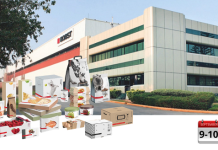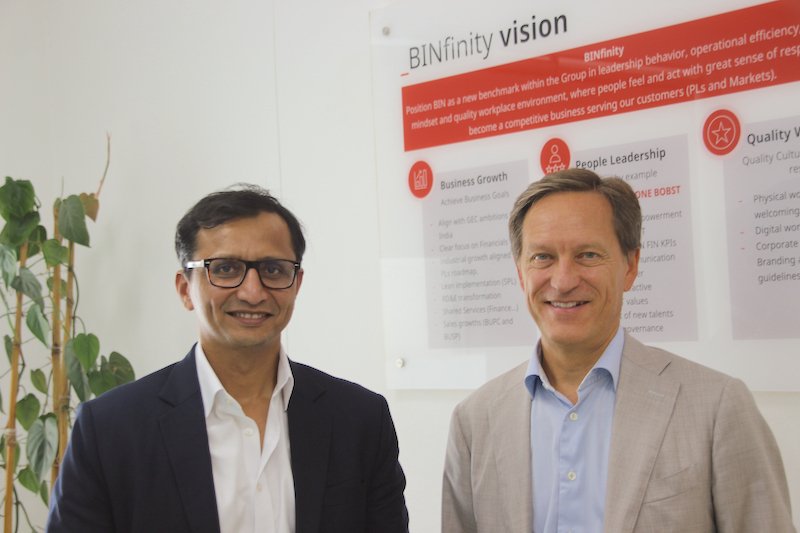
As Bobst celebrated the 30th anniversary of its Indian subsidiary in Pune on 9 and 10 September, we had the opportunity to sit down with Bobst Group CEO Jean Pascal Bobst and Ashish Saxena, the managing director of Bobst India. We have interviewed Bobst a few times over the past fifteen years, and despite the geopolitical context of our meetings, he has always been concerned, unassuming, and frank.
While many of our meetings have come with a geopolitical crisis in the background, our conversations have always discussed the company’s ambition to do more in India, transfer more technology to Pune, and strengthen its resources and structure. More than fifteen years ago at the Bobst factory in Pune, with the global financial crisis in the background, Bobst explained his readiness to do whatever necessary to maintain the liquidity of the company and continue its investments in Brazil, China and India.

When we interviewed the Bobst Group Ceo at drupa24, the Ukraine war had increased energy and steel prices in Europe, putting the company’s operations, customers, and employees under pressure. Nevertheless, he revealed bold and specific plans for manufacturing expansion at the Pune location, including building a second factory on nearby land for manufacturing components, FFG corrugated machines, vacuum metallizers, and other projects.
By the time of our recent meeting in Pune, much of what Bobst had said in Dusseldorf had already come to fruition. The 30th anniversary celebration of the company in India was accompanied by the inauguration of the Bobst Competence Center in Pune and a grand Open House.
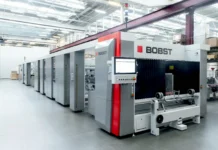
Vacuum metallizers are in serial production and being exported – the seventh machine is on the shop floor of the new factory. The NovaFFG machines have also been rolling out – quick job changeovers were demonstrated live at the competence center. (The Open House also included demonstrations of the Novacut 106 enhanced with Accuregister and Zero patching, the Novafold enhanced with Accubraille, Vision CI flexo press and the Novalam 800 laminator.)
Essentially affirming his comments to us at drupa 24, Jean Pascal Bobst said that several of the ambitious plans he revealed two years ago for the Pune factories have already been implemented, and others continue to progress. “The geopolitical constraints of the last several years, including Covid, Ukraine and tariffs, have disrupted or affected various global supply chains and financial structures. With steep changes in currency exchange rates and higher interest costs, the European-manufactured Bobst machines have become, in some cases, unaffordable for Indian customers. Bobst will run fast, adjust, and even revise its strategy to cope with changes.
“We will continue to move to regions and to countries. With China for China, India for India strategies, we will enhance capabilities in each. And if we are not able to offer everything, we will partner with others. Two years ago, we said that to de-risk China, we would double our capacity in India, and we expect 20% of the increased production will be absorbed in India while 80% will go to exports.
“For Bobst, the Asian market has gained in importance, and the company is doubling its investment and capacity in India not only by increasing the manufacture of more advanced types of machines, but also by turning Pune into a major hub for global components, software capabilities, skill development via apprenticeships, and research and development.”
In our interview and in his comments to customers at the Open House, he said the company is keen to deliver and implement its end-to-end solutions in India, explaining that by this he meant integration of the production workflow. He spoke several times of empowering local leadership so that decisions are made faster and closer to customers.
“Our strategy is to provide three levels of complexity and technology for every equipment line – entry level, medium to high level, and master level. This will also include entry-level gravure with the best price-to-performance ratio.”
Three priorities for India
Ashish Saxena, managing director of Bobst’s India operations, said the company’s immediate strategy had three main priorities: accelerating domestic growth, establishing India as a global manufacturing and services hub, and strengthening the foundational capabilities required to support that expansion.
On expansion across South Asia, Saxena said these markets were smaller than India but had broadly similar requirements and were already buying Bobst equipment. The company plans to increase its sales coverage in the region and strengthen its agent network where direct coverage is not possible.
“Our first and foremost aim is to customize and adapt our global portfolios and technologies and potentially do something that is purely India for India,” he said, adding, “India’s diverse customer base requires equipment and solutions to be adapted to different converter segments.”
The second priority is to expand India’s role within Bobst’s global manufacturing network, including through increased production, R&D, engineering services and software development.
The third is to strengthen capabilities in areas including engineering, innovation, services and the sales network. “We want to be able to sell solutions to our customers and not just offer a machine,” he said.