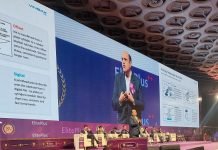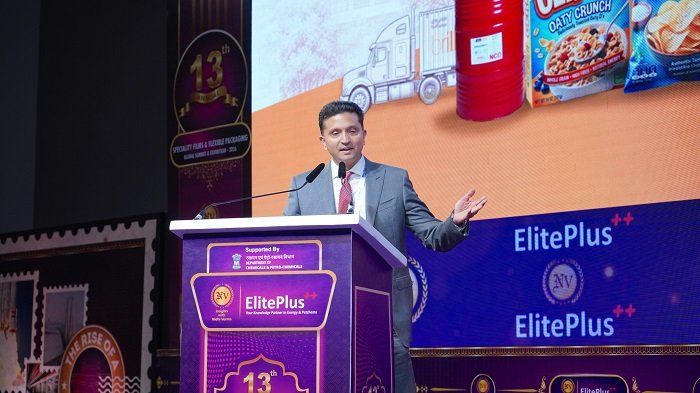
Brilliant Polymers expects the shift from solvent-based to solvent-free laminating adhesives to accelerate as flexible packaging converters seek lower energy consumption, reduced carbon emissions and lower production costs, managing director Gaurav Talwar said at the ElitePlus 2026 summit in Mumbai in August.
Talwar said solvent-free adhesives were becoming an increasingly important technology for the future of flexible packaging, with their performance expanding into applications that traditionally relied on solvent-based systems.
“Solvent-free adhesives are part of the future of flexible packaging,” Talwar said, pointing to their combination of sustainability, cost and performance benefits.
Brilliant Polymers is India’s leading manufacturer of laminating adhesives for flexible packaging, with a manufacturing capacity of 60,000 tons per year and customers across six continents. The company supplies both solvent-free and solvent-based adhesive technologies.
The global market for laminating adhesives is estimated at about US$2.5bn and is growing at around 7.5% annually, according to Talwar. Asia-Pacific accounts for 42% of adhesive sales, while the region represents 51% of global solvent-free adhesive consumption, highlighting its importance in the transition to the technology.
Brilliant Polymers presently derives 74% of its sales volumes from solvent-free laminating adhesives, up from 72% last year, Talwar said. The company accounts for about 12% of global solvent-free adhesive requirements.
Wider application range
Talwar said advances in solvent-free technology were allowing converters to use the adhesives in applications previously considered unsuitable for the technology, including hot-fill packaging, foil laminates, bulk packs, monomaterial and recyclable structures.
The company demonstrated solvent-free applications for products ranging from noodles, curry and coffee to bulk packaging and cement bags. Newer adhesive systems can also work with a wider range of printing technologies, including polyurethane, UV, digital and water-based inks.
According to the company, solvent-free lamination can reduce energy consumption by about 40-65% and carbon impact by 30-60%, while cutting dry adhesive costs by as much as 50%, depending on line configuration, energy source and operating conditions.
The technology eliminates the need for solvents and the energy-intensive drying process associated with conventional solvent-based adhesive lamination. It can also simplify environmental compliance and eliminate solvent retention.
Talwar said the practical benefits of the technology were particularly important in developing markets such as India, where sustainability solutions need to be commercially viable and scalable.
“For us, sustainability has to move beyond aspiration to implementation,” he said, adding that technologies capable of reducing energy consumption and carbon impact while improving converter economics should be deployed more widely.
New adhesive technology
Brilliant Polymers also introduced its Max Cure M5411/M599 solvent-free adhesive system at the summit. The new technology is designed to provide faster curing, quicker primary aromatic amine decay and a wider application window.
The company said the system can achieve primary aromatic amine compliance in about two days while supporting applications ranging from standard flexible packaging to more demanding hot-fill structures. It also incorporates a higher proportion of renewable raw materials.
The faster cure is intended to reduce turnaround times and work-in-progress inventory while giving converters greater production flexibility.
Investment and sustainability
Brilliant Polymers operates a 60,000-ton-per-year manufacturing facility in Maharashtra, which Talwar described as one of the world’s largest single sites for laminating adhesive production. The company is preparing a further capacity expansion, which it expects to announce later this year.
Alongside product development, the company is working to reduce the emissions associated with its manufacturing operations. Brilliant Polymers shifted its manufacturing operations to green electricity during 2026, effectively eliminating Scope 2 emissions. It is targeting up to an 80% reduction in Scope 1 emissions by 2030 from its FY2023-24 baseline, alongside a 45-50% reduction in Scope 3 emissions.
Talwar said the transition to sustainable flexible packaging would require progress across materials, packaging design, manufacturing, collection and recycling rather than relying on a single technology.
For laminating adhesives, however, he said the move from solvent-based to solvent-free systems was already well underway, with the expansion of applications expected to drive further adoption.