In industrial flexographic printing, discussions often focus on production speed, automation and color management. Yet the factors that ultimately determine print quality and process stability are frequently hidden from view. One of the most critical is the mechanical precision of the mounting system. In particular, the interface between the print cylinder and the CFRP (carbon fiber reinforced polymer) sleeve adapter plays a decisive role in print quality, register accuracy, press uptime and makeready efficiency.
SWT Services, based in Ilsfeld, Germany, specializes in precisely this field. As an internationally active service partner for flexographic printing, mounting and balancing technology, the company helps printers and OEMs maintain peak equipment performance throughout the entire service life of their production assets.
Mounting technology
“In flexographic printing, attention is usually directed toward inks, anilox rolls or printing plates. The mechanical precision oft the mounting system is often underestimated. However, even deviations of only a few microns can have a direct impact on print quality,” says Jörg Ehrenfeld, commercial managing director of SWT Services.
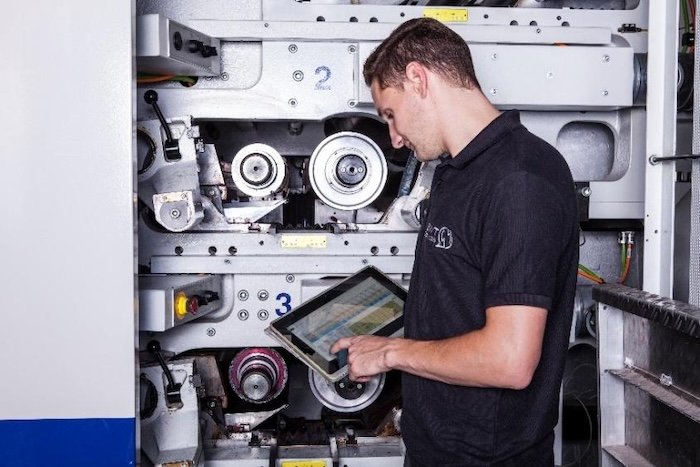
Modern hydraulic expansion clamping systems provide the highly precise connection between the print cylinder and the CFRP adapter. A hydraulic mechanism inside the system expands a precision sleeve in a controlled manner, ensuring uniform and secure clamping of the adapter. At the same time, vibrations are dampened and peak loads are reduced.
Although this process remains invisible to the press operator, it has a significant influence on runout accuracy, print consistency and overall process reliability. In today’s high-performance flexographic presses, where tolerances are becoming increasingly tight, even the slightest mechanical deviation can lead to visible print defects.
Register variations, color inconsistencies and unstable print reproduction are often attributed to ink or plate-related issues. In reality, however, the root cause may be wear, damage or contamination within the mounting system itself.
“Many print quality issues cannot be explained by inks or plates alone. In numerous cases, worn clamping surfaces or damaged expansion sleeves are the actual source of the problem,” explains Oliver Pfeiffer, technical managing director of SWT Services.
Small deviations, significant consequences
The demands placed on modern flexographic presses continue to increase. Packaging converters are expected to deliver high-definition print quality at ever-higher production speeds while meeting increasingly tight delivery schedules.
As a result, press systems have become extremely sensitive to even the smallest mechanical deviations. The connection between the print cylinder and the adapter not only affects print quality but also influences the efficiency of the entire production process.
A properly functioning mounting system enables fast sleeve changes, reduced makeready times and maximum production efficiency. Conversely, contamination, material fatigue and mechanical damage can lead to delays, increased wear and unnecessary downtime.
One of the clearest warning signs is difficulty during sleeve or adapter changes. If excessive force—or even hammers and wooden blocks—is required to remove an adapter, immediate corrective action is necessary.
Ignoring these warning signs can result in unplanned downtime, production losses and costly secondary damage. Under optimal operating conditions, hydraulic expansion clamping systems can maintain exceptional precision over thousands of mounting cycles. However, this level of performance can only be achieved through regular maintenance and professional servicing.
Maintenance as a strategic investment
The maintenance of modern mounting systems goes far beyond basic cleaning procedures. It includes systematic inspection of all clamping surfaces, verification and adjustment of expansion rates, dimensional measurement of critical components and reconditioning of cylinder surfaces.
Piston bores are cleaned, actuation screws lubricated and all functional parameters thoroughly inspected. In addition, target-versus-actual measurements provide a detailed assessment of system condition and performance.
This approach enables potential weaknesses to be identified and corrected before they develop into costly production interruptions.
Following professional maintenance, print cylinders, clamping shafts and adapters can be restored to a condition that is virtually equivalent to new. The result is improved print quality, increased process reliability, reduced downtime risk and a significantly extended service life for critical components.
On-site service
A key element of the SWT Services concept is the execution of maintenance, inspection and repair work directly at the customer’s production facility.
Service engineers assess the mounting system on the press, identify wear points and frequently resolve minor defects immediately. This minimizes downtime and enables production to resume as quickly as possible.
Print cylinders and CFRP adapters are inspected, clamping surfaces cleaned, measurements performed and expansion rates adjusted with high precision. Defective components can often be repaired or replaced on-site.
Thanks to this comprehensive service approach, approximately 80 percent of typical system faults can be resolved during the initial service visit. For packaging converters operating under demanding production schedules, this represents a significant economic advantage.
Beyond technical support, SWT Services places considerable emphasis on operator training. Personnel who understand the function and significance of the mounting system tend to handle components more carefully and are better equipped to identify potential issues at an early stage.
This reduces operator-related errors, improves process reliability and contributes to longer equipment life.
Complete overhaul
In addition to on-site maintenance services, SWT Services offers complete refurbishment and overhaul of print cylinders, clamping shafts, CFRP adapters and anilox rolls.
During the overhaul process, all wear-critical components are replaced while the original base body is retained. Following incoming inspection and functional testing, components are fully disassembled, cleaned and dimensionally inspected. Worn parts are replaced, surfaces are reconditioned and hydraulic systems are refilled and recalibrated.
Comprehensive quality assurance and performance testing are then carried out before the components are returned to service. The result is a component that is technically comparable to a new product while requiring only a fraction of the investment cost.
“Following a complete overhaul, mounting systems are virtually restored to new condition—at significantly lower cost than purchasing new equipment,” says Oliver Pfeiffer.
At a time of rising costs and increasing investment pressures, this represents an attractive alternative for many printing companies seeking to optimize total cost of ownership.
Global service partner
Since its founding in 2010, SWT Services has evolved into an internationally recognized specialist in flexographic printing, mounting and balancing technology. Today, approximately 60 percent of the company’s revenue is generated within the flexographic printing sector. SWT Services supports more than 500 customers in over 40 countries worldwide.
Its service engineers operate globally, serving customers throughout Europe, North America, Asia and Australia. The company’s portfolio includes commissioning, maintenance, inspection, repair, refurbishment, spare parts management and technical training.
“Our strength lies in combining multiple technical disciplines. This allows us to analyze complex issues holistically and provide integrated solutions from a single source,” says Jörg Ehrenfeld.
The combination of expertise in flexographic printing, mounting technology and balancing systems enables comprehensive root-cause analysis and sustainable solutions for demanding technical challenges.
Investing in future growth
A visible sign of the company’s continued growth is its new headquarters in Ilsfeld, Germany. Following groundbreaking in 2023, the facility became fully operational in early 2025.
The modern site offers approximately 300 square meters of office space and around 800 square meters of workshop capacity, providing ideal conditions for maintenance, repair and refurbishment of large components such as print cylinders, clamping shafts and CFRP adapters.
To support its global service operations, SWT Services has also invested heavily in digitalization. SAP Business One was implemented as early as 2018 and serves as the backbone of the company’s service management processes.
Digital documentation, maintenance records, inspection checklists and inventory management systems further support standardized service procedures worldwide and ensure consistently high service quality across all regions.
Competitive advantage
As demands for print quality, production speed and cost efficiency continue to rise, the reliability of mounting systems is becoming increasingly critical. Maintenance, refurbishment and preventive service strategies are therefore evolving from operational necessities into strategic competitive advantages.
Through its specialized service portfolio, SWT Services has established a strong international position that extends well beyond conventional maintenance services. By combining technical expertise, global field experience and close collaboration with machine manufacturers, the company helps customers improve production reliability, operational efficiency and print quality on a sustainable basis.
Conclusion
In flexographic printing, seemingly minor details often determine whether a production run succeeds or fails. The interface between the print cylinder and the CFRP adapter is a prime example of how a few microns can influence print quality, process stability and overall profitability.
Regular maintenance, precision refurbishment and in-depth technical expertise are therefore essential for reliable and efficient press operation. The SWT Services approach clearly demonstrates that engineering precision and professional service must go hand in hand to achieve superior print quality, maximum press availability and long-term economic benefits.
Published in: VerpackungsDruck & Converting, Ebner Media Group GmbH & Co. KG, Issue 2026-03, reprinted with the kind permission of Ebner Media Group GmbH & Co. KG