Owned by global flexible packaging company Uflex, Aseptic liquid packaging major Asepto will commission its new plant in Egypt’s Ain Sokhna by the end of calendar year 2026. The Greenfield plant, which we recently visited, is located in the Orascom Industrial Park in the Suez Canal Economic Zone in a sprawling 30-acre campus with landscaped gardens. A coastal port city along the Red Sea, Ain Sokhna is about two hours by road from the country’s capital, Cairo.
UFlex’s Asepto is among the world’s fastest-growing aseptic liquid packaging brands, with over 250 customers in more than 50 countries. The plant will add 12 billion packs of annual capacity, doubling the combined capacity of Asepto’s Indian facility in Sanand, Gujarat, and the Egyptian unit to 24 billion packs annually. The US$126 million greenfield plant, which will provide faster access to Europe, Africa, the MENA region, CIS countries, the GCC region, and the Americas, is currently undergoing commercial trials covering the complete testing cycle before commercial production.
According to Ashwani Kumar Sharma, president & CEO of the Aseptic Packaging Business at UFlex, the Ain Sokhna plant is expected to reach 30% capacity utilization in its first full year of commercial production, followed by 70% in the second year, and 100% in the third year. “With this new plant, Asepto will become one of the top five aseptic packaging producing companies in the world and a market leader in many geographies,” he told journalists on a field visit to the plant.
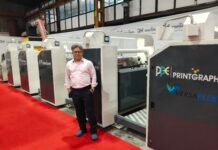
The Heidelberg Board Master XL 1650
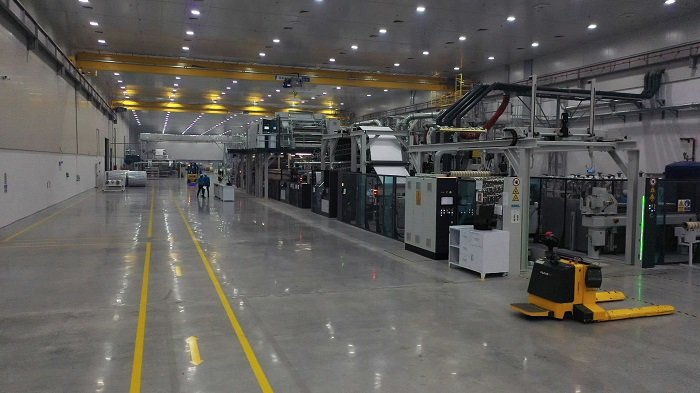
The Asepto Egypt plant integrates printing, inspection, lamination, slitting, material handling and final packaging, with automation, ERP integration and quality-control systems incorporated across the process. The plant is equipped with a Heidelberg Board Master XL 1650 from Germany, designed to enable high-speed printing and efficient job transitions, supported by advanced inspection and creasing technologies.
The Board Master 8-unit printing line operates at speeds of up to 600 meters per minute with high-resolution, high-impact graphics using Esko’s Argus Turbo advanced vision and Intelli Match seamer technologies for autonomous flexographic printing. For extrusion lamination, the plant is equipped with an SML Triplex from Austria, operating at speeds up to 600 metres per minute. The system incorporates a Cloeren die with EVR technology, along with advanced inspection and electronic thickness-control systems.
Also in the converting section is an IMS Italy high-speed slitting machine rated at 1,200 meters per minute with automated web guiding, knife positioning, print-step counting and automatic reel unloading integrated with ERP. Material handling is supported by Madern Automation of the Netherlands, whose automated 160 reels per hour system can deliver finished materials to 12 pallet stations at a rate of 40 pallets per hour.
The Asepto Egypt plant is equipped with ABB L&W quality-control and testing systems. The plant’s quality infrastructure supports testing and monitoring of packaging-material characteristics, while production and quality information is integrated into the plant’s data-management systems. With paper to be supplied by Stora Enso, the plant expects to establish its own plate-making facility, enabling greater integration of the packaging production process.
Product design and formats
UFlex Asepto has its own in-house design shop, Asepto Pro, in India for modifying packaging designs and creating aesthetic packaging solutions for customers. The company plans to establish a similar capability in Egypt following commercial production at the plant.
Asepto has developed a portfolio of premium packaging solutions incorporating holography, foil-stamping effects, customized color options and anti-counterfeiting features. Value additions developed in India, including dynamic QR codes, Magnetic Design Reader (MDR) and Asepto’s paper-straw solutions, are also planned for the Egypt facility.
The new plant is equipped to provide a wide range of packaging formats, including 65 ml, 70 ml, 90 ml, 100 ml, 125 ml, 200 ml, 250 ml, 330 ml, 500 ml and 1,000 ml, covering the range from on-the-go packs to family packs. Packaging formats such as Edge, already introduced in India, are also part of the new plant’s portfolio.
Aseptic packaging is used across a range of applications, including juices and nectars, dairy-based products such as milkshakes and buttermilk, and plant-based beverages such as soy and almond milk. Niche applications, including liquid pharmaceuticals and certain other specialized food and beverage products, are also being explored in different markets. “Aseptic packaging reduces food wastage while extending shelf life. In a 10-year time frame, these niche segments will mature,” Sharma said. Asepto provides form-fill-and-seal (FFS) machines with speeds ranging from 10,000 to 25,000 packs per hour, supported by a global service network.
Egypt as a global logistics and supply-chain hub
On our visit, we learned that the Ain Sokhna port, about 12–15 km from the plant, will facilitate import and export, due to its proximity to the Suez Canal and major maritime routes. “It gives UFlex Asepto access to six broad market clusters – Europe, Latin America, North America, West Asia and the GCC, Africa, and the CIS,” Sharma said. “With the Asepto Egypt plant, we have become a multi-location, strong global aseptic packaging powerhouse. Egypt is a strategic location for us to reach every part of the world.”
“From Ain Sokhna, the GCC and Middle East can be reached in approximately 2–10 days; CIS countries in around 10 days; Europe in around 10 days; Africa in approximately 5–20 days; and North and Latin America in around 30 days,” added Sharma. Exports already account for approximately 35–40% of Asepto’s Indian production. “Egypt has a trade and tariff advantage,” he explained by pointing to Egypt’s network of trade agreements, including MERCOSUR, the Greater Arab Free Trade Area (GAFTA), the Agadir Agreement, the African Continental Free Trade Area (AfCFTA), the Common Market for Eastern and Southern Africa (COMESA), and the European Free Trade Association (EFTA). In addition, Egypt itself is also an important market for Asepto.
Sustainability concerns
Aseptic liquid packaging is expected to see significant growth over the coming years, making sustainability an increasingly important consideration for the industry. International regulators and brand owners are increasingly focused on the complete lifecycle of aseptic cartons, from collection and recovery to the use of recycled materials. UFlex’s recycling facility for aseptic packaging at Malanpur, in Gwalior, uses enzymatic delamination technology to recover the different components of aseptic packaging, including polymers, aluminium and paper fibers. The process operates with zero liquid discharge.
The recovered materials can be directed towards different applications. Aluminium can be used in products such as roofing sheets, while recovered paper fibers can be used for applications including egg and fruit crates. Recovered polymer can be converted into film, while pulp can be sent to paper mills for conversion back into paper for use in UFlex’s other non-food packaging applications.
Sharma made clear that the company places significant emphasis on quality and consistency. According to him, manufacturing high-quality aseptic packaging requires a combination of top-of-the-line machinery, premium-quality raw materials and skilled people. Skilled manpower from India has been sent to Egypt to train the local operations team.
“Sustainability will drive a lot of innovations in the near future,” Sharma said, adding that what matters is not simply how many packs are sold, but how responsibly those packs are manufactured. Packaging, he concluded, becomes truly meaningful when it can participate in a circular economy.