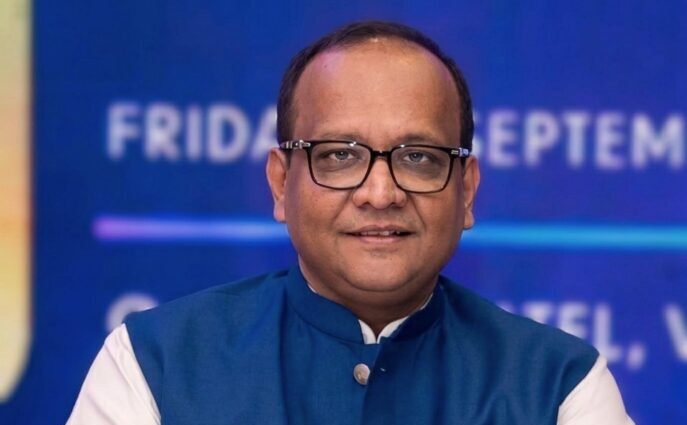
In an interview with Indian Printer & Publisher, Bombay Master Printers’ Association (BMPA) president Saubhagyanidhi Seksaria discusses the association’s priorities for 2026–27, including a target of 25% active membership growth over two years, the launch of a centralized digital dashboard for compliance and industry information, and initiatives to deliver measurable financial and operational benefits to members.
He examines rising costs, skills shortages, automation, investment trends and the convergence of commercial printing with packaging, labels and digital print.

Seksaria outlines his plans to strengthen industry collaboration and previews Print Summit 2027, scheduled for 12 January at the Nita Mukesh Ambani Cultural Centre in Mumbai
What are the BMPA’s top priorities for 2026-27, and what are the key initiatives you plan to undertake in the coming year?
The BMPA leadership team has established three core strategic priorities supported by a clear, actionable portfolio of member-centric initiatives designed to drive connection, digital modernization, and broad-based growth. For this, we want to expand our networking platforms wherein members get an opportunity to interact with one another, which helps to build trusting relationships among industry peers, competitors, and allied suppliers. We also want to consolidate BMPA’s collective intelligence, legal frameworks, regulatory tools, market insights, and resource-sharing capabilities into a single, seamless digital platform accessible at the touch of a button. Also, it will be our endeavor to work towards actively expanding the membership base by reaching out to non-traditional and fast-growing print-packaging segments across Mumbai and National printing hubs.
The BMPA’s new committee takes charge at a time of “significant change and opportunity” for the printing and packaging industry. What are the biggest changes currently affecting printers and packaging companies in Mumbai and across India?
The printing and packaging ecosystem in Mumbai and metros across India is undergoing a structural evolution driven by changing consumer demographics, geographical realignments, and rapid technological convergence. The traditional boundary between commercial printing and packaging has blurred, and several new specialised print verticals are redefining the space. Rapid growth in eCommerce, organized retail, FMCG, and quick-commerce has catalyzed massive demand for short-run digital packaging, flexible labels, corrugated containers, and specialized point-of-sale (POS) structural displays.
Over the past two decades, high real estate prices, stringent urban environmental norms, and elevated operational costs in the metros have driven large converting plants outward. Conversely, metro cities have transitioned into a high-value hub dedicated to pre-press, client handling, rapid digital printing, specialized finishing, and design prototyping.
What are the main challenges facing BMPA members today in terms of costs, technology, manpower, demand and competition?
BMPA members face a complex matrix of operational pressures that squeeze profit margins, which hinder long-term strategic planning. Print companies encounter relentless cost inflation across paper substrates, plates, ink, energy, factory space, and statutory compliance. Operating within a capital-intensive business model amid rapid technological shifts—coupled with a compressed window to recover return on investment (ROI)- creates severe financial and operational pressures. Furthermore, attracting and retaining skilled shop-floor operators, prepress engineers, and production managers remains a critical bottleneck. Compounding these hurdles, operating in a hyper-competitive market alongside chronic payment delays adds further strain, creating a demanding environment where members must continually strive to perform.
The association plans to expand its member services and knowledge initiatives. What new services, training programmes, workshops or knowledge-sharing platforms can members expect during 2026–27?
As I said earlier, we will be creating more networking opportunities to continuously encourage engagement between our members. Going forward, our knowledge-sharing platform will be digitized into a centralized, one-touch portal offering compliance updates, legal risk advisories, standard contract templates, market intelligence, raw material pricing insights, and an online technical repository. Looking ahead, BMPA is committed to acting as a powerful enabler—creating a mutually beneficial ecosystem where our members can freely interact, share resources, and help one another succeed.
The BMPA press release highlights industry advocacy as a key focus. What are the most important policy or regulatory issues that BMPA intends to take up with government authorities?
Over the years, we have taken up numerous issues that have affected our industry at large. We have submitted representations to the GST Council from time to time, most recently regarding the refund of accumulated input tax credit due to the inverted duty structure, and have also taken legal action concerning raw material pricing to protect the interests of our members and the printing industry at large. As an association, we remain committed to representing, protecting, and advancing the common interests of our members on critical policy and regulatory issues.
How is the printing industry in Mumbai evolving, particularly with the growing convergence between commercial printing, packaging, labels, digital printing and other allied segments?
Mumbai’s printing landscape is undergoing a profound structural shift characterized by segment convergence and a specialized hub-and-spoke operational model. Traditional commercial printers are actively diversifying into folding cartons, corrugated boxes, labels, flexible packaging, and point-of-sale displays. This convergence allows business owners to de-risk their operations, offset declining commercial print volumes, and capture growing retail and packaging demand.
High urban operational costs have divided Mumbai’s print manufacturing into two distinct operational tiers:
1. Urban Hubs (Mumbai Proper): Dedicated to high-touch client management, design consultation, prepress execution, short-run digital customization, and luxury embellishments.
2. Industrial Corridors (Bhiwandi, Vasai-Virar, Palghar, Navi Mumbai): Dedicated to high-volume manufacturing, heavy multi-color offset presses, high-speed corrugators, and automated converting lines.
Print companies are increasingly deploying hybrid production lines that seamlessly combine offset, flexo, digital inkjet, and automated post-press inline finishing, enabling economic production across both micro-runs and bulk orders.
How can BMPA encourage greater collaboration between printers, packaging converters, suppliers, technology providers and other allied businesses?
At BMPA, we strongly believe that growing in isolation is far more difficult than thriving within a connected ecosystem, which is why we are actively building deliberate collaborative bridges. Through structured initiatives like ‘Share to Benefit’, ‘Carton Forum’, and off-site retreats, our printers, packaging converters, and industry peers can sit together transparently to share operational insights and strengths.
We also intend to have strategic supply chain alliances with bodies like the Paper Trade Association and TechNova to address pricing stability, supply predictability, and quality standards. On the commercial side, we are scaling MLDP, our Khari Kamai initiative, by adding new vendors annually across ink, paper, and other inputs to secure direct discounts for members, while optimizing Stocklaabh for trading surplus stock.
Furthermore, we intend to have a strong industry-academia interface to enable more and more students to see our industry favourably.
What is your assessment of the current investment appetite among printing and packaging companies? Are members looking to invest in new presses, finishing equipment, automation and digital technologies?
When looking at the investment appetite among Indian and Mumbai print entrepreneurs, you see a very pragmatic and tech-savvy mindset where capital expenditure is driven by clear return on investment and strategic alignment rather than speculative expansion. Members who have refined their business models are firmly on a growth trajectory.
Recognizing that manual labour is a major operational bottleneck, investments are increasingly pouring into automation. While print companies fully understand the value of AI and robotic automation, widespread adoption will naturally accelerate as cost-effective, problem-solving tools become available. Sustainability is another major focus, with members actively adopting rooftop solar systems and other energy-efficient solutions. Ultimately, rather than blindly adding raw capacity, current investments are vision-based, prioritizing new capabilities, reduced costs, enhanced efficiency, and automation where needed.
The association has served the printing community since 1955. How do you see BMPA’s role changing as the industry becomes more technology-driven and increasingly integrated with packaging and other sectors?
Since our founding in 1955, BMPA has continually adapted to serve the evolving needs of our printing fraternity. As the industry becomes increasingly driven by technology, our institutional role is undergoing a profound transformation. We are expanding our scope beyond traditional commercial print- packaging to encompass an all-inclusive ecosystem covering labels, corrugation, and other digital print verticals, while formally inducting leaders from these emerging segments into our fold. In the coming years, our members will experience this transition firsthand as we evolve into a proactive, digital-first enabler designed to enhance their engagement within the industry
What would you like to achieve by the end of the 2026–27 term that would allow you to say the new committee has made a meaningful difference for BMPA members?
To ensure accountability and tangible progress, the BMPA Team has defined specific quantitative benchmarks and qualitative milestones:
Three Primary Measurable Targets
25% Active Membership Growth: Expanding active membership by 25% over two years, successfully inducting emerging segment players (digital, label, corrugation, POS), and appointing leadership representatives across the new emerging segments within our fold.
Full Launch of the Unified Digital Dashboard: Developing and rolling out a fully operational digital dashboard integrating compliance tools, statutory updates, market intelligence, legal advisory, and industry-academia linkage modules.
Delivering At Least 2X Tangible Member Value: Ensuring that active members realize direct financial and operational benefits worth at least 2X their annual membership fees.
Qualitative Leadership Milestones
Overcoming the ‘Unrealistically Busy’ Mindset: Successfully encouraging business owners to step away from daily shop-floor routines to actively engage in networking, strategic learning, and technology adoption.
Deepening ‘Printers Helping Printers’ Culture: Building trusting cross-segment relationships that foster genuine collaboration, resource sharing, and mutual support.
Elevating Industry Pride & Stature: Instilling profound pride across the printing fraternity and positioning Indian printing as a modern, high-tech, and vital manufacturing sector.
Last but not least, what can we expect from PS 2027?
For Print Summit 2027 on January 12, we are taking a step up by moving to The Grand Theatre at the Nita Mukesh Ambani Cultural Centre. We want to give our printing fraternity a world-class stage to showcase a simple sentiment—that the world is our playground and it is our time to make our presence felt. We are bringing over a thousand delegates, suppliers, and brand leaders together under one roof to connect and share, not to forget an excellent line-up of achievers to make it meaningful, thought-provoking, as well as entertaining