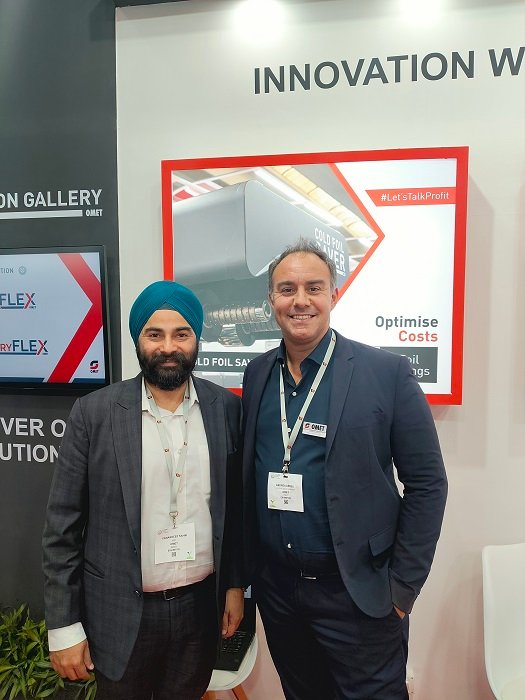
Omet, the Italian manufacturer of narrow- and mid-web flexo presses for label and packaging solutions, attempted to position profitability and process optimization like many other exhibitors in its conversations with packaging converters at the recent Loupe India show. Speaking to Packaging South Asia at Loupe India 2026, Pawandeep Sahni, managing director, India and Subcontinent of Omet India, said the company’s theme ‘Let’s Talk Profit’ reflected the industry’s growing focus on the economics of printing rather than simply investing in new machinery.
According to Sahni, “The most important question being asked by everybody is how to make money. Our philosophy is to configure printing presses in a way that optimizes the production process and ensures that the cost of the final output is as low as possible.” He said that Omet achieves this through improved machine performance, additional technology, and combinations of printing processes, depending on customer requirements. The objective is to ensure the finished product delivers the best possible profitability for converters.
Omet presses cover web widths from 370 mm to 850 mm. Its Indian installed base includes presses with 370 mm, 440 mm, 530 mm, 670 mm and 850 mm widths. The customer base is across labels, folding cartons, flexible packaging and foil printing. Sahni said Omet works with some of the largest players in each of these segments and has expanded considerably beyond its traditional label-printing business.
“Before Covid, we were fundamentally a label-focused company. Since then, we have expanded into every sector,” he said, adding that Omet has a pan-India presence. A key part of the company’s approach is customizing machine configurations to suit individual converters’ specific requirements rather than offering standardized solutions.
Flexo and combination printing
Commenting on the growing adoption of flexography in India, particularly as some converters consider shifting work from gravure, Sahni said, “Flexo simplifies many processes that are more complex with other technologies. It is relatively easy for people to understand and operate. However, this accessibility increases competition,” he said.
Despite the competitive pressures, he sees considerable scope for flexo as the technology continues to evolve and offer improvements in production capabilities, and rejected the notion that flexo and gravure should be viewed as competing technologies. He said Omet has advocated combining printing technologies for several decades, with the choice determined by the requirements of each application.
“We don’t say one technology or the other. We say let’s optimize what can be optimized,” he said. His view is that flexo is suitable for achieving accurate Pantone colors, while gravure is preferable for metallic effects and applications requiring high volumes of barrier coatings or primers. And that offset can be used for highly detailed work involving halftones and textured materials. Sahni added that the company had already implemented such projects in India by combining technologies and configuring presses for specific applications.
Looking ahead, he expects India’s packaging industry to undergo significant changes over the next five years, driven largely by shifts in consumer behavior and the growing influence of younger generations. Citing changes in consumer behaviour since the Covid19 pandemic, he said Gen Z and Gen Alpha are likely to influence packaging preferences in the future.