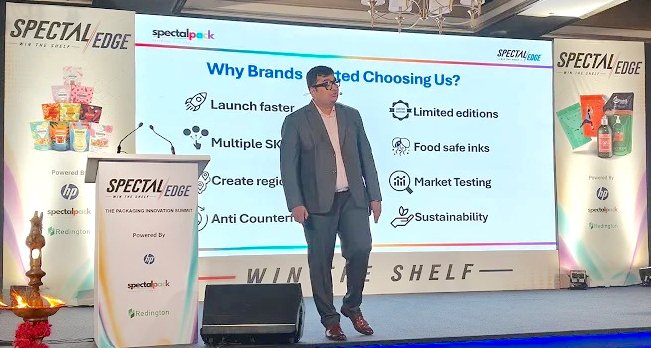
Bengaluru-based SpectalPack has positioned digital printing as a faster and more flexible alternative to conventional packaging, enabling brands to launch new products in as little as seven to 10 days, while also supporting customized packaging, export orders and anti-counterfeiting initiatives, founder Priyesh Dalmia said at the SpectalEdge event organized by HP, SpectalPack and Redington in Bengaluru on 20 July.
Dalmia said his packaging company shortens the time between product concept and retail launch, allowing startups and established brands to test new products without the high upfront costs associated with conventional printing.
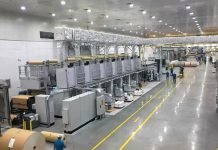
Now operating three HP Indigo presses across Bengaluru and Noida, it began with one HP Indigo 25K digital press, at its old Bengaluru plant. The company added two HP Indigo 200K presses to its new Bengaluru plant in the past year, with the Indigo 25K moved to the recently launched Noida plant.
“We are not selling packaging. We are selling time,” Dalmia said, adding that SpectalPack’s average turnaround time is 8.9 days, with emergency orders delivered within seven days.
Founded in 2024, SpectalPack has worked with more than 700 brands as a product launch and innovation partner rather than a conventional packaging supplier. The company offers digital printing across a range of flexible packaging formats, including pouches, sachets, shrink sleeves, wraparound labels and cold-seal applications.
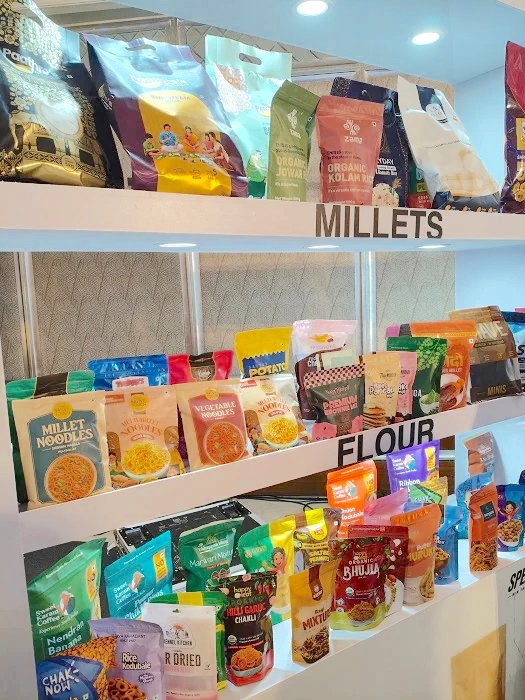
Dalmia says digital printing enables brands to produce smaller print runs, launch regional or limited-edition packaging, conduct market testing and implement variable data printing without investing in printing cylinders or plates.
The technology is particularly suited for export markets, where brands often require multiple language variants and smaller production volumes. The company has supported exporters supplying products to markets, including Saudi Arabia, Australia, the UK, the US and Russia.
Dalmia highlighted digital printing’s role in promotional campaigns, regional marketing and anti-counterfeit packaging. The technology allows every package to carry different graphics, names or QR codes, enabling personalized consumer engagement and improved product traceability.
Food safety is another advantage, he said, noting that HP’s digital printing inks comply with European food-contact standards. He also argued that digital printing can reduce waste by producing only the quantities required, eliminating obsolete packaging inventories and reducing the environmental impact associated with conventional cylinder engraving.
Apart from the three HP Indigo presses, SpectalPack has invested in automated pre-press systems, integrated finishing lines and enterprise resource planning software to accelerate production workflows and support rapid product launches, Dalmia said.
New Noida plant
Bengaluru operations at full capacity, resulted in lead times extending from seven days to as many as 20 days. SpectalPack was producing between 2.5 and 3 print impressions per month before deciding to expand capacity. Increasing capacity and adding to its manufacturing footprint with a new facility in Noida, strengthens its northern presence, cuts delivery times, and ups monthly production capacity to 15 million pouches, Dalmia said in an interview after the event.
The decision to establish a second production base was driven by rising demand and logistical constraints, rather than a shift away from the company’s Bengaluru operations. He says the company plans to use the Noida facility to serve customers across northern and eastern India more efficiently by reducing dependence on long-distance road transport from Bengaluru.
The Bengaluru plant is being upgraded to produce around 10 million pouches per month, while the Noida plant will initially have capacity for about 4 million pouches a month. Combined monthly output across both sites is expected to reach approximately 15 million pouches with further expansion based on demand growth.
Bengaluru will remain the company’s primary manufacturing hub, handling more complex packaging formats such as shaped, flat-bottom and foil pouches. Higher-volume standard packaging jobs for North Indian customers will gradually be shifted to Noida, with additional finishing equipment to be installed as production ramps up.
He said North India represents one of the country’s largest growth markets for digital packaging, citing the concentration of food manufacturers and industrial clusters around the National Capital Region, Punjab, Himachal Pradesh and Uttarakhand. The Noida plant is expected to enable deliveries to most parts of northern India within 24 hours.
Looking ahead, Dalmia said the company’s immediate focus remains scaling high-volume digital flexible packaging rather than entering specialized segments such as aseptic or UV-coated packaging, which require dedicated production infrastructure and could slow turnaround times. Addressing broader industry challenges, he said talent acquisition and workforce development remain a bigger constraint than technology adoption, adding that investment in employee training is critical as digital printing technologies continue to evolve.