The ALFT plant near Colombo was committed to defect-free production even earlier when it was running the Bobst 9-color gravure press with AVT’s 100% defect detection system and laminators from Bobst and Nordmechanica and a Kabra blown film line. In our recent conversation with Lakshman De Fonseka, he said that the global standards of the plant are not merely certifications but a deep commitment to hygiene, health, and safety standards. He says, “After four years of operation of the gravure plant, we felt that we were very dependent on cylinders being made outside and a lead time of about six weeks. The next step, especially in a crisis situation, was to become self-sufficient and deliver packaging materials at a fast pace, and hence we decided on the W&H and the Miraclon.”
With the new flexo prepress and hi-spec CI flexo with automation and defect detection systems, ALFT has achieved a breakthrough in its implementation of Extended Color Gamut printing. By making its Miraclon Flexcel NX plates in-house for running on the W&H Miraflex II, it has implemented ECG process printing commercially. Running small-run jobs on a wide web flexo gives it enormous efficiency by eliminating the repeated clean-up and changes for spot color inks. Since the use of spot and special colors requires mixing and matching inks and cleaning and preparing the press decks for each job, several flexo printers in India and South Asia have been speaking about implementing ECG on a wide web CI flexo press.
However, before any other flexible packaging printer and converter in South Asia, ALFT in Sri Lanka company appears to have made the transition from gravure to flexo and to ECG almost simultaneously. At the same time, it has established an exceptional operation of global standards as far as the hygiene and safety of its plant for its employees and a workflow that prevents with a very high degree of reliability any quality defect in packaging materials from reaching its customers. One presumes that adopting the new ECG system required the combined or related standardization of the Flexcel NX plates, the CI flexo press running conditions, and the 6- and 7-color ink sets.
De Fonseka says, “I felt it was a much better plan to run the jobs on a 7-color system somehow. We have been successful with ECG on the wide-web CI flexo and in Sri Lanka, all the big brands are familiar with this technology. They can now benefit when changing their designs and getting the new materials in four and five days with both economical shorter runs and the speed of turnaround.”
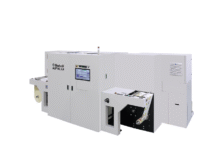
The recently installed W&H Miraflex II CI flexo 8-color press at ALFT in Sri Lanka is rated at speeds up to 500 meters a minute. The 1270 mm width Miraflex II at ALFT contains many of the automation features that will enable it to be extremely efficient for frequent job changes and shorter runs. The Easy Set HD and Reg D systems on the press should enable the printer to complete the impression setting and registration of even challenging and time-consuming makereadies within 90 seconds. The line scan cameras integrated into the press optimize the print results in a closed-loop automated correction system. While the entire press is controlled from a single panel by one operator, there is little need for manual intervention or optimization. De Fonseka says it takes 15 minutes to change over to a new job.
The fully integrated 100% defect detection technology on the Miraflex press aids in problem identification as the source of the print defects is referenced to an online root cause detection capability. Apart from simpler diagnoses of problems, the fault detection data can be saved for study in the future and identify the causes of errors for corrective measures in subsequent production. Incorporating artificial intelligence (AI) Ruby Check assists in determining the reason for printing defects and issues and provides data recording, alarm creation, and remote access which is available in Ruby Go.

Photo ALFT
In addition, the Rubycheck@slitter facility helps in filtering out and removing print defects online in the slitting and inspection machine. The slitter-rewinder stops automatically once it reads the defect detected during printing and is confirmed by the quality department as a defect –and the operator can cut out the print defect parts of the reels.
Making sure that printed rolls with defects are not dispatched to the end customer or brand owners are in line with ALFT’s goal of zero defect production. De Fonseka says, “We can assure our customers that the materials we send them are 100% defect free and we can give this to them in writing too.”