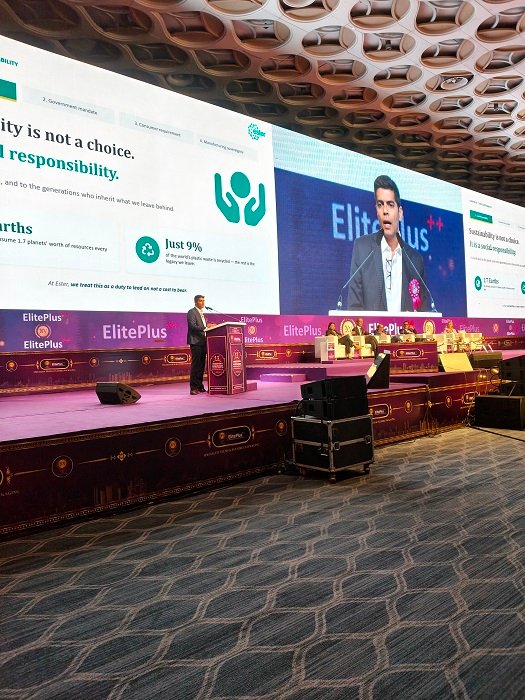
India’s flexible packaging industry needs to move beyond incremental recycling improvements and accelerate investment in technologies that can deliver genuine circularity, Vaibhav Jha, CEO of Ester Industries, said at the 13th Speciality Films & Flexible Packaging Global Summit & Exhibition 2026 in Mumbai.
Jha said sustainability should not be treated simply as a regulatory requirement but as a broader responsibility for the industry. “Sustainability is not a choice; it is a social responsibility for all of us,” he said.

Despite growing investment in recycling, only around 10% of global plastic waste is recycled, Jha said.
“We are all from the plastics industry, and we feel proud we are doing such a great job at recycling. But if you look at a global level, hardly 10% of the total plastic waste actually gets recycled,” he said.
Tougher regulations and changing consumer preferences were accelerating the sustainability transition, he said. Citing a McKinsey report, Jha said 40% to 85% of consumers surveyed across markets seek sustainable solutions and are willing to pay a premium.
“In India, almost 85% said yes, we want sustainability, and we will pay a premium for it,” he said.
Recyclability was the attribute most strongly associated with sustainability among consumers, he added.
“We talk about aspects such as thin gauging, bio-based polymers and others. But for the consumers, they think recyclability when they think of sustainability,” Jha said.
Jha linked sustainability to manufacturing sovereignty, arguing geopolitical tensions and supply-chain disruptions made domestic resource utilization increasingly important.
“Given the current geopolitical scenario, sustainability is essential to achieve manufacturing sovereignty for any country,” he said.
Push for food circularity
Jha said the flexible packaging sector had made significant progress in mechanical recycling but now needed to focus on technologies capable of delivering true circularity, particularly in food-contact applications.
“We have done great work in developing technologies to take recycling forward. So much of mechanical recycling is happening. But what is the next big thing?” he said.
“That is why my intention as a group is that now is the time to push the envelope on technology and innovation to really aim for food circularity.”
He said brand owners and manufacturers would need to support emerging technologies before they reached commercial scale, pointing to textile and automotive recycling as examples.
“The recycling breakthroughs needed commercial commitments before the certainty arrived in the technology,” he said.
Ester expands recycling technology
Jha highlighted Ester’s work on RPE (recycled polyethylene) and PCR technologies, saying tougher recycled-content mandates would make reliance on mass-balance solutions increasingly difficult.
Ester has vertically integrated its RPE technology and developed a patented process to make RPE suitable for PCR film production.
“We are very proud to say that now we are running around 20,000 tons of RPE capacity directed toward film and we are ready to serve the industry,” Jha said.
He highlighted Ester’s ability to produce films containing up to 90% actual PCR content rather than relying on mass balance.
The company has developed a patented monomaterial PET technology that can enable thinner films and provide a cost advantage over competing solutions.
Rs 1,000 crore-plus chemical recycling plant
Ester is investing more than Rs1,000 crore in a 70,000-ton-per-year chemical recycling facility in Gujarat. The plant will process polyester-heavy laminates and convert them into virgin-like monomers for recycled PET production.
Jha said the technology had been proven at a smaller production unit in Canada and that the Gujarat facility was expected to take around 18 months to become operational.
Major brands have already signed commercial offtake agreements, he said.
“Nike has signed up. Another leading global brand has signed up a very large contract. And then there is Staroplast,” Jha said.
He urged flexible packaging companies to support the technology and help accelerate its commercialization.
Jha said sustainable materials currently carry a premium because technologies are still being scaled, but said the eventual impact on consumers would be limited.
“Innovation is a necessity now for achieving meaningful sustainability goals for all of us,” he said.