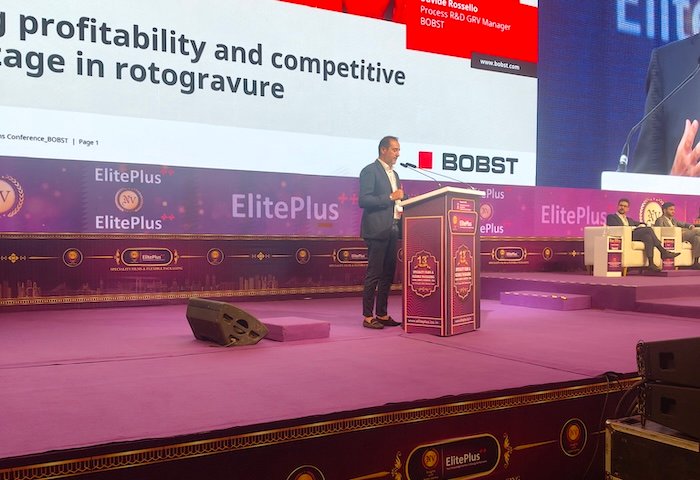
Packaging converters face a market that looks very different from a few years ago, and it’s set to change faster still. Speaking at the 13th Speciality Films & Flexible Packaging Global Summit & Exhibition, Davide Rossello, process R&D manager for gravure at Bobst Italy, outlined how the company is positioning its gravure technology for fast-developing markets such as India.
Categories such as baby food or fruit juice, once served by around ten standard formats, now see far more product variants across the same packaging, each with its own design. The result—a sharp rise in short and ultra-short runs, alongside tighter sustainability requirements, a combination Rossello said gravure must now be built to solve.

Bobst is a global supplier of packaging and label machinery across folding carton, corrugated, flexible packaging and labels, with thousands of machines installed worldwide and a large service network. The company has operated in India for 30 years.
Rossello framed competitiveness around four factors—high speed, fast and flexible job changeovers, consistent quality, and minimal start-up waste. Bobst has focused on stabilizing the web-handling and tension-control system at very high speeds, the foundation, he said, for reliable register precision. A floating-roller unit supporting the reverse side of the web further improves register while cutting set-up time, waste, and cost, particularly on the newest press platforms.
The press’s redesigned ink circulation and metering unit is built for efficiency and splash-free operation. Rossello noted that only a fraction of circulating ink, roughly 8-12%, “let’s say 10%”, is doing productive work at any moment; reducing that circulating volume cuts waste and shortens ink use at changeover. A low-speed, high-pressure cylinder-cleaning approach and automatic viscosity control were cited as further consistency drivers across short and long runs alike.
An offline tool lets operators enter a new job’s parameters, cylinder dimensions, ink film weight, substrate, and automatically generates a recommended machine set-up, including the maximum speed achievable while holding quality and register.
Rossello cautioned that higher speed doesn’t automatically mean proportionally lower energy use per unit of output in gravure drying — a key reason Bobst invested in a redesigned drying system aimed at cutting energy cost per square meter, especially for the shorter runs now dominating many order books.
Built for markets like India
The platform is designed to run efficient short jobs and high-volume long runs equally well, combining high speed, fast changeovers, the floating-roller system, and the new inking and register technology.
The new base-generation press, Rossello said, cuts ink held in circulation by roughly half versus current systems while holding full production quality. He invited attendees to a later session for a closer look at the line running at full speed.