At the trade fair in Shanghai, the Plastic is Fantastic Association (PiFA) strengthened its strategic presence in Asia. This positions the association in one of the industry’s most dynamic growth markets. Because China demonstrates in practice what PiFA emphasizes — the future of the plastics industry will be decided not only technologically, but also by the public perception of the material.
“Here, plastics are not discussed ideologically, but understood as a strategic enabler,” says Dominic Fiel, executive director of the Plastic is Fantastic Association (PiFA).

PiFA expands international presence and plastics dialog
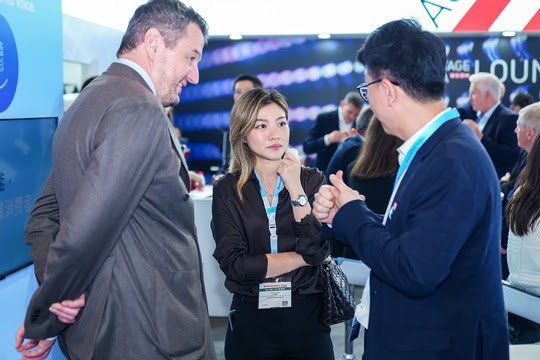
This is where PiFA takes action. By establishing a presence in Asia, it is strengthening its role as an international platform for a fact-based dialogue about plastics. Appearing at Chinaplas for the first time, PiFA presented itself in the Austrian Pavilion, where it strengthened its international network and engagement with industry and academia.
A core element of PiFA’s engagement is the development of an Asia cluster led by Sandy Lin, Director of Global Business Development at Da Fon Environmental Technology (Taiwan), a leading recycling company focusing on rHDPE and rPP. She is driving regional development, partnerships, and the integration of material and communication strategies. “Our goal,” says Fiel, “is to place the debate about plastics on a fact-based foundation. Innovation arises from facts, technology, and collaboration, not from myths. Asia is already demonstrating this.”
Asian plastics industry shows strong momentum
Moreover, Chinaplas 2026 showcased a plastics industry in acceleration mode. AI, automation, and the circular economy are no longer topics for the future, but industrial reality. “The speed and scaling of the Asian plastics industry impressed me in particular,” Fiel explains.
The focus is on concrete applications: automated production lines, real-time quality control, and data-driven optimization systems. The transformation ranges from traditional robotics to self-optimizing production systems. “China demonstrates an implementation speed that is a clear benchmark for Europe,” says Dominic Fiel. He adds, “In Europe, the discussion is more politically driven, with a focus on restriction rather than innovation and execution.”
At the same time, the circular economy is gaining practical relevance in Asia. Recyclates, bio-based materials, and new recycling technologies are increasingly being transferred into industrial applications. At Chinaplas, a wide range of solutions were presented: from post-consumer recyclates and chemical recycling to closed material loops in automotive and packaging applications.
The different perception of the material was another key takeaway. “In China, plastics do not have a strongly negative image,” says Fiel. “Instead, there is a sense of pride in the industry and its contribution to technological solutions.”
Chinaplas as an international platform and global pace-setter
With more than 390,000 square meters, 16 halls, and over 5,000 exhibitors from 46 countries, the trade fair in Shanghai underlined its position as the world’s leading platform for plastics and rubber. Over 3,800 machines in live operation, 1,900 material manufacturers, and more than 350 newly presented technologies and applications demonstrated the scale and future potential of the industry.
“Chinaplas 2026 clearly showed: plastics are not concluding a debate, but marking the beginning of a new industrial phase,” summarizes the PiFA executive director, taking these impressions with him into his international discussions and dialogu.