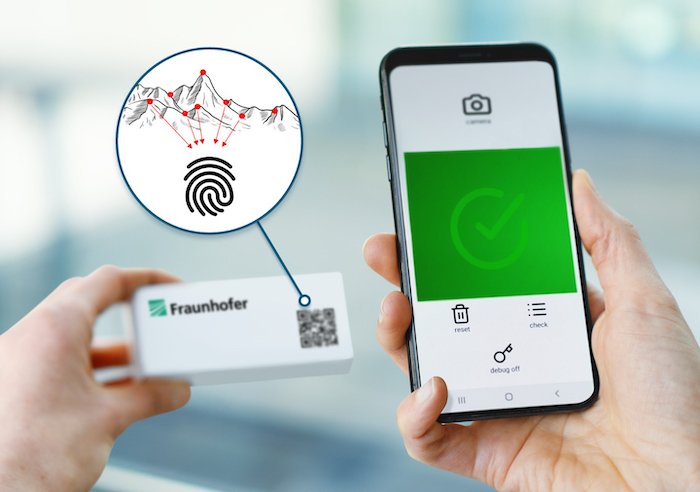
Researchers at Fraunhofer have developed a new system that combines conventional product information, data for the digital product passport, and authenticity verification into a single counterfeit-proof QR code. This solution supports companies in complying with legal requirements while simultaneously enhancing product protection and traceability. The system can be easily integrated into existing printing lines. At this year’s Interpack—one of the world’s leading trade fairs for the packaging industry—the Fraunhofer consortium will showcase the ready-to-use technology for the first time according to a press release dated 9 March 2026.
Digital product passport and brand protection combined in a single code: The SmartID identification system integrates the unique surface structure of packaging or a product into a counterfeit-proof QR code. Manufacturers, retailers, and consumers can use an app to read the QR code and surface features, thereby verifying the authenticity of a product or obtaining further information about it.

Mandatory digital product passport to be introduced gradually in 2027
After nearly 50 years, the classic barcode is slowly being retired. Beginning in 2027, it will be supplemented by 2D barcodes such as QR codes. The reason: New regulations issued by the European Union require that products and packaging carry significantly more information—such as production date, material composition, batch number, origin, or expiration date.
SmartID: an innovative solution for compliance and brand protection
SmartID enables manufacturers to ensure legal requirements while addressing the need for authentication, product protection, and full traceability along the entire supply chain. “Our identification system SmartID links the unique surface structure of a package or product to a QR code,” explains Dr Tobias Jochum, project coordinator at Fraunhofer Center for Applied Nanotechnology CAN, a research division of Fraunhofer Institute for Applied Polymer Research IAP. SmartID can be easily integrated into a manufacturer’s app. “To access the information, users simply scan the QR code with a smartphone. This allows them to view the product data and verify authenticity—all in one step,” says Jochum.
How it works: unique surface structure as a fingerprint
Every surface, whether packaging or product, has unique patterns with elevations and depressions in the submillimeter range that are invisible to the human eye. A camera system captures these natural microstructures and generates an individual and unique fingerprint of the product or packaging. Combined with a serial number and additional data from the digital product passport, this fingerprint is stored within a QR code. Researchers at Fraunhofer Institute for Secure Information Technology SIT have developed special software that can be easily integrated into existing printing lines and camera systems. The QR code is then printed directly onto the product or packaging and serves as a bridge between product authentication and the digital product passport.
Storage, verification, and transparency
Manufacturers store the serial number and the unique fingerprint of the product or packaging in a database. When needed, such as during purchase or product returns, staff can scan the QR code and surface features using the app. The app compares the fingerprint and the encoded information with the stored reference data, instantly verifying whether the item is genuine or counterfeit. Not only manufacturers and retailers but also end consumers can scan the code at the point of purchase to confirm authenticity and access further product information.
Practical application: ready-to-use solution for printing lines
“SmartID combines regulatory compliance, product identification, and transparency in one technology. After five years of research and optimization, we are now presenting a ready-to-use system that can be seamlessly integrated into any printing line worldwide,” summarizes Jochum. The first licensees have already been secured. One partner, the evia Group, plans to implement the technology in the fashion industry—one of the sectors for which the digital product passport will become mandatory in 2027.
In an interview conducted by Andrea Schneidewendt from the Strategy and Communication Department at Fraunhofer IAP Jochum answered several questions regarding Smart ID of which we reproduce two below.
AS – Apart from paper, what other materials can be used?
Jochum – For the time being, we have concentrated on fiber-based surfaces, which allows us to address the major issue of packaging. We are also working on identifying other surfaces using SmartID. At the moment, we are investigating plastics and leather.
AS – How can SmartID be integrated into existing production processes?
Jochum – Quite easily. Manufacturers who want to use SmartID technology need an industrial camera and our Fraunhofer license. There is no additional outlay initially. Consumers, in turn, use a smartphone app to verify the product.
The Fraunhofer Institutes for Open Communication Systems FOKUS, for Secure Information Technology SIT, and for Applied Polymer Research IAP will be presenting the SmartID camera system integrated into a production line at the Interpack 2026 trade fair from May 7 to 13 in Hall 4, C54 at the booth of the German Machinery and Equipment Manufacturers Association (VDMA).