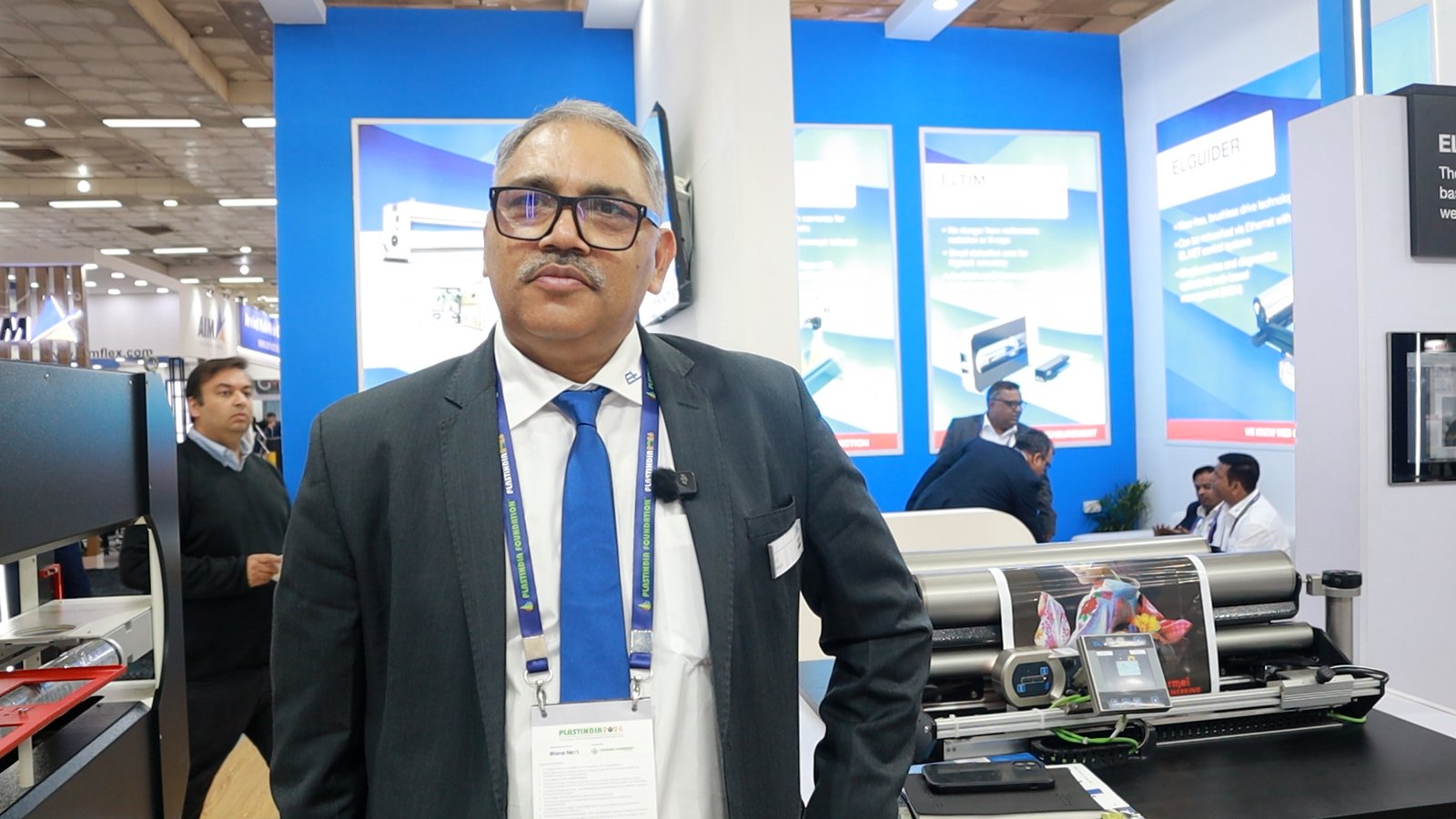
Erhardt+Leimer India, a subsidiary of the Germany-based Erhardt+Leimer GmbH, has been operating in India since 1980. Talking to Packaging South Asia at PlastIndia 2026 in Delhi, ID Singh, managing director of Erhardt+Leimer India, gave an overview of the company’s legacy, its technology portfolio, and latest innovations showcased at the exhibition.
Singh said the parent organization has a history spanning over a century, while its Indian arm has grown into a significant manufacturing and R&D hub. “We are more than 45 years old in India and represent a global legacy of over 100 years in web-handling technologies,” he said.

The company is recognized for its web-guiding systems, which Singh described as its flagship offering. These systems ensure precise alignment of moving materials such as films, paper, and textiles during processing.
At PlastIndia 2026, the company showcased its high-accuracy web-guiding solutions targeted at demanding applications where precision is critical. “There is a growing market for highly accurate web guiding systems, and we are addressing that need with advanced solutions,” Singh explained.
Beyond web guiding, Erhardt+Leimer India displayed a broad portfolio of solutions, including web-viewing systems, surface inspection systems, thickness measurement technologies, and GSM (basis weight) measurement systems.
According to Singh, the key highlight this year was the introduction of an ultrasonic-based GSM measurement system. Unlike conventional nuclear-based sensors, this system eliminates regulatory challenges and safety concerns. “Our ultrasonic sensor does not require compliance with atomic regulatory authorities, making it easier to use and maintain while ensuring high accuracy and long life,” Singh said.
Another major launch at the show was the next-generation surface inspection system, ELSIS-2(E+L surface inspection system). Designed primarily for coating applications, the system uses advanced 8K smart cameras to detect defects such as pinholes and impurities in real time. According to Singh, “All imaging is done within the camera itself, and any defect is immediately displayed to the operator, enabling quick corrective action. This marks a significant upgrade over earlier inspection systems, offering improved resolution and faster processing.”
The company introduced its OMS-5 web viewing inspection system, which stands out for its ability to inspect reflective surfaces such as aluminium foil and metallized films—an area where conventional systems often struggle. Equipped with dual 18-megapixel cameras and advanced LED lighting, the system delivers highly detailed images, allowing operators to detect even minor print defects. Singh highlighted that this dual-camera technology was originally patented by the parent company and continues to offer a competitive edge. “It enables us to capture extremely fine details, such as minor doctor line variations during printing,” he noted.
Expanding beyond inspection and monitoring systems, Erhardt+Leimer India is venturing into precision motion technologies. At the exhibition, the company showcased its BLDC servo motors designed for applications requiring precise pressure control, particularly in coating processes. Unlike conventional high-torque motors, these compact motors offer fine control and digital precision. Additionally, the company introduced the AG-98 actuator, capable of handling unwind loads of up to 10 tons. This electrically driven solution provides an alternative to traditional hydraulic systems, offering improved efficiency and control.
Singh spoke about the company’s strategic collaborations and manufacturing initiatives. Under a licensing agreement with Softal, Erhardt+Leimer India has been supplying corona treaters in the Indian market since the mid-1990s. These systems are used in BOPP, polyester, and CPP lines and are a preferred choice among OEMs. Additionally, the company recently started assembling web cleaning systems from Switzerland-based Kelva for the Indian and Asia-Pacific markets.
A notable achievement, as Singh said, is the company’s contribution to the ‘Make in India’ initiative, even before it became a national slogan. Load cells manufactured in India are exported globally. “We have been exporting load cells from India to the global market for over 15 years,” Singh stated.
Reflecting on the significance of PlastIndia, Singh described it as the most important exhibition for the company in the region. “PlastIndia is our numero uno show. It brings together demanding customers who challenge us with new problems, which in turn drives innovation,” he said. He emphasized the remarkable progress made by Indian machine manufacturers over the years. Comparing the present scenario with that of two decades ago, Singh observed a significant improvement in quality, design, and professionalism.
Looking ahead, Singh expressed optimism about the future of the Indian packaging industry. He believes that continued innovation, coupled with increasing customer expectations, will drive further advancements. “The quality of machines and presentations today is highly professional, and I am confident that future editions of the show will be even better,” he concluded.