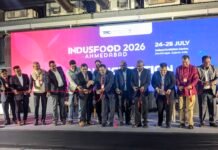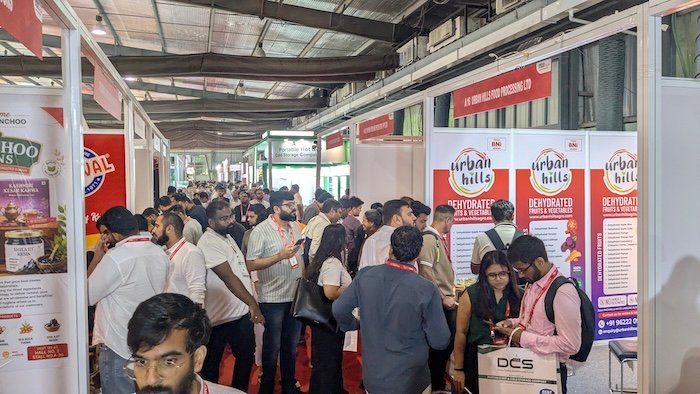
The inaugural edition of Indusfood Ahmedabad 2026 concluded successfully at the Helipad Exhibition Centre (HEC), Gandhinagar, from 24 to 26 July. Despite the heavy rainfall throughout the three-day event, the exhibition witnessed a healthy turnout of domestic and international trade visitors.
Marking the debut of the Indusfood platform in Ahmedabad, the exhibition brought together stakeholders from the food processing, ingredients, packaging and manufacturing sectors, reinforcing Gujarat’s growing stature as a key manufacturing, food processing and export hub. Exhibitors, buyers and technology providers from India and overseas, highlighted the state’s strategic importance in the country’s expanding food and beverage ecosystem.

Speaking at the inaugural ceremony, Sandip Das, director general, Trade Promotion Council of India (TPCI), said the industry’s response had exceeded expectations despite concerns over the weather. He noted that although trade visitor pre-registrations had been comparatively modest, more than 500 trade visitors entered the venue within the first hour of the exhibition, alongside hosted buyers from over 28 countries and a significant number of domestic hosted buyers.
“Even with the harsh climate, the business community of Gujarat has shown tremendous resilience by turning up in large numbers. It gives us great encouragement to launch our first flagship trade show in Gujarat,” Das said.
Das added that the encouraging turnout reflected Gujarat’s vibrant business ecosystem and expressed confidence that the successful debut of the exhibition could pave the way for establishing a larger national platform in the state. He also acknowledged the support of industry stakeholders and institutional partners in making the event possible.
The inaugural session underscored the growing importance of innovation, exports and value addition in strengthening India’s food manufacturing ecosystem. Speakers highlighted the need for greater industry collaboration, technology adoption and product innovation to improve global competitiveness across food processing segments.
Addressing opportunities in the dairy sector, Aditya Jain, deputy general manager, National Dairy Development Board, said India must increasingly focus on producing value-added dairy ingredients and specialised products for export markets rather than relying solely on conventional dairy offerings.
According to Jain, products such as fractionated proteins, lactoferrin and other high-value dairy ingredients present significant export opportunities. However, he emphasised that success in international markets would depend on maintaining global quality standards while embracing sustainable production practices.
Jain also highlighted the growing role of artificial intelligence and automation in helping dairy processors scale operations to meet global demand, while stressing that farmers must remain central to India’s dairy growth story.
“While we move towards exports and advanced technologies, we cannot lose sight of the farmer. They remain the cornerstone of India’s dairy sector,” he said.
Speaking on opportunities in the snacks segment, Ashish Agarwal, managing director, Bhikaram Chandmal, highlighted the rapid evolution of the Indian snacking industry, noting that the sector has grown from catering primarily to domestic consumers to becoming a recognised category on the shelves of leading global retailers. Agarwal urged manufacturers to continue investing in innovation, arguing that continuous product development would be essential for sustaining growth in both domestic and international markets. “The market is open for everyone. Keep innovating, and the opportunities will continue to grow,” he said.
FoodTekPack Conference focuses on innovation, compliance and export readiness
A key highlight of the exhibition was the FoodTekPack conference, jointly organised by IppStar and the Trade Promotion Council of India (TPCI), with sponsorship support from Pelican Rotoflex and Echaar Equipments, which brought together industry leaders, policymakers, technology providers and brand owners to deliberate on the latest developments in food processing and packaging.
One of the major sessions at the conference was the Save Food and Innovation session, which explored ways to reduce food losses and improve value addition. Foram Badani, assistant director, Indian Institute of Packaging, Ahmedabad, highlighted the significant post-harvest losses occurring at the farm level and explained how advanced packaging solutions, including micro-perforated films and modified atmosphere packaging (MAP), can extend shelf life, reduce spoilage and ensure the safe transportation of protein-rich foods. Milan Darji, team leader – consumer foods, value and nutrition, Bühler India, discussed emerging technologies capable of converting plant-based residues into high-value protein-rich products, demonstrating how innovation can simultaneously improve sustainability and resource efficiency.
The conference also examined the increasing importance of regulatory compliance for food exports. During the session on FSSAI regulations, Rashida Vapiwala showcased LabelBlind, a digital platform that automates food labelling by incorporating the latest FSSAI regulations alongside compliance requirements for multiple export markets. The solution aims to simplify regulatory processes, minimise export risks and enable Indian food manufacturers to enter international markets with greater confidence.
The conference concluded with discussions on authentication, brand protection, supply chain integrity and investments in food processing technologies, packaging innovation and automation including the standardization of flexible packaging printing. Apart from discussion new structures for recyclable food packaging, the possibilities of water-based gravure and 7-color flexo printing was taken up by a panel that included local flexible packaging converters who are standardizing and innovating. Speakers and panelists agreed that digitalisation, sustainable packaging and technology-driven manufacturing will be central to strengthening India’s food processing sector and enhancing its global competitiveness.