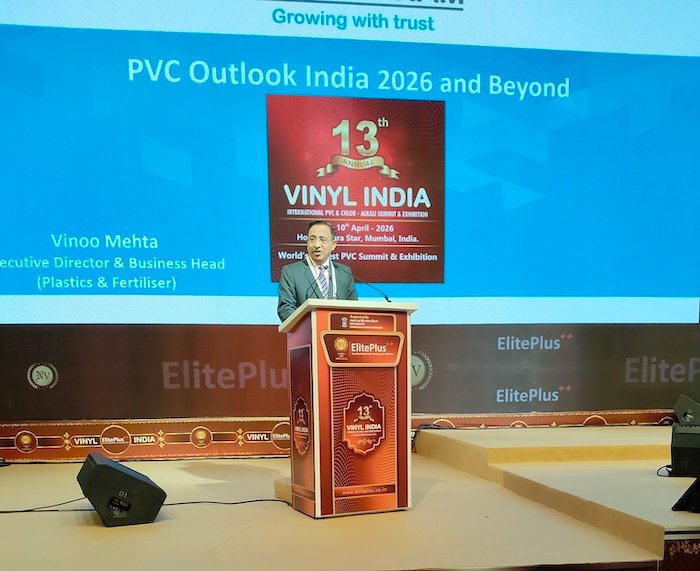
India’s polyvinyl chloride (PVC) industry is poised for long-term growth despite facing one of its most challenging years, according to Vinoo Mehta, executive director and business head at DCM Shriram Ltd.
Speaking at the 13th Vinyl India organized by Elite Plus in Mumbai on 9 and 10 April, Mehta said FY26 had been particularly difficult for domestic PVC manufacturers, marked by weak pricing, rising costs and limited policy support.

He noted that while short-term conditions remain uncertain due to geopolitical tensions and market volatility, the medium- to long-term outlook for PVC in India remains positive, supported by strong demand fundamentals.
India’s plastics industry, currently valued at around $26.6bn, is growing at 6–7% annually and is expected to reach nearly $44.6bn by 2030. Within this, PVC plays a critical role, driven by its widespread use in infrastructure, agriculture, construction and healthcare.
The domestic PVC market has expanded steadily from around 3.3mn tonnes to approximately 4.4mn tonnes in recent years and is projected to reach 6mn tonnes by 2030, implying a growth rate of about 7%. Mehta emphasized that PVC’s versatility, durability, cost-effectiveness and resistance to chemicals make it a key material for India’s development.
“Demand has never really been a constraint,” he suggested, pointing to strong consumption across segments such as pipes, fittings, cables and construction materials. In India, nearly 78% of PVC demand comes from pipes and fittings, significantly higher than the global average, highlighting the importance of water, irrigation and infrastructure projects.
Government initiatives such as rural drinking water schemes, irrigation projects, affordable housing and infrastructure spending are expected to continue driving demand. With nearly 20% of public expenditure directed toward infrastructure, PVC consumption is likely to remain on a steady growth path.
However, the supply side presents significant challenges. India remains heavily dependent on imports, meeting around 65% of its PVC requirements from overseas markets. Even with upcoming capacity additions by Reliance Industries and Adani Group, domestic production is expected to reach only about 3.7mn tonnes by 2030, leaving a gap of over 2mn tonnes.
Surge in imports from China
A major concern highlighted by Mehta is the surge in imports from China, which now account for nearly half of India’s PVC imports. This follows the expiry of anti-dumping duties in 2022, leading to increased inflows of low-cost material that has put pressure on domestic manufacturers.
He pointed out that average PVC prices have dropped sharply, from around $850 per tonne in earlier periods to nearly $720 in FY26, making operations increasingly unviable for local producers. At the same time, input costs, particularly feedstocks such as ethylene, VCM and EDC, remain elevated due to global supply disruptions and energy market volatility.
“The mismatch between falling product prices and high input costs is putting severe pressure on margins,” Mehta stated, adding that geopolitical tensions have further complicated supply chains and logistics.
Energy costs, including coal and other raw materials used in manufacturing, have also risen significantly, adding to the cost burden. Meanwhile, converters are grappling with price volatility, inventory risks and disruptions in sourcing patterns.
Despite these headwinds, Mehta expressed confidence that market conditions would stabilize over the coming months as geopolitical uncertainties ease.
He also highlighted structural opportunities for the industry. India’s per capita PVC consumption remains low at around 3 kg, compared to over 10 kg in developed markets and about 16.5 kg in China. This gap indicates substantial headroom for growth as the economy expands and infrastructure development accelerates.
At a global level, PVC capacity stands at around 67mn tonnes, with demand at approximately 51–52mn tonnes. While capacity additions are expected to continue, particularly in China, the resulting oversupply has intensified competition and export pressures.
Mehta stressed that increasing domestic capacity is essential to reduce import dependence and insulate the industry from global disruptions. He also called for stronger policy support to ensure a level playing field for domestic manufacturers.
On sustainability, he noted that the PVC industry has made progress in areas such as energy efficiency, emissions reduction and recycling, with a growing focus on circularity and responsible manufacturing practices.
However, regulatory gaps remain, particularly in enforcing quality standards on imports, which could allow substandard materials to enter the market.
Summing up, Mehta said India’s PVC demand outlook remains robust, driven by infrastructure and economic growth, but the industry must navigate near-term challenges related to imports, pricing pressures and input costs while building long-term capacity and resilience.