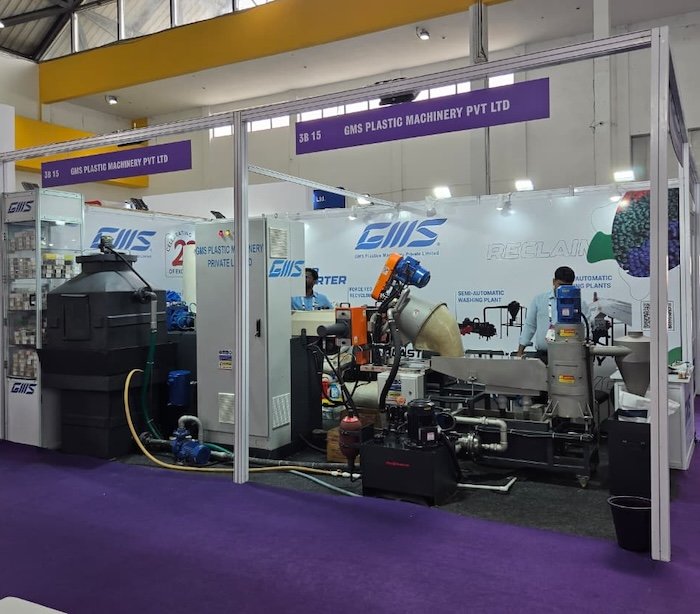
At the recently concluded Hiplex 2026 in Hyderabad, GMS Machinery focused on a specific challenge in plastic film recycling— improving the value of printed and metallized film waste that would otherwise have limited reuse potential.
The company showcased its demetallization and deprinting technologies, while highlighting developments around automation and recyclate quality enhancement.
Haren Sanghavi, managing director, GMS Machinery, explained that the company’s demetallization process uses high-friction washing equipment along with specially formulated detergents to remove metallized coatings from films. Deprinting works on a similar mechanical principle but uses a detergent formulation designed to remove printed ink layers from the film’s surface.
“These processes help restore the surface of suitable films for further recycling,” Sanghavi said, adding the technologies apply to films where the printing or metallization is on an open surface. They are not intended for laminated structures where the printed or metallized layer is embedded within the material.
The distinction is important because flexible packaging waste is often difficult to recycle into material suitable for lateral or higher-value applications. Sanghavi said the removal of metallization and printing can improve the quality and appearance of the recovered material. The company is also working on odour removal.
According to him, the objective is to address the gap between a material being technically recyclable and being commercially valuable enough for wider reuse. “These solutions are for the flexible packaging industry and will help to get virgin-like waste which can be reused for making fresh packaging from which scrap was generated,” he said.
Sanghavi pointed to the economic aspect. Printed and metallized waste can fetch lower value compared with cleaner production scrap, and technologies that improve the quality of recovered material could help processors extract more value from such waste.
The response at Hiplex, he said, indicated growing interest in recycling technologies alongside automation and energy-efficient machinery. GMS received visitors primarily from South India, but also saw interest from Maharashtra, Gujarat, Odisha and Uttar Pradesh. Sanghavi said the exhibition generated enquiries from both existing customers and new prospects.
“The industry is increasingly looking at automation, Industry 4.0 compliance and sustainability-driven machinery,” he said. GMS believes this shift is creating demand not only for conventional recycling systems but also for specialized equipment capable of improving recyclate quality.
Looking ahead, Sanghavi said GMS is working on AI-enabled and Industry 4.0-compliant machinery with capabilities such as real-time monitoring, predictive maintenance and data analytics. The company is looking at continuous filtration technology to improve recyclate purity and reduce contamination.
Another area of development is odour removal. GMS is investing in R&D for detergents aimed at tackling odour in post-consumer plastic waste, which remains a significant challenge when recycled materials are considered for more demanding applications.
For GMS, Hiplex 2026 was not only about displaying machinery but also about testing market interest in technologies that seek to improve the usability and value of recycled flexible packaging waste.