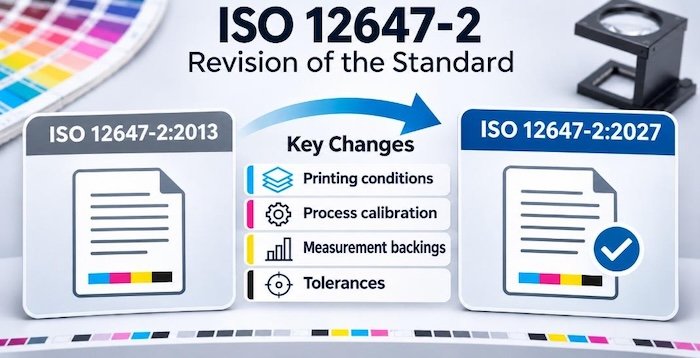
After eight years of revision, the responsible technical committee of the International Organization for Standardization (ISO) has reached an agreement on the revision of the standard for the offset printing process. The key changes concern printing conditions, process calibration, measurement backings, and tolerances. To help printing companies prepare for these changes, Fogra will offer training courses in early 2027.
For many years, ISO 12647-2 has provided the indispensable foundation for economical, environmentally sustainable, and high-quality offset print production. The previous version of the standard dates to 2013. In 2019, a revision process was launched with the active participation of Fogra. Due to the difficulty of reaching compromises among all participating countries, the process extended over eight years.
After a long process, the relevant ISO committee, TC130 WG3, has finally reached an agreement. According to this, a so-called DIS version (Draft International Standard) shall be published by the end of 2026. Although the final ballot will take place at the beginning of next year, it can be assumed that the content of this draft will be adopted without changes.
The key innovations can be summarized as follows:
Printing conditions
In the future, there will be three types of standard printing conditions: native, registered, and relative.
The 12 native printing conditions represent the most commonly used substrate categories in practice and are explicitly defined in the standard together with their target values. These include the sheetfed offset printing conditions for coated (Fogra51) and uncoated (Fogra52) papers that have been established for many years. However, for coated papers, the tone value increase of black has been slightly raised by an average of 1.5% in the midtones.
Registered printing conditions are fully characterized and listed on the website of the International Color Consortium (ICC). These include the unchanged Fogra51 condition, as well as the “legacy” printing conditions for heatset web offset printing that Fogra and the ProcessStandard Offset (PSO) continue to recommend.
If the actual paper white differs from a native or registered printing condition, the target color values must be recalculated accordingly. This creates a so-called relative printing condition. The standard specifies suitable conversion formulas for this purpose. These formulas are expected to be implemented in common colour measurement devices and software solutions.
Process calibration
The previously common process calibration based on solid tone colors and density-based tone value increases has been supplemented by two additional methods.
Instead of density-based tone value increases (Murray Davis), colorimetrically determined ΔCTV values (Color Tone Value) may now be used. Since these values are based on human visual perception, they contribute to a more uniform reproduction of color gradients. However, due to the currently limited practical experience, this method should be applied with caution.
In the so-called NNC method (Near Neutral Calibration), which also forms the basis of the G7 method developed in the United States, no target values for tone value increases are specified. Instead, they must be individually adjusted to achieve defined color values for overprints close to the grey axis.
Although the NNC method can offer advantages in terms of consistent grey reproduction, Fogra recommends the other two methods. The main reasons are their lower complexity and their superior capability for analyzing and correcting printing defects.
For practical application, it is important to note that the different calibration methods can produce different print results. Likewise, a print may be compliant according to one method but not according to another. Therefore, the calibration method to be used should always be clearly specified in advance.
Measurement backings
Unlike the previous version of the standard, target color values are now defined only for a white backing (wb). The corresponding target values for a black backing (bb) depend on the opacity of the substrate and must be calculated individually. The standard provides the same conversion formulas that are used for relative printing conditions.
Tolerances
If paper white falls outside the specified tolerance range, the target colour values must be recalculated as described above.
In addition, the variation tolerance for the solid tone colours of all primaries has been standardized to ΔE*ab = 5. The previous additional criterion ΔH*ab has been completely eliminated. Furthermore, the midtone range for tone value increases has been extended up to 70%.
Characterization data and profiles
Alongside the standard, universal characterization data (UCD, Fogra62) has been developed for sheetfed offset printing on coated papers. These make it possible to achieve consistent print results regardless of the process calibration method used.
Extensive print trials have shown that the established printing standards for coated paper applications are already very close to the new reference condition. Therefore, it is not necessarily required to maintain two separate process calibrations when both Fogra51 and Fogra62 data are provided.
Based on the new characterization data, ECI has already developed an ICC profile (Universal-Coated_Dataset_2026_final candidate.icc), which has been successfully tested. In cooperation with other international organizations, the aim is to publish a single, jointly recommended ICC profile for the new printing condition PC1. This would help avoid different profile variants for the same printing condition and facilitate international print data exchange. The final agreement on this profile is still pending.
To support a smooth implementation of the new ISO 12647-2 standard, Fogra will offer online training courses on 15 January 2027 and 21 January 2027, each running from 09:00 to 11:00 CET.