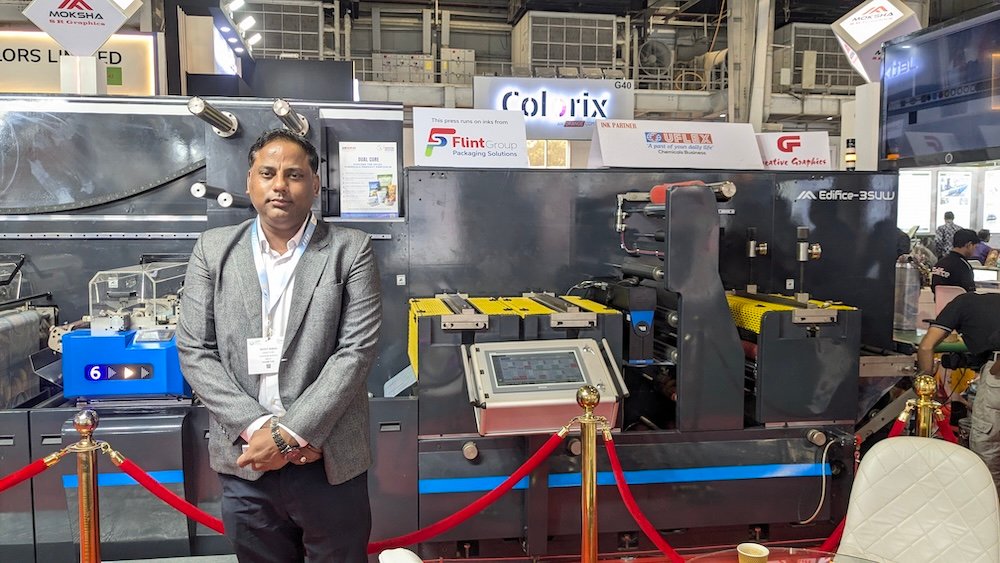
Moksha Label Printing and SR Graphics showcased a 6-color, 4-servo-per-station flexographic press at Loupe India 2026, demonstrating its ability to process substrates ranging from 12-micron films to 300 GSM paperboard. The company reported nine deliveries through 31 October 2026, with another 13 machines in its order book, bringing its projected installations for the current financial year to 17-18 machines.
Speaking to Packaging South Asia at the exhibition, Rohit Singh, director of Moksha, said the press was developed to serve a wider customer base across the label, flexible packaging and folding carton segments. The company demonstrated the press running a 300 GSM, two-ply ITC board with a white back, completing a 5-color job with foiling and cutting.
“From 12 micron to 300 GSM, this is not a tagline. It’s shown,” Singh said, emphasizing that the demonstration was intended to establish the machine’s capabilities beyond conventional label and film applications.
The demonstration included printing, foiling, creasing and full-cut operations, making it a complete production job rather than an isolated machine capability. According to Singh, the company wants customers to run label, string, film, and board applications on the same press, rather than simply claim multi-substrate capabilities.
4-servo architecture and multi-substrate capabilities
The 6-color press has a web width of 520 mm and a printing width of 470 mm. Its unwinder accommodates reels up to 1,300 mm in diameter, a specification intended to support both board and flexible packaging applications.
Each of the six printing stations is equipped with four independent servo drives. Unlike common-impression presses, the machine uses an independent roller arrangement, with the anilox, impression, drive and ancillary rollers operating independently.
Singh described this as a European technology, designed to provide greater control over the printing process. The machine incorporates a Corona treater supplied by IEEC, a Kelva web-cleaning system and extended hot-air drying units before the first printing station and after the sixth station. These drying arrangements allow customers to undertake undercoating and overcoating operations depending on the substrate and job requirements.
“We don’t limit our customers to only one station,” Singh explained.
Another important feature is the machine’s three independently configured die-cutting stations. Rather than integrating all three die-cutting operations into a single plate arrangement, Moksha has separated them into individual stations. According to Singh, this configuration allows the press to achieve online printing and die-cutting speeds of up to 150 meters per minute.
The machine features a rewinder, a full-plate conveyor and a separate waste-collection conveyor. The latter is particularly useful for board applications, where small foil and substrate waste pieces cannot be conveniently handled through conventional rewinding.
Alongside the multi-substrate flexographic press, Moksha presented a 450 mm × 450 mm flatbed die-cutting machine. The machine supports full-cut operations and is equipped with a conveyor system and hot-foil capabilities in both longitudinal and transverse directions. This arrangement allows converters to undertake different applications, including barcoding and label jobs, without being restricted to a single foil orientation.
Discussing the company’s business performance, Singh provided an updated picture of Moksha’s machine sales for FY 2026-27. As of 31 October 2026, the company had delivered nine machines, which were running at customer facilities. It had 13 machines in its order book, with installations expected within the current financial year.
The company confirmed booking two additional machines on the second day of Loupe India: one 10-color and one 8-colour press. Singh said one of these orders was from Delhi-NCR and the other from Gujarat, but withheld the customers’ identities.
Input cost pressure on margins
Despite the company’s order pipeline, Singh described the current financial year as relatively slow and static compared with FY25-26. He attributed the challenging market environment partly to geopolitical developments, including wars, and the resulting sanctions-related complications that are affecting the availability and pricing of certain electronic and machine components.
He specifically pointed to rising prices of aluminium, steel, copper, plastics and other industrial inputs. The increase has affected machine manufacturing costs, particularly when manufacturers have already committed to customer orders at previously quoted prices.
The cumulative effect of these increases has been a significant reduction in manufacturing margins. Singh estimated that margins had declined from around 15-17% to approximately 10-12%, or even 6-7% in certain situations.
The challenge was not simply about accepting lower margins or increasing machine prices. The larger concern was maintaining service standards and customer expectations in an environment where manufacturing costs were rising, he said.