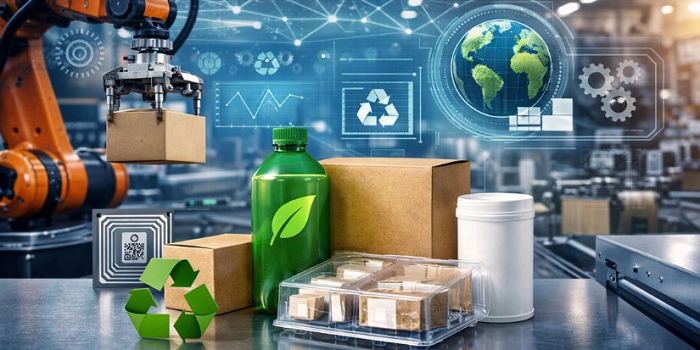
The packaging sector is entering 2026 at a moment of structural transformation, marked by the real integration of sustainability, industrial efficiency, and digitalization into production models. After years of accelerated adaptation to new regulatory and technological demands, the industry is moving towards a phase of greater maturity, where packaging is consolidated as a strategic asset with a direct impact on industrial competitiveness.
European regulation stands as one of the main drivers of change. New requirements for recyclability, waste reduction, and extended producer responsibility directly influence the design of packaging and, especially, the configuration of production lines. Compliance becomes integrated from the engineering phase, conditioning materials, geometries, and industrial processes, rather than being a post-adaptational step.
In this context, sustainability evolves from a conceptual approach to an industrially viable sustainability. New materials and designs must function efficiently on automated lines, maintain product stability, and not generate operational inefficiencies. Sustainability thus becomes an applied engineering issue, where packaging and machinery technology must evolve together.
The circular economy advances towards a real operational model. Beyond recyclability, the packaging sector adopts systemic approaches that consider reuse, return, and reprocessing, requiring greater coordination among machinery manufacturers, industrial brands, and logistics operators.
Flexible automation establishes itself as a strategic priority in 2026. The growing diversity of formats, materials, and short runs drives the demand for solutions capable of quickly adapting to reference changes, reducing manual adjustments, and maintaining efficiency, especially in end-of-line processes.
Meanwhile, data-driven digitalization enters a phase of practical application aimed at smart data use. Connectivity translates into real-time monitoring, predictive maintenance, and integration of production, quality, and energy consumption data, while the progressive application of artificial intelligence starts to generate tangible improvements in efficiency and reliability.
Smart packaging and traceability are gaining importance as functional tools, facilitating regulatory compliance, improving transparency, and reinforcing trust throughout the entire value chain. At the same time, packaging design evolves towards clearly industrial criteria, prioritizing logistical efficiency, process stability, and complexity reduction.
In this scenario, the packaging sector in 2026 is characterized by its ability to integrate regulation, sustainability, automation, and digitalization into a coherent industrial model. The Barcelona Packaging Hub is promoting this transformation through collaboration among machinery manufacturers, industrial brands, and technology partners, with the goal of accelerating real, efficient, and sustainable solutions for the packaging industry.