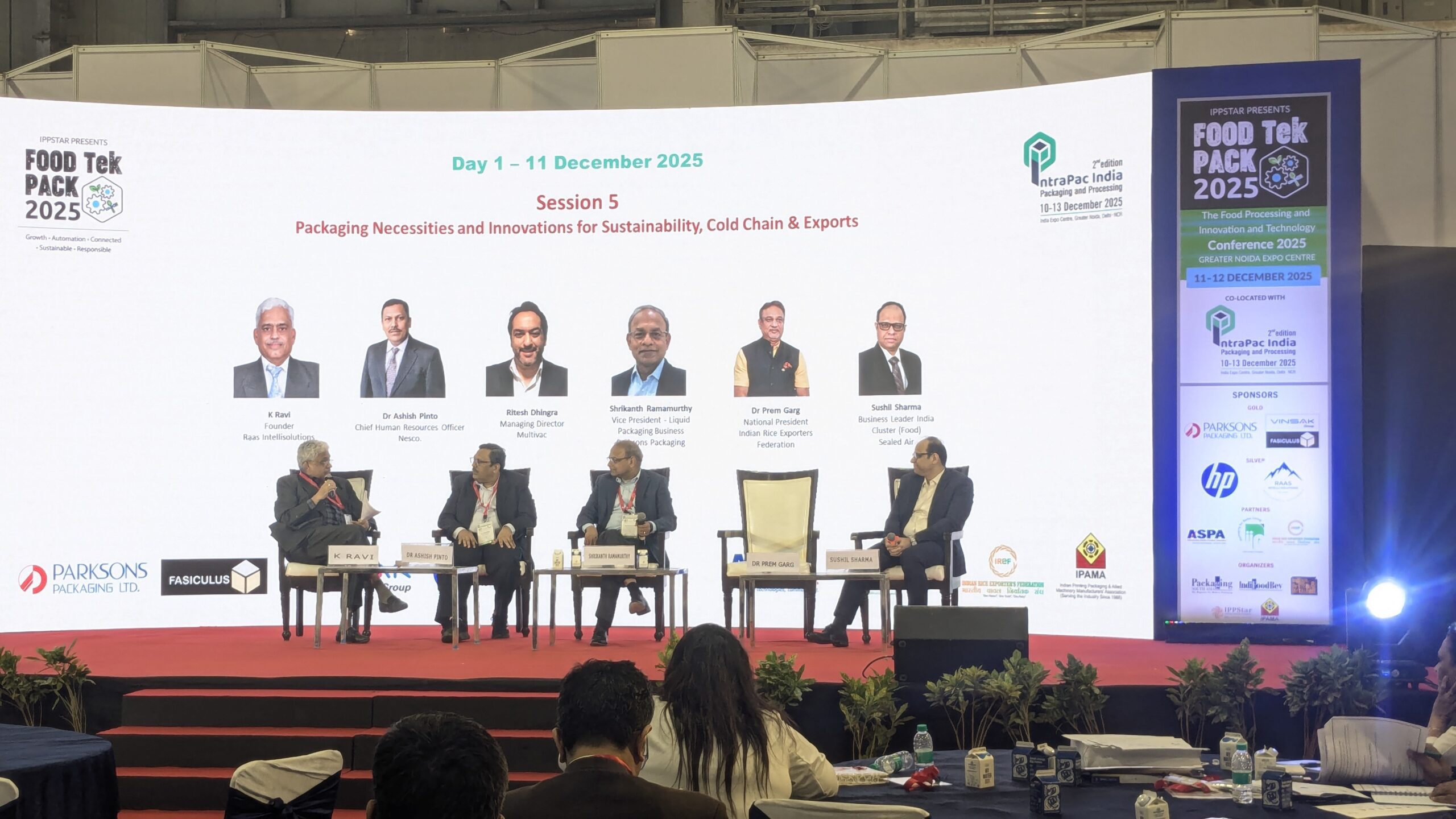
In a post-lunch session on Day 1 of the FoodTekPack conference in Greater Noida, a focused panel discussion deliberated upon the most urgent challenges in India’s packaging and cold-chain ecosystem. Moderated by K. Ravi, founder of Raas Intellisolution, the panel featured Ashish Pinto from Nesco, Shrikanth Ramamurthy from Parksons Packaging and Sushil Sharma from Sealed Air, each bringing a unique perspective spanning materials, sustainability frameworks, food safety, and export readiness.
The panel unanimously agreed that sustainability has moved from a buzzword to a baseline expectation for brands, retailers, and consumers. Shrikanth Ramamurthy emphasised the shift clearly, “Sustainability is the norm now. Five years ago, it used to be bad to talk about sustainability, but today it is at the centre of most packaging conversations.”

Ramamurthy highlighted the growing importance of chemical recycling, PCR materials and compliance with India’s evolving plastic waste management rules. “Every company must register and declare the plastic it buys and sells. Once you start using recycled materials, you begin to understand the total garbage footprint in the system,” he said.
However, he cautioned that a mere discussion is not enough. “Some data cannot even be derived unless businesses adopt these initiatives and invest in new materials and systems.”
Packaging’s role in food safety and extended shelf life
Representing Sealed Air, Sushil Sharma noted how packaging is directly tied to food security and economic efficiency. “Food is power. The question is whether we truly understand what we don’t know about the ecosystem,” he said, emphasizing the need to analyze the full lifecycle of food—from production to consumption.
He noted packaging’s role in extending shelf life, minimizing contamination, and enabling safe transportation across geographies. As India strengthens its position in global food exports, packaging that protects freshness while reducing waste becomes even more critical.
Cold chain gaps
A major part of the discussion centered on India’s broken cold chain infrastructure. Ramamurthy presented the true picture and said, “India has 40 million metric tons of cold storage, but most of it is allocated to potatoes. Meanwhile, sectors such as meat—where we are the fourth-largest exporter—and fruits, where we are second-largest, lack adequate facilities.”
He said cold-storage availability is misaligned not only for exports but also for domestic consumption. Without decentralized cold stores near consumption centres, products degrade, leading to waste and financial losses. “Otherwise, you are creating waste in the supply chain and creating sustainability issues.”
He stressed that packaging must evolve to suit these new distribution realities, especially for categories such as meats and ready-to-cook foods, where consumer expectations for hygiene and consistency are rising.
Technology-enabled efficiency
The panel highlighted how small technological interventions can create large sustainability gains. One example involved a South Indian ice cream chain that installed sensors on deep freezers to track energy consumption, door openings, and temperature settings. “The first measurement is awareness,” the speaker stressed. With real-time data, the brand corrected inefficiencies and reduced power consumption by 23%.
Such examples underscore how IoT-driven monitoring can strengthen cold-chain reliability, bring down operational costs, and improve environmental performance.
K Ravi concluded by noting that packaging innovation, cold-chain enhancement and sustainable materials will collectively define India’s future in both domestic food security and global exports.