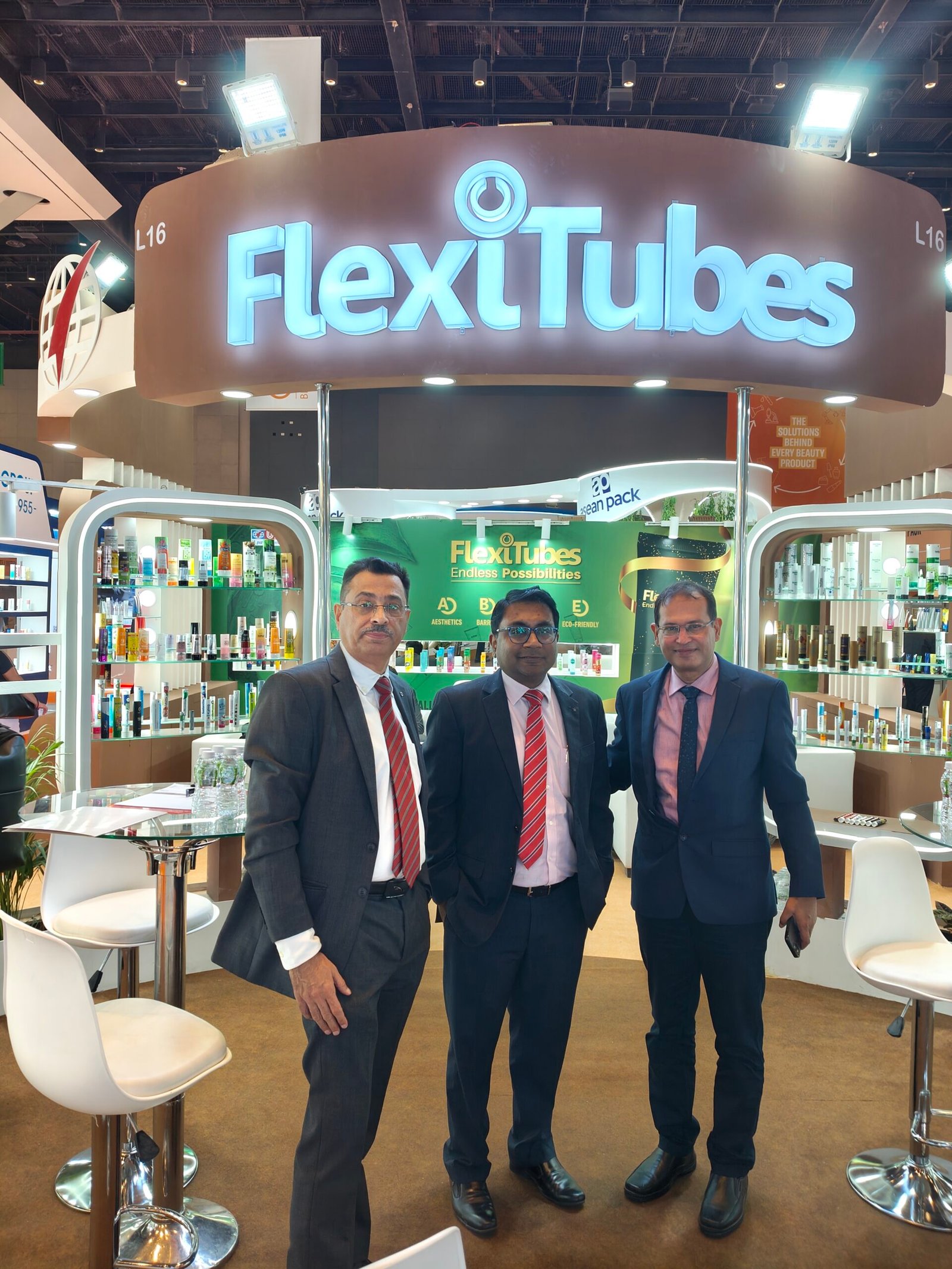
At Cosmoprof India 2025, held from 4 to 6 December at the Jio World Convention Centre in Mumbai, UFlex showcased how its Flexitubes portfolio is reshaping cosmetic and personal care packaging through advanced printing, premium aesthetics and sustainable material structures.
Speaking at the show, Subrata Bose, senior vice-president and business head – tubes at UFlex, said the company’s approach to tube manufacturing deliberately departs from conventional industry practices.
“Traditionally, tubes are printed using flexography. What we do is very different,” Bose said. “We adopt flexible packaging technologies and use reverse rotogravure printing, which allows us to deliver extremely high levels of decoration.”
According to Bose, this printing method enables superior graphic quality, true-to-life imagery and full 360-degree decoration, making Flexitubes particularly well-suited to the beauty and cosmetics segment. “This segment forms the bulk of our core business,” he said. “Around 60 to 65% of our tube business comes from cosmetics and personal care.”
He noted that the global tube market is crowded, with dozens of manufacturers offering largely similar products. “Our strategy was to approach this differently,” Bose said. “We wanted to give brands something that truly stands out on the shelf, especially those that may not have the budgets to invest heavily in branding and communication.”
By embedding UFlex’s strengths in printing, decoration and surface enhancement into tubes, the company aims to deliver a distinct look and feel. “When you pick up a Uflex Flexitube, it is visually and tactically very different from a conventional tube,” he said.
Cosmoprof India, Bose added, offers a dual advantage for the company. “It allows us to meet converters and customers, but also gives us direct access to brand owners who are exhibiting here,” he said. “It’s very much a two-way engagement.”
Beyond cosmetics, pharma is the next major segment for UFlex’s tube business. In this space, the company leverages its leadership in holography to offer anti-counterfeiting solutions. “UFlex is the largest player in holography globally,” Bose said. “We embed these capabilities into pharma tubes to provide authentication and brand protection, while in cosmetics, the same technology enhances shelf appeal.”
Smaller segments such as oral care and other applications account for roughly 10% of the business, but Bose stressed that cosmetics and skin care remain the primary growth drivers.
Discussing broader trends, Bose said the beauty and colour cosmetics market in India is still underpenetrated compared to categories such as toothpaste or shampoo. “There is significant headroom for growth,” he said. “At the same time, brands are clearly pushing towards premiumisation.”
He pointed to large FMCG players increasingly moving up the value chain. “If you compare packaging from three or four years ago to what you see today, even mass brands are shifting towards a more premium look and feel,” he said. “Packaging, especially tubes, plays a critical role in delivering that perception.”
Another opportunity lies in replacing traditional rigid formats, such as jars. “Jars have been used for years, but they come with issues like contamination during use,” Bose said. “Tubes offer better hygiene, controlled dispensing and, with the right decoration, a far more premium experience.”
Sustainability, however, is emerging as the most decisive lever shaping the future of tube packaging. Bose said UFlex’s backward integration across polymers, films, adhesives and extrusion gives it a strong advantage. “We can customise structures based on customer needs, including monomaterial solutions, without compromising on decoration,” he said.
He also highlighted the growing regulatory push to incorporate post-consumer recycled (PCR) content. “PCR is no longer a choice,” Bose said. “The government is talking about 30% recycled content and potentially moving towards 50%.”
To address this, UFlex is expanding its in-house PCR capabilities. “We already produce mechanically recycled PCR that is USFDA-approved, and we are setting up a dedicated PCR manufacturing plant in Greater Noida,” he said. “This allows us to simplify the supply chain and offer customers a complete solution under one roof.”
According to Bose, customers will increasingly look for packaging that combines premium decoration, sustainable structures and assured PCR availability. “Whether it’s metallic finishes, holography, monomaterial tubes or PCR content, we want to offer everything through a single window,” he said.
Reflecting on Cosmoprof India, Bose described the exhibition as a vital industry interface. “Globally, Cosmoprof is an established platform that brings together brand owners, suppliers, converters and fillers,” he said. “Under one roof, you get a clear sense of where the industry is heading.”
He said the Indian edition has grown steadily and has the potential to match the scale of global Cosmoprof events. “We see this as a place to connect, but the real value lies in what follows after the show,” Bose said. “We are happy to be here, engage with customers and work towards solutions that will define the future of packaging.”