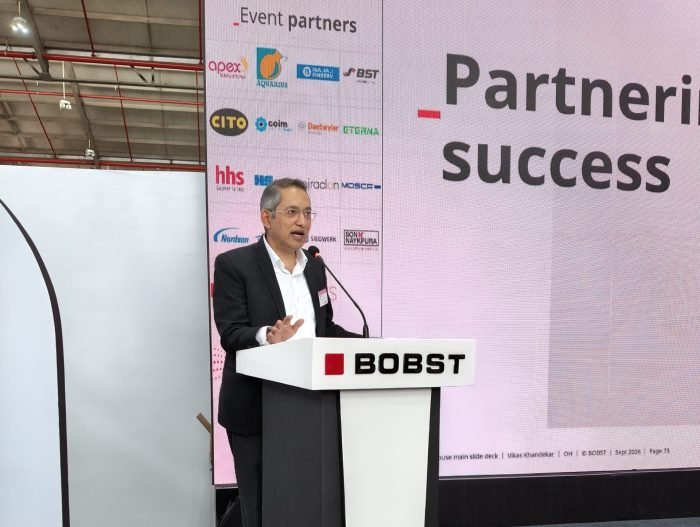
Bobst expects India’s flexible packaging industry to maintain strong growth as rising consumption, inevitably expanding film production and exports drive investment in printing, laminating, coating and metallizing technologies. At the company’s Open House celebrating its 30 years in India, Nilesh Pinto, Zone Business Director, Bobst India, said India’s flexible packaging market has expanded consistently alongside the growth of polyester, BOPP and CPP film production.
He explained that India’s per-capita flexible packaging consumption remains significantly below that of developed and other major Asian markets, indicating substantial room for further growth. Per-capita consumption in the US is roughly 10 times India’s, while China’s is about five times higher, he said. “Even a 1% increase in India’s per-capita consumption of flexible packaging would represent a major leap in market size,” he said, highlighting the scale of the opportunity.
Industry data from PIRA projected India’s flexible packaging market to grow at 6.7% annually. Pinto added that many anecdotal industry estimates put growth at higher levels, possibly closer to 10 to 12% a year, partly because informal economic activity is not fully captured in official data. India’s flexible packaging capacity could approximately double over the next five years, with a significant portion of new demand coming from tier 2 and tier 3 cities, he said.
India is emerging as an important global film manufacturing base, Pinto said. Commissioning a single biaxial film line typically increases production capacity of about 35,000-40,000 tons a year, and several even bigger lines are on order. Recent trade agreements could further support growth in Indian film exports.
Global flexible packaging consumption is expected to grow substantially through 2030, with APAC accounting for the majority of the increase. Pinto’s presentation indicated APAC is expected to account for about 70% of the estimated global consumption growth of 8.7 million tons in these years. Adding Africa, the share would rise to about 75% of total global growth.
Bobst, which entered the flexible packaging sector in the late 1990s through its acquisition of Schiavi, supplies equipment and technology across the flexible value chain, including gravure and CI flexo printing, lamination, coating, metallizing and labels. Pinto said the breadth of its portfolio allows Bobst to work with customers as a technology partner rather than simply as an equipment supplier. The company has worked with brand owners to develop benchmark processes and packaging structures that have subsequently gained wider use across the industry.
Sustainability reshaping technology
As the packaging industry moves from its traditional focus on reduce, reuse and recycle towards regulation-driven circularity, Pinto expects that between 2025 and 2030, the key priorities include the use of post-consumer recycled content, paper and fibre substitution, decarbonization, supply-chain resilience and greater use of artificial intelligence in production.
Increasingly driven by regulatory requirements, particularly the European Union’s Packaging and Packaging Waste Regulation and the Indian EPR regulations, new structures demonstrate the direction of travel. Mixed laminates for aseptic packaging have already reduced aluminium while increasing renewable content. Bobst has worked with Blue Loop Paper on a paper-based structure with high-barrier performance, while Innovia Films and Toppan have developed recyclable BOPP and polyethylene film structures, respectively.
Bobst is also focusing on mono-material structures, compostable and biodegradable films, and paper and fibre-based packaging. Citing a paper structure achieving an oxygen transmission rate of 0.1 using coating and metallizing without plastic, technologies such as Bobst’s FibreCycle, PrimeCycle and EasyCycle are supporting the development of recyclable and lower-impact packaging structures.
Flexo gains ground on gravure
CI flexo printing is gaining market share in India, although Pinto expects flexo and gravure to coexist rather than displace each other. Bobst currently occupies about 35% of India’s CI flexo press market, according to him. The company’s Graphic Positioning System (GPS), combined with Extended Colour Gamut technology, is designed to improve registration and color quality efficiently, while reducing material and ink consumption.
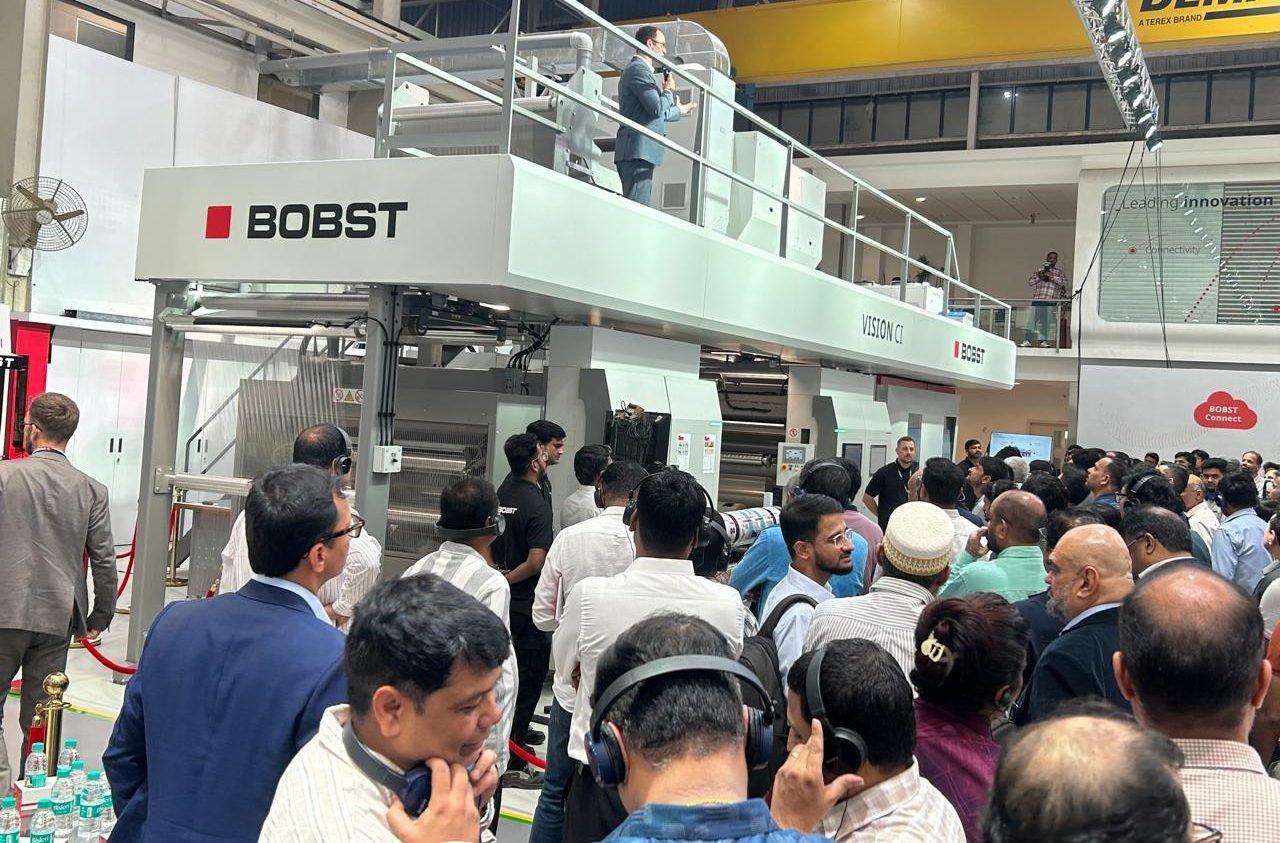
Bobst introduced GPS on its CI flexo presses in 2010. Pinto recounted that the technology initially faced scepticism among customers who questioned whether a CI flexo press could produce a saleable, in-register approval sample within 15 meters.
The company is also promoting its Flexo Trolley technology for solvent-based lamination. The system replaces the conventional gravure cylinder trolley with flexo technology, reducing solvent consumption by about 50% and adhesive consumption by 20%, Pinto said. The savings stem partly from the higher solid content of adhesives applied using flexo technology, with Indian customers who have adopted the system seeing these savings.
Bobst showcased its Multi-Coater laminator, which combines solvent-based gravure, solvent-less, flexo trolley and water-based lamination technologies on one platform. Pinto said the flexibility allows new converters to begin with a basic configuration, and subsequently expand to other lamination technologies.
Automation and digitalization
Automation is another major area of development. Bobst’s Master 6003 gravure press is designed to enable remote job loading, while reducing manual intervention on the shop floor. Pinto said the operator’s main manual task is changing print cylinders, while ink handling is automated across the fixed set of seven inks using Extended Colour Gamut technology. He explained that limiting production to a seven-ink system can also reduce the requirement for the much larger ink palettes typically used in conventional printing.
Bobst is simultaneously expanding its presence in labels through narrow-web machines using UV flexo and UV inks. The technology can process labels, films, paper and board, allowing converters to use one platform across multiple applications. The company’s digital printing can be integrated with flexo printing to give converters a modular or hybrid combination of digital and conventional production.
Pinto said the combination of growing domestic consumption, increasing exports, and rapid technological change is creating significant opportunities for Indian flexible packaging converters and for equipment suppliers. Bobst India is keen to provide end-to-end solutions by understanding market needs and their customers’ constraints and pain points.