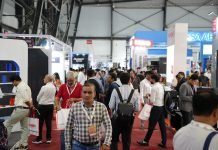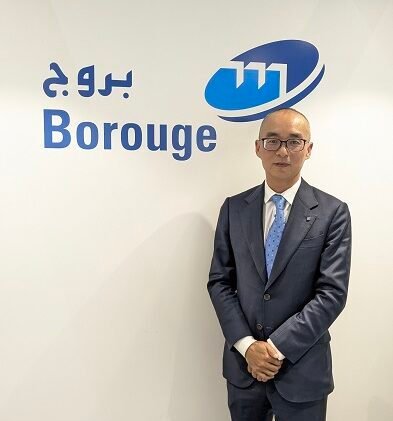
Borouge, an Abu Dhabi-headquartered petrochemical company specializing in innovative plastic solutions (polyolefins) across key industries, including infrastructure, energy, healthcare, packaging, mobility, and agriculture in India, had a prominent display at PlastIndia 2026 in Delhi from 5–10 February, 2026.
Packaging South Asia interacted with Eddie Wang, SVP, Region Asia South, about Borouge’s regional growth strategy in India and South Asia; expansion initiatives; insights on innovative solutions; approach to sustainability; and customer and partner collaborations. The interaction took place before the Middle East conflict broke out on 28 February.
Primary growth drivers
According to Wang, Borogue’s strategy has always been differentiation at scale. “India is a high-growth market for us, within the Asia South region I manage. It is a growth region within a growth region. If you look at the external factor from the trading environment, it has a lot of pro-business, pro-growth initiatives. If you look at our segments, we provide a range of products from infrastructure to energy to advanced packaging, healthcare, and mobility. We have circularity-related initiatives. In every single segment, India presents a great future.”
India is a very big country with different geographic and logistical complexities. “We have to increase our ability to provide reliability and flexibility for our customers to receive our goods. That’s why in a recent initiative, we have opened up our warehouse footprint.”
Wang said they are also partnering with local players to build a full solution to support India’s sustainability and the circularity initiatives.
Borouge opened its first warehouse in Chennai in December 2025. “There is more to come as we grow our business. In addition to our own footprint, we work with multiple partners, specifically in the recycling industry, with names such as Pashupati and Pico, for collection, sorting, and aggregation and and jointly provide the service and the product to the Indian communities.”
The company’s head office is located in Mumbai with a sales office in Delhi.
Agricultural initiatives
Wang talked about Borouge’s initiatives for the agricultural sector. “India is huge and you need to feed the country. Agriculture is an important segment for us. Our solutions support precision farming. It’s not only about how much plastic volume we support and supply for the agriculture sector but also about the value addition to increase crop yield, reduce water consumption and increase farming efficiency,” he added.
In Jaipur, Borouge helped local farmers build over 4,000 greenhouses, including fuel, drip irrigation, and mulch fuel.
“Our precision farming projects have been well-received. We have expanded our influence with over 20,000 farmers in terms of how to use polyolefin solutions to improve crop yield,” he said.
Packaging portfolio
“In India’s evolving perspective, like many growing markets, you’re always starting from chaotic and non-differentiated growth. India is a market that not only appreciates quality supply, but also appreciates value-adding and solution-providing, differentiated products,” he said.
Wang said advanced packaging is one of Borouge’s largest segments in volume in both the polyethylene and rigid packaging verticals.
Its film portfolio includes virgin films as well as combinations with recyclates. One example is recycled bottles for international and local brands in the FMCG segment, he said, adding Borouge has the collation shrink to wrap secondary packaging, which can wrap 24 bottles in a pack. “We provide up to 50% recyclate as a solution,” he added.
In rigid packaging, Borouge works with local and international producers and brand owners to create grades for storage boxes or luggage. “We have a specific grade called the BD265, which is widely regarded by the Indian market. It is nicknamed the no-break grade or the luggage grade.”
On specific segments with the highest demand in India, Wang said infrastructure growth has been great and will accelerate. “We have been a major participant in the Jal Jeevan mission to supply clean water to households with our pipe business.”
India, he said, can expect high growth in energy — largely driven by the need for renewable energy, urbanization and average household income growth. “People will tend to have more household appliances and consume more energy.”
“India is more fossil fuel-heavy on the east coast side and has more renewable energy on the west, which requires a lot of transmission. So, the grid itself needs to be strengthened,” he added.
Digital and AI
On automation and efficieny, Wang said there are multiple ways to apply AI and digitization into operations, in the way we produce, buy, and sell. “We use digital sensors and AI to build a smart system in manufacturing in order to reduce waste and increase energy efficiency.”
He took the example of a collaboration with Honeywell on an AI-powered automated control room. “This is first in the industry and hopefully will soon become a case study that can deliver customer value. We use digital tools to help us to remain in close touch with customers. We have a customer portal where the customer can directly interact with our system to reduce human interaction.”
Wang said we are in a volatile world with trade conflicts and AI, whether disruptive or wealth-creating. The future, he said, is very uncertain as it brings opportunity and risk at the same time.
“For a company like us, the key to answering this is to stick with what we believe is good for the future, the industry and the environment. We maintain our manufacturing excellence to produce the best products, and keep innovation and differentiation at scale as the core commercial strategy.”
“We have a resilient feedstock position to provide a reliable supply to our customers. I believe all business is about people, and I’m proud to say we have the best team in India to serve our customers and the community. As long as we stick to that, we will always be safe in risky times and enjoy the benefits brought in by opportunity,” he concluded.