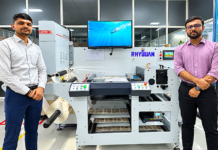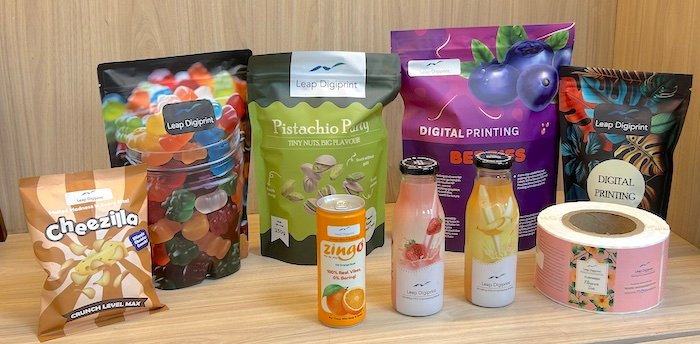
Leap Digiprint, a native digital startup based in Noida, was established in 2017. Founded by two professionals from the flexible packaging and label industry, the company began with an HP Indigo WS6800 webfed digital press. It subsequently added converting and finishing equipment, such as an AB Digicon, and eventually lamination, sleeving, and pouching machines.
Apart from short-run and quick-turnaround pressure-sensitive labels, the company has pioneered digital sleeve and flexible packaging production in the country. With the addition of a laminator and pouching machine, and other requisite ancillary infrastructure, it has grown further in the direction of flexible packaging. Notably, in the past few months, Leap Digiprint has added an HP 6K digital press in its quest for increased capacity and redundancy. The installation of a new finishing machine is also imminent.
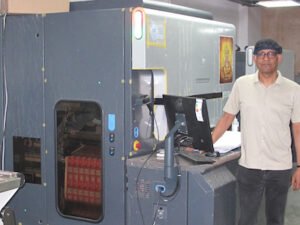
On our recent visit to the plant, we saw that with the addition of the new press and the extensive finishing equipment, the current phase of what can be described as consolidation and expansion of the digital packaging project, is not without its challenges. The founder partners are veteran professionals from the organized flexible packaging industry, and the expansion of their project aligns with their risk appetite and effort to build an ethical and sustainable industry, and their belief in digital as the technology of the future.
The customers for digital labels, sleeves, and flexible packaging include several large brands, and a number of small and medium brands in the food, beverage, cosmetics, healthcare, wellness, fitness, and pet care industries. As founding director and partner, Vikram Prasad points out, Leap’s customers are no longer predominantly local startups or smaller brands but increasingly include many newer and middle-sized brands that have significantly grown their presence and distribution, and are progressing to becoming regional and in some cases national brands.
Notably, he feels that the big brands are still not exploiting the many opportunities that digital labels and packaging can provide to them. “The larger brands tend to use digital only for prototyping and promotions, which, from our point of view, is not enough. They could, in fact, use digital more creatively and advantageously to align with their marketing and point of sales needs,” he says.
“All our customers can benefit not only from short runs, fast turnaround, and complete color quality and consistency, but also from our background as flexible packaging professionals and our thorough expertise in sleeve and flexible pouching. Our high-end press provides total color matching, including a wide gamut of spot colors, and there is no such thing as misregistration in our process.”
Challenges
As a company that relies on digital printing with no gravure or flexo presses for longer-run production, Leap Digiprint faces several challenges in making sure its new investments are viable. With the increased proliferation of digital presses for labels and flexible packaging, generally by established flexo or gravure converters, margins are under pressure. Prasad notes that the capital cost or CAPEX of digital label presses is still significantly more expensive than analog technologies, which are increasingly automated and capable of competing on short runs.
Prasad adds, “Another challenge to rationalization by increasing capacity and redundancy is the high price of digital consumables.” This view is shared by other leading packaging and label converters that have expanded their digital capacities recently. This is a credible expectation of customers of high-end digital presses who were, at one time, told by the OEMs that they were only interested in realizing revenues from clicks, and not from selling large numbers of digital presses. The reasonable expectation is that with the proliferation of these digital presses and the steady increase in volumes, there would be some rationalization of consumable costs.