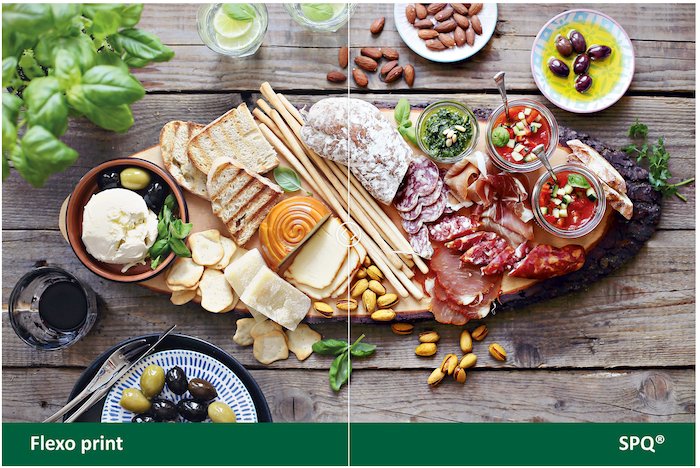
Switching to a standardized 7-color flexo print process is a logical step toward greater sustainability. As part of its development work on more sustainable printing technology, film manufacturer Südpack made a deliberate decision to focus on 7C – taking package printing to a new level. While 7C (also known as ECG or extended color gamut) does require some explanation, a deeper understanding of the printing process, and adjustments to established workflows on the customer side, it clearly delivers a wide range of benefits. These include not only brilliant color reproduction, maximum color consistency, greater efficiency, and stable processes, but above all, reduced ink and film waste, lower solvent and energy consumption, less downtime, and fewer print adjustments.
As a first step, the 7C flexo print process expands the familiar CMYK 4-color process ink palette (cyan, magenta, yellow, black) to include OGV (orange, green, violet), while largely moving away from Pantone and special-effect colors. More than 85% of these colors can be automatically reproduced within the expanded color space, with color accuracy ensured through binding references and proofs with precise Pantone simulation.
At industrial scale, however, the 7C flexo print method also requires rigorous process discipline and strict adherence to defined workflows with firmly established parameters to ensure stable, efficient, and reproducible production. What may sound straightforward is, in reality, a genuine paradigm shift in process logic. Südpack successfully initiated this shift with the introduction of SPQ (Sustainable Print Quality) in 2019 – and has since demonstrated the process’s many advantages across numerous customer projects.
SPQ – a disciplined, system-driven approach to sustainability
With SPQ, all designs are reproduced at the pre-press stage using a standardized color palette limited to just seven colors. Consistent color management and the implementation of end-to-end process stability is the essential foundation for optimizing efficiency, sustainability, and quality. Both factors proved to be the greatest challenge – and ultimately the greatest achievement – during the development project. This underlines the fact that 7C is not created at the printing machine, but much earlier in the upstream process.
In terms of sustainability, Südpack’s innovative flexo print technology is setting new standards. In essence, limiting the process to the 7C scale significantly reduces changeover time and effort, as well as ink and solvent consumption. Alongside lower film waste, these factors have a direct impact on the carbon footprint of printed packaging films. According to a certified LCA, SPQ can reduce CO2 emissions by up to 18% overall in comparison to conventional flexo print methods. SPQ’s standardized processes, in turn, result in faster adjustments, more stable repeat orders, and tighter tolerances. In short, the real driver of sustainability is not the additional color set, but lower process variability.
7C in practice: consistent quality, creative freedom, sustainable choices
Compared with the conventional flexo print process, 7C can deliver even higher standards with regard to quality and consistency. Print quality remains consistent across print runs, plants, and countries. In addition, almost all existing print images can be converted from standard flexo to 7C flexo print. Customers – and the agencies creating the print artwork – simply need to provide the required data as usual. “We take care of everything else,” says Achim Herter, Senior director of the Competence Center Converting at Südpack. “The only exception is that, when relaunching a product or creating a new print design, it absolutely makes sense to involve us from the very beginning – to achieve the best results, avoid unnecessary revision cycles, and, not least, shorten time-to-market.”
Additional benefits for customers include no longer needing to be on–site for print approvals. The 7C-based approach also allows multiple packaging variants and short runs to be produced far more flexibly – and significantly more sustainably – than with the conventional flexo print process. And when it comes to creativity and design freedom, there are virtually no limits – the SPQ spectrum covers everything from clean, minimalist, and large-area print images to CI-sensitive artwork and color-intensive, complex layouts.
Yet despite these proven benefits – and the growing pressure to adapt in response to tighter sustainability requirements – many companies still hesitate. “Interest in 7C printing is enormous, but making the switch is not easy when design expectations, production realities, and sustainability pressures all have to be balanced. Even if it means stepping out of your comfort zone at first, switching to 7C is absolutely worth it,” says Achim Herter.
Südpack is a leading manufacturer of high-performance films and packaging solutions for the food, non-food, and medical goods industries, as well as customer-specific compounds for technically demanding applications. The family business, which was founded by Alfred Remmele in 1964, is headquartered in Ochsenhausen. The production sites in Germany, France, Poland, Switzerland, and the Netherlands are equipped with the latest plant technology and manufacture to the highest standards, including the capacity to operate under clean room conditions. The global sales and service network ensures a high degree of proximity to the customer and comprehensive technical support in more than 70 countries. The company’s joint venture in India, Kamakshi-Südpack, inaugurated a new plant near Ahmedabad in 2022.