India has an opportunity to emerge as a global leader in circular plastics by strengthening its waste collection and recycling ecosystem as regulations mandating recycled plastic content become more stringent, according to Ayanish Sen, chief procurement officer at Alternicq (formerly Manjushree Technopack).
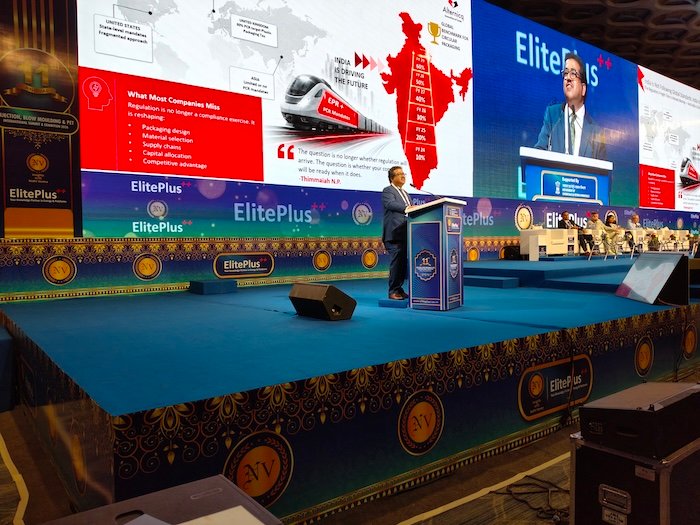
Addressing delegates at the 11th Injection, Blow Moulding & PET International Summit & Exhibition, organized by ElitePlus in Mumbai, Sen said recent geopolitical disruptions had exposed the vulnerability of global supply chains and highlighted the need for manufacturers to build greater resilience.

Referring to the conflict involving the US and Iran, he said sharp volatility in crude oil markets had disrupted supplies of downstream petrochemical products, forcing manufacturers to reassess business continuity plans.
“The next major supply chain disruption may not be driven by crude oil. It could be driven by the availability of recycled content,” Sen said, adding that companies investing early in circular economy practices would be better positioned to manage future risks.
Sen said governments worldwide were tightening regulations on the use of post-consumer recycled (PCR) plastics, with India emerging as one of the frontrunners. He noted that India’s recycled-content mandates, which began at 30% and are set to rise progressively to 60% by 2029, demonstrate that the country is leading rather than following global sustainability trends.
He said businesses should anticipate regulatory changes instead of merely complying with them after implementation.
Highlighting evolving industry practices, Sen said consumer goods, beauty, beverage and alcoholic drinks companies were increasingly redesigning packaging to improve recyclability, reduce material usage, adopt mono-material structures and incorporate higher levels of recycled resin.
Packaging design and regulatory compliance, he said, were no longer separate functions, with sustainability now becoming an integral part of product development.
Sen identified weaknesses in India’s recycling value chain, particularly in waste collection, aggregation, segregation and sorting. While recycling capacity has expanded significantly, he said inadequate collection infrastructure and inconsistent quality of post-consumer waste continue to constrain the availability of high-quality recycled resin.
To address these gaps, he called for the mandatory source segregation of waste, expansion of public collection infrastructure, formalisation of waste management systems and digital traceability across the recycling chain.
He urged the establishment of uniform quality standards for recyclable materials, including specifications for bale quality, moisture levels and contamination thresholds, to improve consistency and support greater adoption of recycled plastics.
Calling on all stakeholders to accelerate the transition to a circular economy, Sen urged consumers to view waste as a valuable resource, encouraged recyclers to invest ahead of demand, asked brands to continue designing products for circularity and called on policymakers to prioritise investment in collection and recycling infrastructure.
“If the entire value chain works together, India is well positioned to become a global leader in circular plastics,” he said.