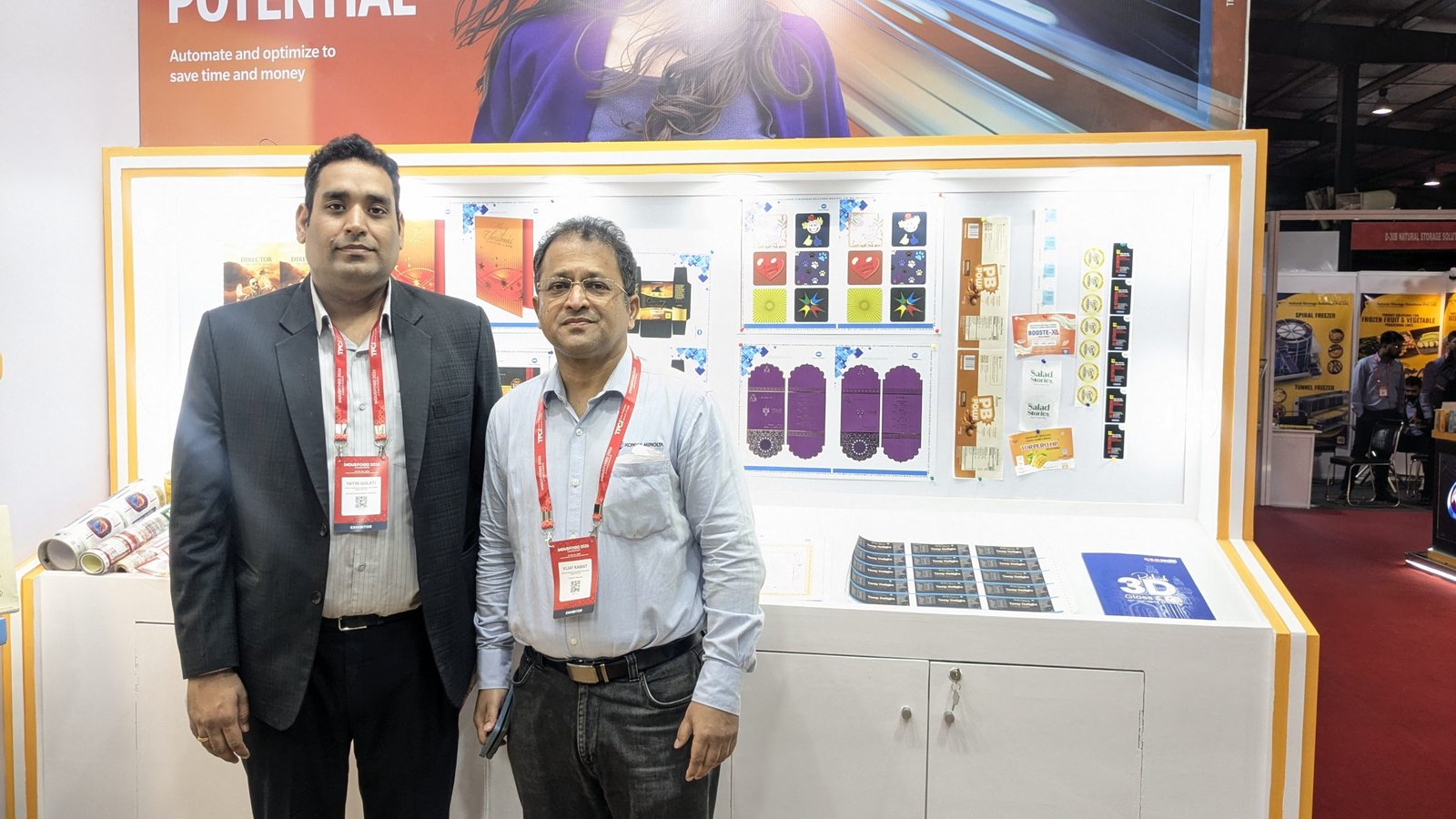
At IndusFood Ahmedabad 2026, Konica Minolta, instead of focusing solely on machinery, highlighted its commitment to helping customers generate new business opportunities, particularly in fast-growing sectors such as food, beverages and FMCG.
According to Vijay Kamat of Konica Minolta, the company’s objective is to ensure that customers recover their investments faster by supporting them throughout the entire business lifecycle.

While various technologies from the company address diverse print applications, Kamat pointed out that industrial digital printing requires substantial capital investment, not only in the press itself but also in prepress, workflow, finishing and post-press infrastructure.
“Customers invest a significant amount in these machines, so our responsibility does not end with the installation,” said Kamat. “We follow a 360-degree support model where we supply consumables, spare parts, service support, workflow assistance and, most importantly, help customers generate business.”
This business-generation approach has become one of Konica Minolta India’s key differentiators. Beyond providing technical support, the company actively connects its printing customers with brand owners seeking packaging, labels and promotional print applications. Through participation in non-print industry exhibitions such as IndusFood, Cosmotech, Cosmoprof and pharmaceutical expos, Konica Minolta creates opportunities for converters to engage directly with potential buyers.
Kamat explained that the company does not participate in such exhibitions to sell presses. Instead, it showcases real-world print applications produced by its customers. After every event, the company shares leads and brand contacts with relevant customers based on geography, enabling them to pursue new business opportunities.
“Our objective is to increase print volumes for our customers,” Kamat noted. “If a converter is currently serving 20 brands, we want that number to become 30 after exhibitions like these. Connecting brands with printers is an important part of our support system.”
The strategy is particularly relevant for the food industry, where packaging and labels have become critical tools for branding, product differentiation and regulatory compliance. With food manufacturers demanding shorter print runs, faster product launches, multilingual packaging and seasonal designs, digital label printing is witnessing strong momentum across the sector.
According to Vijay Kamat, Konica Minolta installed around 15 digital label presses during FY 2025-26 and expects installations to cross 20 units in FY 2026–27, reflecting the growing demand for short-run digital label production and premium embellishment technologies.
The food processing industry, in particular, is emerging as a significant driver of this demand. Brands are increasingly looking for high-quality labels, customised packaging and faster turnaround times to serve changing consumer preferences, regional product variants and limited-edition offerings. Digital printing enables converters to meet these requirements efficiently while reducing waste and inventory costs.
Commenting on the response at IndusFood Ahmedabad 2026, Kamat said the exhibition gathered momentum despite rain affecting visitor turnout during the morning hours. “We were a little concerned because of the weather initially, but after noon we saw visitor numbers increase steadily. The response has been encouraging.”
In the exhibition, Konica Minolta was highlighting itself not merely as a technology provider but as a long-term business partner. The company’s 360-degree support philosophy offers converters a pathway to maximize both productivity and profitability.