The success of webfed HP Indigo label and packaging presses has drawn considerable attention in our industry recently because of their efficiency in producing short-run flexible packaging pouches, and their sales to several traditional gravure and flexo printers. In labels and packaging, the Indigos are rarely competing with other digital manufacturers, but more likely with gravure and flexo and occasionally multicolor offset presses for short runs and prototyping, and increasingly for complex or unique high-value applications. The traditional methods require a higher cost for prepress, plates and cylinders and in comparison, entail more difficult process standardization and optimization.
What we saw at Barcelona last year with the new HP Indigo V12 press changed our perception about the marketability of what we thought was an expensive technology for the intensely competitive Indian market. That machine revealed HP’s continuous and ingenious development of longer and more productive engines. The company’s strategy appears to basically keep improving the utility of its unique core drum, blanket and liquid toner technology by adding engineering and software tweaks to take it toward its nth possibility in terms of quality, workflow and changeover ease, width, and the number of inline units that ultimately raise the system’s unique output and net productivity.
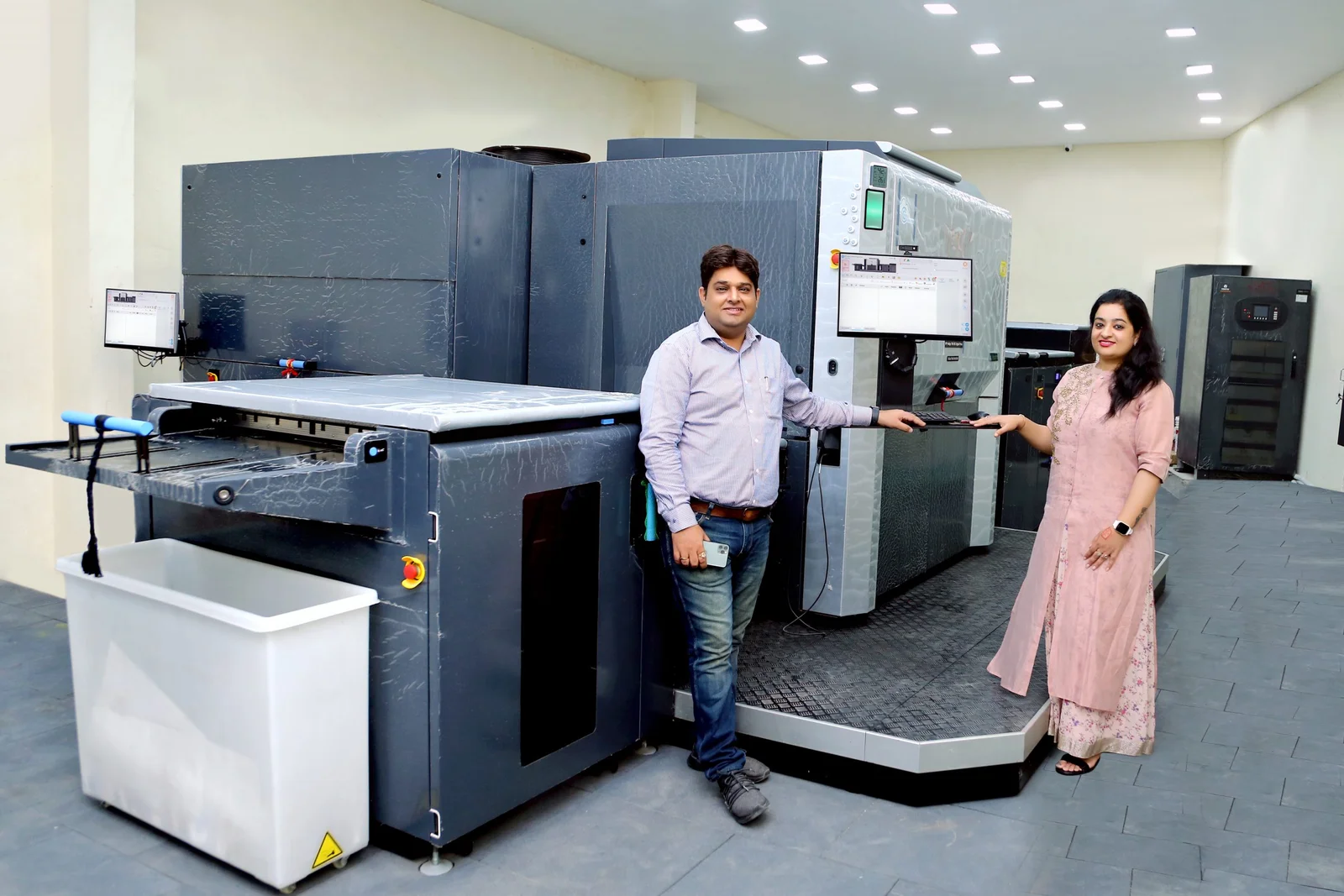
However, since the number of digital production presses sold to the commercial print market in India comes from Konica Minolta, Canon, Ricoh, Fujifilm, and Xerox at much lower CAPEX, we have generally seen HP Indigo sheetfed press sales as a special category. This is partly because the numerous traditional drum and toner vendors provide a large range from what is called “light production” to heavier-duty production presses comprising more than CMYK inks and quality automation features. The combined annual volume of these digital presses in our market is in the range of 2,500 machines or more, while the HP Indigo press volumes are perhaps less than 2% of this number.
Nevertheless, the HP Indigo sheetfed commercial presses have established a significant footprint in the country over the past 17 or 18 years, starting with the B3 Indigo 3000 and 4500 presses but mainly with the 5000, 7000, 7600, 7800 and 7,900 series. While all Indigo series have an engine configured for 7 colors (CMYK plus Orange, Green and Violet), Indian customers have often opted for 5- and 6-color configurations, presumably to save on both capital and running costs. This creativity of the printers and flexibility of the manufacturer have been key to making the seemingly higher Capex viable in our market.
Another dynamic of the success of the Indigo B3 presses in India is that they never competed with the drum and toner digital presses. Right from the outset, with their up to 7-color capability, they competed in photorealistic quality with the silver halide photo reproduction machines used by photographic shops for producing prints.
As the wedding album market in India boomed, the Indigos gained traction, and HP kept tweaking the technology to introduce improvements and upgrade many of the earlier machines. A feature of the Indigo core engines has been that the presses have generally been field upgradable and can even be resold as refurbished machines. Many earlier customers have upgraded, although older machines, which the company continues to support with service and consumables, continue to work.
The Indigo technology has always allowed the use of paper, plastic and metallized substrates. The B3 presses do not require a primer for paper, although plastic and metallized substrates do. While more than 2,000 paper substrates are certified for quality color reproduction, the presumption is that the combination of the Indigo electroink and rubber blanket drum will perform well on practically any printable paper.
HP improved the B3 sheetfed machines with various features, including handling substrates as thick as 550 microns, and improved inks. Most recently, it added white, silver, and invisible inks to the 7K series machines. Altogether, with scratch-off and fluorescent inks, there are 20 special inks available. The latest B3 models are the Indigo 18k and 120K, meant to be workhorse productivity models, allowing continuous and robust feeders and substrate movement from multiple bins, and the use of thicker substrates up to 600 microns. We believe that several may be on their way to our market for imminent installation.
The Indigo B2 sheetfed presses in India
Another side of the HP Indigo commercial printing story in India is that of its sheetfed B2 presses starting from drupa 2012, where the company launched its ‘Series 4’ architecture with the Indigo 10000. The oversized B2 sheet size (29 inches or 750 x 530 mm) press was a sensation at the show, printing fabulous posters using FM screening. This press first gained traction in the Indian market with photo and photo album printers who branched out into high-quality indoor posters. A few of the large Indian photo printers bought multiple machines for their regional locations.
However, the growth impetus for the slow and steady B2 machines in our market has come from the Indigo 12000 and the 15k presses as the dynamic shifted from photo printing to the high-quality multicolor commercial print market. The specialty inks and automation features of the HP PrintOS have played a part in the Indigo B2 narrative as it added reality to the possibilities of reduced inventories, faster-to-market and high-value versioning. It made possible the integrated print factory that could churn out several hundred completed jobs and invoices each week, with Indigo quality and consistency, and the flexibility of media including special value luxury stocks.
In this scenario, the cloud-based HP PrintOS managed the workflow by automatically streaming jobs from a variety of platforms directly into the queue. HP’s digital front end and Smartstream Production Pro did the prepress page imposition, ganging-up, variable data printing, color management, and ultimately its high-speed RIPping. On press, an AI defect detection feature scanned for errors and discarded bad sheets and, if needed, automated the production of needed reprints without human intervention. Delivering real-time analytics, the automated workflow, prepress, Ripping and on-press feedback create the possibility of a web-to-print environment and an integrated print factory.
The newest Indigo B2 presses are the 15K, 18K, 100K, and 120K, and several of these are on the way to our market, with perhaps one or two already under installation. The B2 Indigos are also field-upgradeable, and commercial printers are appreciating the new way of working that produces more completed work each day with potentially higher profits.
It is sometimes said that the HP Indigo’s success in India is unique despite the lower cost of human resources, in that some of its customers rank amongst the highest globally in page volumes. This may be a reflection of a large print market with varying needs. In our view, it is also to the credit of agile and adaptable customers and the manufacturer who have together created new paradigms for creativity, quality and premium productivity.