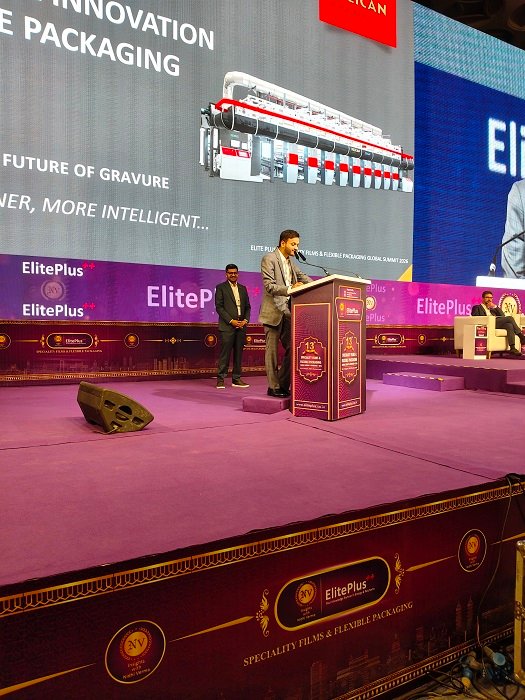
The flexible packaging industry’s shift toward recyclable substrates and lower environmental impact will require not only changes in materials and inks but also smarter machinery, artificial intelligence and digitalized production systems, according to Pelican Rotoflex.
Speaking at the 13th Speciality Films & Flexible Packaging Global Summit & Exhibition in Mumbai, Vasu Shrimanker and Yash Shrimanker of Pelican Rotoflex said sustainability and profitability were increasingly interconnected as converters faced pressure to reduce waste, energy consumption and conversion costs.
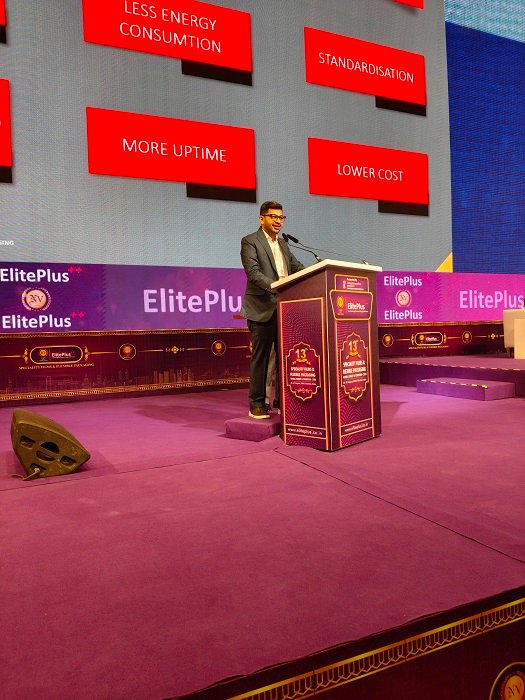
Vasu Shrimanker said customer priorities had changed significantly. While productivity, technology and higher output were previously the main concerns, customers were now placing greater emphasis on sustainability, waste reduction, energy efficiency and conversion costs.
He said the next stage of the transition would involve the greater use of artificial intelligence, helping operators make better decisions while using fewer resources.
“Every unnecessary meter of substrate you save reduces costs and your carbon footprint,” he said, adding sustainability should be viewed not only in terms of recyclable materials but also the efficient use of resources.
Pelican Rotoflex has more than 1,200 installations and is expanding its manufacturing facility in Rajkot, with the new facility designed to support next-generation engineering and production, he said.
The shift toward sustainable packaging is creating technical challenges across the value chain. Brand owners are demanding recyclable and environment-friendly structures, prompting film manufacturers to develop thinner and more sensitive substrates. Ink manufacturers are also developing water-based and other lower-impact ink systems.
Converters, meanwhile, are dealing with shorter production runs. Volumes previously produced as large jobs are divided into multiple smaller runs, resulting in more frequent changeovers, greater setup waste and lower productivity.
Machine manufacturers need to develop presses that can handle sensitive substrates at higher speeds while maintaining print quality, reducing setup waste and consuming fewer resources.
Another challenge is the shortage of highly skilled operators. As substrates and inks become more complex, operators need to manage a growing number of parameters, including tension, drying, registration and other process settings.
Pelican Rotoflex has responded by developing an AI-powered system integrated into its new machines. The system allows operators to seek guidance on issues such as unstable registration, machine parameters and power consumption through an AI platform, reducing dependence on manuals and individual experience.
The company’s production-reporting system records output, waste, power consumption, machine settings and operators involved in each job. This production history can help operators reproduce jobs with lower waste and greater consistency.
Yash Shrimanker said the objective was not to introduce AI just because it was a widely discussed technology, but to ensure it provided practical value on the factory floor.
He said AI would not replace skilled operators but enable faster decisions. This could reduce waste and energy consumption while improving uptime and print consistency.
However, he said AI recommendations are useful only if the underlying machinery is capable of implementing them.
This is particularly important with recyclable monomaterial films, which can be softer, more prone to stretching, and difficult to control at high speeds.
Pelican Rotoflex has developed advanced tension-control systems, including counterweights in film dancers and servo-driven systems, to improve registration stability when running sensitive films.
The company manufactures specialized tungsten-carbide-coated rollers with controlled surface roughness to improve film grip and minimize slippage.
Drying presents another challenge as converters adopt water-based and mono-solvent inks, which can have lower VOC emissions but are more difficult to dry. Pelican Rotoflex has developed a semi-flotation-assist dryer using 3D-enabled technology to apply hot air to both sides of the film.
Digitalization is being used to reduce changeover times. The company has developed an offline job-setup process incorporating pre-registration, automatic cylinder centering, stored recipes with AI integration, and press-ready configurations.
The system generates digital production records, providing the data required for AI-based analysis and recommendations.
Yash said the technology could eventually allow a machine to recommend the most suitable operator for a particular complex job based on historical production data and experience.
Pelican Rotoflex has been testing its technology across a wider range of substrates. At a recent factory open house co-hosted with the Global Rotogravure Association, the company successfully ran thin MDO-PE, thin PE and nylon films on gravure while maintaining print quality and registration stability. It achieved stable printing on 250 gsm and 320-micron cardboard with porous and uneven surfaces.
The Shrimankers said the industry’s sustainability challenges could not be addressed by machine manufacturers alone. They called for closer collaboration among converters, film producers, ink manufacturers, brand owners and technology suppliers to develop solutions for new substrates, inks and production requirements.
They said a combination of engineering, digitalization and AI would help the flexible packaging industry reduce its environmental footprint while maintaining productivity and profitability.