Packaging already tells us where our food came from, when it was made, what’s inside, and its calorie count. Researchers are now imagining packaging that can “see” what’s happening inside in real time — and turn that into information producers and consumers can actually act on.
Kyushu University researchers had earlier developed a self-healing hydrogel that reliably signals spoilage through color change while extending food shelf life. The process involves fixing a natural pigment onto a metal-organic framework, a post on the university stated.

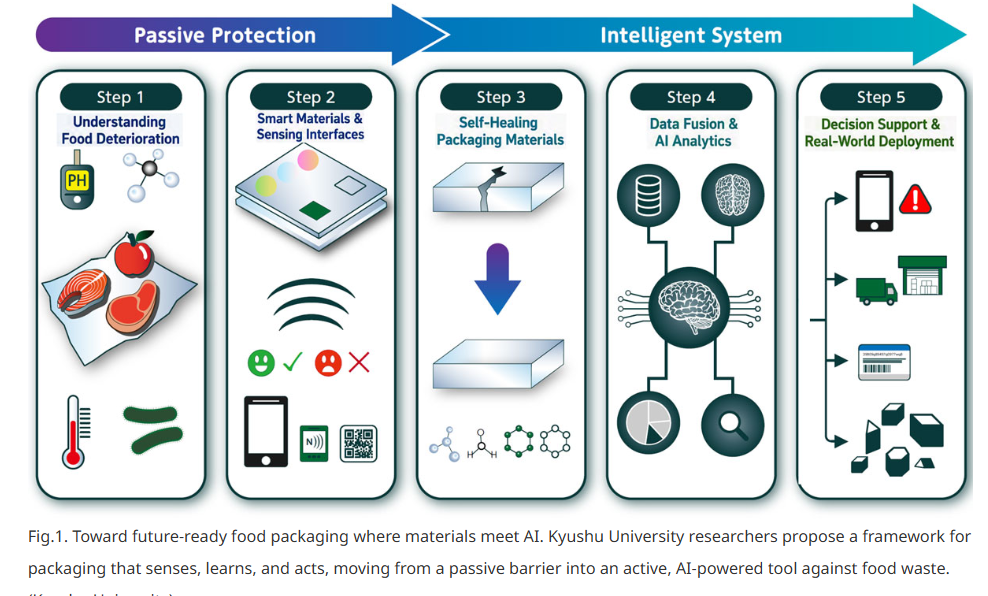
In a paper published 13 July 2026, in Trends in Food Science & Technology, a Kyushu University team lays out a framework for “future-ready food packaging” built on a closed loop of recognition, judgment, actuation, and feedback.
The work pulls together three fields that have mostly developed separately — intelligent sensing, self-healing materials, and AI-based prediction — into one unified system.
“About a third of all food produced worldwide ends up wasted,” says Fumihiko Tanaka, professor at Kyushu University’s Faculty of Agriculture in a blog post on the university website. “There’s also a climate toll — food loss accounts for around 8% of global greenhouse gas emissions, not far behind the roughly 10% attributed to road transport.”
Some of that waste comes from food being crushed or torn in transit. But a bigger source is food thrown out before it’s actually gone bad — tossed due to inventory pressures or an arbitrary printed date rather than its true condition. Drawing a sharper line between “starting to spoil” and “actually inedible” could prevent a lot of that waste.\
Real-time sensing
To push packaging beyond simply slowing spoilage, the team reviewed recent advances and connected previously disconnected technologies into a single recognition-judgment-actuation-feedback loop.
“Future-ready packaging needs a different mindset,” says Fanze Meng, the paper’s first author and a postdoctoral researcher at Kyushu University. “We wanted the film itself to communicate with the food — converting optical or gas signals into electrical data, then using AI to interpret what’s going on inside.”
Recognition starts with the material itself. Embedded sensors act as the packaging’s “eyes,” picking up on pH shifts, gases, and microbial byproducts that indicate spoilage. Natural pigments such as anthocyanins — the compounds behind the color of purple sweet potatoes, for example — are promising candidates, since they change color with pH and give a readable signal at every stage of decay. In spoiling meat, alkaline gases build up, causing the material to shift gradually from purple-red to yellow-green.
“To hold up through real-world distribution, the material needs more than sensing ability alone,” explains Xirui Yan, a JSPS researcher at Kyushu University. “Light and heat can trigger false readings, and a bump or scratch can break the signal, so reliability has to be built in. One method we’ve explored is anchoring the pigments with metal-organic frameworks and carbon quantum dots, plus adding self-healing properties so the film keeps functioning even after it’s damaged.”
Once a signal comes through, AI takes over — converting optical and odor changes into electrical data that a connected device reads and interprets. That system could then act: releasing antimicrobials to slow spoilage, sending alerts, or setting off logistics actions.
“It’s essentially a full check-up for produce,” Yan says. “The film picks up the signal, AI interprets it, and together they tell you the food’s condition and what to do about it.”
AI for supply chain and consumer
The team’s vision extends past a single smart package. They imagine an AI system that continuously updates its understanding of how different foods spoil — since fruit, meat, and seafood all decay differently, and even different fish species break down at different rates. By tracking the compounds each food type releases while spoiling, the film picks up distinct patterns AI can learn from over time, helping material designers and food producers tailor solutions to specific foods.
“Understanding spoilage more precisely can also shape sales and consumption strategy,” Tanaka adds. Working with local governments and logistics partners, the team is looking into grading produce by how well it holds up during storage and transport — routing short-shelf-life items to local markets while reserving hardier varieties for export, cutting losses by matching each item to the right destination from the outset. For consumers, that same intelligence could eventually come through a simple phone scan, delivering an instant, readable read on the food’s condition.
Real-world challenges remain, though. Long-term safety and stability testing for food-contact materials — especially certain nanomaterials — along with reliable quality control at industrial scale still need further work.
“We’re setting a direction,” Meng and Yan conclude. “We hope others build on what we’ve started. If enough people move together, it becomes a beam of light, then a path — and eventually, that path could lead from the lab to something real.”