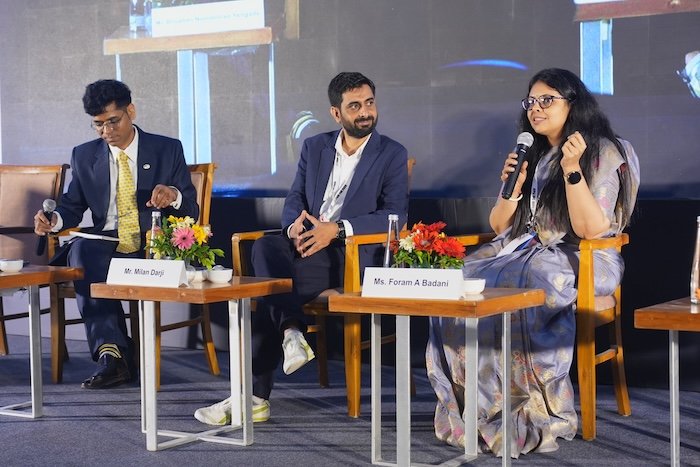
In a technical session at the FoodTekPack Conference 2026 in Gandhinagar in July, panelists Milan Darji and Foram Badani and moderator Bhushan Namderao Yengade discussed the management food waste on a large scale.
The session discussed how, though India is a leading food producer, a significant amount is lost or wasted before it reaches the consumer. Better waste management, improved supply-chain visibility and the adoption of new technologies could play an important role in reducing food losses.

Opening the discussion, Yengade spoke about the paradox of India’s food sector — a country with enormous food-production capacity that generates substantial food waste. He stressed the need to examine waste management more closely, particularly at different stages of the food supply chain.
Yengade took the example of traditional agricultural markets such as Ahmedabad’s Vasna Yard and Jamalpur Yard, where an early morning visit can provide a clear picture of food waste. Such losses demonstrate the need to look beyond food production and examine how products are handled, transported, stored and marketed before reaching consumers, he said.
Technology could provide another part of the solution. Foram Badani discussed the role of artificial intelligence (AI), Internet of Things (IoT) and smart packaging in improving monitoring across the food supply chain. Smart packaging was traditionally divided into two broad categories — active packaging and intelligent packaging. The evolution of digital technologies has now added a third dimension, connected packaging, Badani said.
The growing importance of connected packaging is linked to changing consumer expectations and the increasing use of IoT technologies. Connected packaging can enable products to communicate information and provide greater visibility into their journey through the supply chain.
Badani highlighted the relevance of AI in tracking food from farm to fork. Food quality can change during harvesting, transportation, storage, and distribution. By collecting and analyzing data at different stages, AI-based systems can help identify such changes and provide information that could support timely intervention.
This approach could be particularly valuable in reducing losses caused by poor handling or deterioration during the supply chain. Instead of identifying waste later, technology can help stakeholders detect problems earlier.
The discussion highlighted how packaging is evolving from being primarily a protective layer to becoming an intelligent component of the food supply chain. Active packaging can help influence the conditions surrounding a product, intelligent packaging can provide information about its condition, while connected packaging can link that information to digital systems and consumers.
For the food-processing and packaging industries, the convergence of these technologies represents an opportunity to address food waste while improving traceability and supply-chain efficiency.