An Italian business delegation led by Confindustria Vicenza visited Mumbai in October to explore investment opportunities and strengthen industrial ties with India, with Maharashtra promoting its manufacturing infrastructure and investment facilitation services to prospective Italian investors.
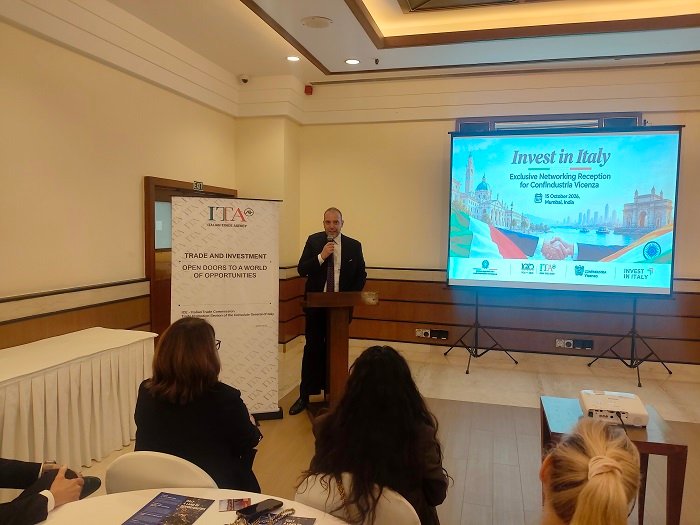
The Italian Trade Agency (ITA) in Mumbai hosted a networking reception and dinner on October 15, 2026, at the Trident Hotel in Nariman Point. The event was hosted by Italian Trade Commissioner Martino Castellani in the presence of Walter Ferrara, Consul General of Italy in Mumbai, and brought together Italian and Indian business representatives to discuss cross-border partnerships.
Ferrara said bilateral relations had been elevated to a Special Strategic Partnership during Indian Prime Minister Narendra Modi’s visit to Rome in May 2026. The two countries had also launched a strategic action plan for 2025–2029 to provide a framework for deeper political and economic cooperation.
He said the relationship was increasingly moving beyond exports toward manufacturing, technology transfer, workforce training and joint ventures. Around 1,000 Italian companies had invested in India, employing thousands of people, according to Ferrara.
“India is no longer simply a large market where Italian companies want to be present to export, but it is increasingly becoming an industrial partner,” he said.
Ferrara highlighted Maharashtra and Gujarat as important destinations for Italian investment, citing their industrial, financial and technological capabilities. He said Italy and India should measure the success of their partnership not only through trade volumes but also through joint investment, technology development, research and collaboration between businesses.
He also cited an ambition to increase bilateral economic exchanges to €20 billion by 2029.
Maharashtra pitches industrial clusters
Varsha Damodar Thakur, joint chief executive officer of the Maharashtra Industrial Development Corporation (MIDC), presented the state’s industrial infrastructure and investment opportunities to the delegation.
Thakur said Maharashtra offered opportunities across automotive manufacturing, engineering, electronics, textiles, pharmaceuticals, steel, food processing, clean technology and innovation. The state has more than 300 industrial areas, according to her presentation.
Pune, Talegaon and Chakan were highlighted for automotive manufacturing and engineering, while Ranjangaon was identified as an important location for electronics manufacturing. Other industrial locations and clusters offer opportunities in textiles, food processing, pharmaceuticals and steel.
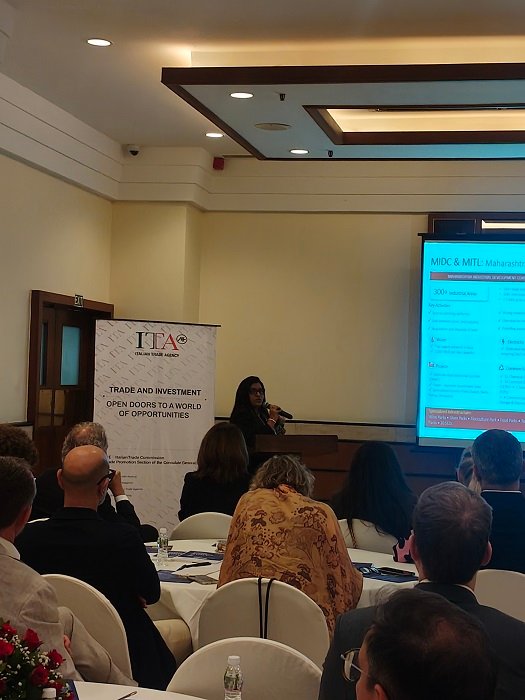
Thakur also outlined Maharashtra’s investment facilitation initiatives, including the Maitri single-window portal, which brings together 176 services across 14 government departments. The platform is intended to simplify approvals, improve transparency and provide coordinated support to investors.
The state is interested in establishing specialized industrial zones for Italian companies, following the model of dedicated investment parks for businesses from other countries.
Thakur identified advanced manufacturing, engineering, automotive components, electric mobility, clean technology and innovation as potential areas of cooperation. She proposed a follow-up roundtable with Italian businesses in December or January to discuss specific investment opportunities.
Technopaper assesses India’s premium packaging market
The delegation’s visit also provided an opportunity to examine India’s potential for specialized packaging products. A representative of Italian company Technopaper said the company was assessing the Indian market for its premium packaging operations and exploring possible sourcing opportunities.
Technopaper produces paper cores for industrial customers and premium round boxes for luxury products, food and confectionery. Its products include high-end packaging for perfumes, gift items and traditional Italian panettone cakes, as well as rigid boxes with metal bases and lids used for premium spirits and other products.
The representative said the company was interested in exploring India as a potential source of metal components amid difficulties sourcing some materials from China. However, she said the company needed more time to understand the market before making any investment decisions.
Price sensitivity, access to suitable raw materials and the time required to establish a commercially viable operation were among the factors under consideration.
She raised concerns about the availability of premium paper grades in India, saying some materials used in high-end packaging were imported from countries such as Thailand.
Labor availability and production technology were additional considerations. Technopaper operates highly automated machinery in Italy, with some equipment requiring only two workers. The representative said the company was assessing whether a similar production model would be suitable for India.
She acknowledged that India’s premium packaging market was still relatively small but appeared to be growing, particularly in major urban centers such as Mumbai, Delhi and Bengaluru. Demand for premium boxes for confectionery, luxury goods and retail products could create opportunities over time, although price competitiveness would remain important.
The representative said Technopaper planned to continue studying the market and could consider a return visit before deciding on its next steps.