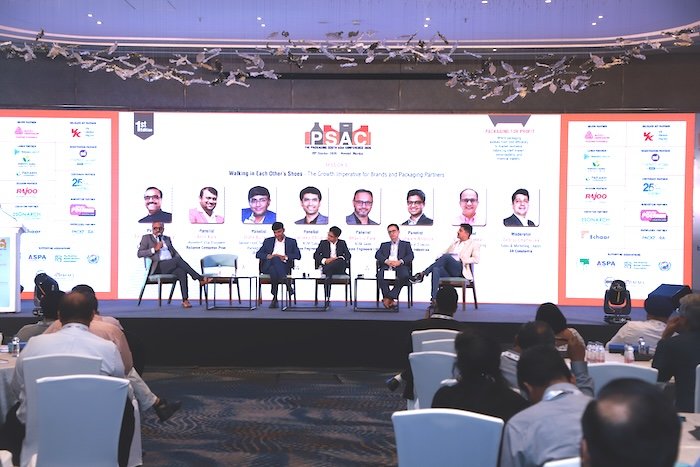
An exciting panel at the PSA Conference highlighted practical and real-world collaboration as a driver of innovation. Brands and converters discussed written agreements that could value and help balance intellectual property protection, supply-chain resilience, and cost pressures as brands and converters work toward sustainable packaging solutions.
Greater transparency, trust and strategic partnerships between brand owners and packaging converters are essential to drive innovation, manage costs and improve supply-chain resilience, panelists said in a discussion at the Packaging South Asia Conference (PSAC) in Mumbai on 9 October.

The panel, titled Walking in each other’s shoes: The growth imperative for brands and packaging partners, explored the challenges brand owners and converters face as they develop new packaging technologies while balancing intellectual property protection, sourcing requirements and commercial viability.
The discussion featured Santanu Chowdhury, CEO of Core Group Industries, whose quick presentation, Packaging for Profit, set the stage; Dipta Banerjee, senior lead technologist, Packaging Development at ITC; Vishwam Bhotica, Technical director at SAPCO Industries; and Vishal Thakkar, AVP, sales and marketing, Films Division at VK Global. Debraj Chatterjee of SB Constantia moderated the session.
Collabs beyond price negotiations
Panelists emphasized that collaboration between brands and converters must go beyond price negotiations and individual supply contracts to support long-term innovation. They said clearly documented agreements, including exclusivity provisions, and the eventual wider adoption of new ideas and technologies could help protect the interests of both parties.
Banerjee said brand owners often work with multiple suppliers to reduce the risks associated with depending on a single vendor. However, this approach can create concerns for converters, who may be reluctant to share proprietary technologies, fearing that competitors will replicate their innovations and supply the same solutions to the brand owner at lower prices that discount the costs of innovation.
He argued that the industry needed greater transparency, particularly as cost pressures and sustainability requirements increased. Packaging structures for products such as dishwashing liquids, handwash and body wash should be simplified where possible to enable adoption by multiple converters and facilitate the incorporation of post-consumer recycled (PCR) materials.
Banerjee also cited the commercial benefits of using recycled PET, noting that it could be more economical than virgin PET in the prevailing market conditions.

Photo- PSA
He described a collaboration with SBConstantia Flexible Packaging that led to the development of a monomaterial pouch several years ago. The project involved technical and cost challenges, including adapting the laminate and spout to existing filling equipment.
The initial use of preformed pouches increased costs, while difficulties in sealing the specialized spout limited the brand owner’s ability to source the packaging from other suppliers. The experience highlighted the risks associated with relying on a single converter for a proprietary solution, even when the partnership delivers innovation.
Banerjee said brand owners should assess packaging costs across the entire value chain rather than reject innovations solely because primary packaging becomes more expensive. Savings elsewhere in the value chain could help offset the additional costs, making new solutions commercially viable.
Chowdhury, who has experience on both the brand-owner and packaging-supplier sides, said documented exclusivity arrangements could provide converters sufficient confidence to invest in developing new technologies. Under such arrangements, an innovator could receive exclusive rights to supply a solution for an agreed period, after which the technology could be made available to other suppliers.
He also advocated exploring commercial models that link payments to the value created for customers, allowing suppliers and brand owners to share the benefits of improved profitability or sales.
Thakkar said brand owners and converters should treat each other as strategic partners rather than engage on a project-by-project basis. Innovation priorities should be clearly agreed and documented, with development initially undertaken by one supplier, and before being extended to other vendors.
Transparency & long-term planning
Vishwam Bhotica highlighted the importance of long-term planning, particularly for manufacturers investing in production capacity to meet customer requirements. Greater clarity on expected volumes, material costs and pricing adjustments would help converters plan investments and minimize disruptions to customers’ production lines and supply chains.
The panel also examined the price discovery of packaging by brands, and whether requests for quotations (RFQs) could discourage innovation by prioritizing price over value creation. Banerjee said RFQs remained useful for routine procurement but argued that innovation should be developed through partnerships rather than treated as a price-comparison exercise.
He added that suppliers should receive appropriate commercial benefits for their development work, while brand owners should recognize that raw material price movements can justify changes in packaging costs.
The discussion concluded with a call for collaboration that extends beyond individual brand owners and converters. Panelists said successful innovations should, where feasible, be made available more widely across the industry to support common sustainability objectives and improve adoption of recyclable and recycled-content packaging breakthroughs.
They suggested this approach could help reconcile the need to protect intellectual property with the industry’s broader requirements for supply-chain security, cost efficiency and sustainable packaging development. The session created a buzz, and the ensuing panels kept ‘Walking in Each Other’s Shoes.’