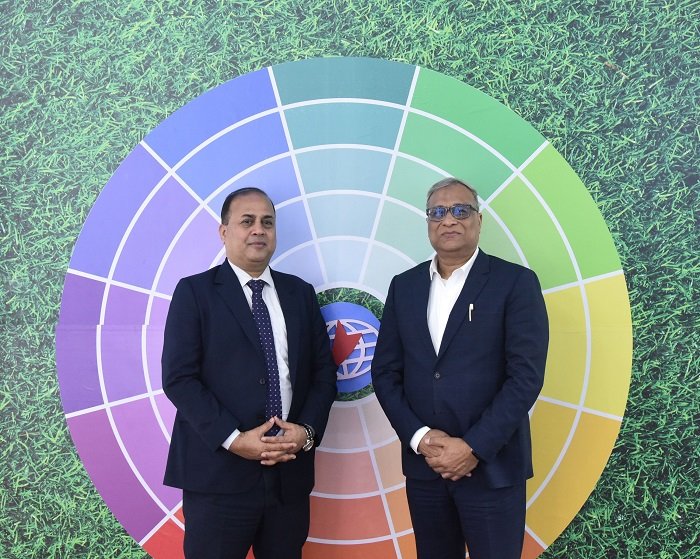
UFlex Chemicals showcased its comprehensive inks, adhesives, and coatings for flexible packaging, offset, and flexo printing, and for corrugation, décor, and construction applications at the recent PlastIndia show in Delhi. Desh Deepak Misra, joint president, Chemicals Business, and Rajesh Srivastava, executive vice-president sales and marketing, Chemicals Business of UFlex, discussed the company’s key focus areas—water-based technologies, the PU division, Radcure, and its ink portfolio.
While its water-based technologies include water-based inks, adhesives, and coatings, the PU division includes solvent-free, solvent-based, mono-component, and high-performance adhesives. Radcure consists of its UV, UV LED, and electron beam inks. The comprehensive inks portfolio includes various technologies ranging from vinyl-based to PU-based to non-toluene, acrylic, polyamide, and water-based inks.
“As the food segment is where packaging is growing fastest, it comprises 40% of our portfolio. Non-food, such as soap, detergents, and cosmetics, make up the rest,” Desh Deepak Misra said, adding that food packaging, food safety, and migration regulations and compliance are to be met. “With this, our responsibility becomes more stringent in the selection of pigments, resins, and formulation solvents.”
Misra said UFlex Chemicals is evolving and developing as per the market dynamics. The company launched its 401 A and 401 C adhesives, which work at high speed for multiple applications such as big bags, bulk bags, ketchups, oil, all kinds of atta, cement bags, rice bags, and foil-based laminates.
For appropriately laser-engraved cylinders, ink manufacturers are introducing water-based inks, Rajesh Srivastava said, adding this creates pressure on technologists to offer a product and solution that works not only for good printing but enables good lamination, bond strength, post-lamination, and post-printing coatings as well. “The moment the laser cylinders are active, there is a reduction of 15 to 20% of ink consumption. So, it becomes very challenging for us, as ink designers, to formulate an ink that works on a smaller cell volume. We have to increase the pigmentation levels, grinding efficiencies, and the transverse properties of these inks,” he said.
“Converters are seeking faster curing solutions, and we are developing advanced technologies with improved green bond strength to deliver more efficient performance,” Misra explained. “Additionally, converters are moving towards lower gsm of adhesives and inks, which may impact bond strength.”
Srivastava elaborated that in India, the Bureau of Indian Standards has issued the IS: 15495-2020 regulation, banning the use of toluene. These specifications are being monitored by FSSAI, which is particular about the ink raw materials in terms of migration. “We have a well-equipped laboratory setup, and we do all kinds of migration testing for solvents and GCs. We check everything and formulate inks that are suitable for food packaging, to avoid migration. Ultimately, the selection of raw materials and the chemistry is not only for India but for the global market.”
There are multiple global compliances, such as Nestle compliances, Swiss compliances, and the halal certified product compliance in the UAE market, Srivastava said. “When we export to any particular country, we make sure that the inks are fully compliant with that country’s regulations and specifications.”
Sustainability challenges in printing & packaging industry
Whether it is the printing and packaging industry or its suppliers, with overcapacity, everybody is trying to get maximum volume share, according to Srivastava. “There are two things to consider – one is on the cost side, and the other is regulation.”
While regulations are present and there is a big effort toward sustainability, at the end of the day, cost overrides most considerations. According to Misra, “Many of the low-cost manufacturers are able to flood the market with inks and adhesives that are not sustainable. Within the same market, we focus on real value-added products. Instead of just providing the product, we interact with printers and converters to understand their pain points, which could be on cost or sustainability.”
“Often, we see converters buy a product with a low cost per kilogram, but if you examine its actual application, the cost is much higher,” Srivastava added. “We end up providing converters with a sustainable product, where the per kg cost could be higher, but the per square meter cost would be comparatively lower. Additionally, we keep educating converters about the long-term or even the medium-term impact of using a non-sustainable product.”
Significant import dependency is another challenge, Srivastava said, adding India is still lacking in the production of many raw materials, whether it is titanium or MDI (methylene diphenyl diisocyanate). “While we are able to get some solvents in India, for all the expensive and qualitative materials, we are still largely dependent on imports. Many price variations, supply delays, and shortages accompany import dependency. I think that’s a big challenge to the entire Indian ink industry. Several local players have popped up. They don’t invest in the safety, quality, and technology front, and merely try to penetrate the market on the basis of lower prices.”
Overcapacity is creating razor-thin margins and competitive challenges. Only customers who understand continuity, quality, and service remain loyal for years. Srivastava added, “We are expecting the government to play a much stronger role in working with the industry on sustainability. While the government has regulations, these are not fully enforced. This leads to a situation where responsible organizations, like us, are facing competition. While, as an industry, we are putting in our best, we need support from the government to enforce many of these regulations stringently.”
“We would also like credit insurance and credit guarantees,” Misra said. “While MSME sectors are being protected by the government, organized companies like ours provide many products on credit. While there can be big credit risks, we are conscious and careful. In exports, we are fairly covered by government insurances, and the Export Credit Guarantee Corporation of India (ECGC), but some countries provide their exporters with several types of credit insurance. I am sure that eventually the government will think about our industry and also protect it.”
At PlastIndia, UFlex Chemicals interacted with visitors not only from India but also from Europe, the Middle East, and Africa. “We met a lot of potential users, customers, and distributors during the six days,” they concluded.