During a recent visit to the Jupiter Group’s plants in Sonipat and Murthal, we had the opportunity to witness a tightly run manufacturing ecosystem in action, steadily positioning itself as among India’s most integrated flexible packaging companies. Conversations with Kaushik Nag and Ketki Sute and the operational heads of the several independently run verticals revealed not just the scale of operations, but the thinking behind it.
Spread across Sonipat, Murthal, Manesar, and Jammu, with its head office in Gurgaon, the Jupiter Group’s operations reflect a deliberate and structured move toward end-to-end control of the packaging material value chain. From critical raw material production and processing to final pouching, the group has built capabilities that reduce external dependency while enabling consistency, speed, innovation and value creation.


The Sonipat plants serve as the group’s converting hub, where blown film extrusion, printing, lamination, and pouching, come together in adjacent buildings. The printing setup is equipped with multiple gravure presses from Bobst and Pelican, and the lamination section is equally versatile, operating solvent-based, solvent-less, and water-based systems from Nordmeccanica and Pelican as well as multiple extrusion laminators. This multi-process workflows allow the company to efficiently process standard and specialized film and laminate structures for diverse packaging requirements.
The mulitiple high speed and turret rewinder slitters are followed by a large and separate pouching section capable of advanced spouting and capping for the leading producers of food and beverages. Pouching machines from Totani and Zhoutai, enable precision in finished packaging formats including those using high barrier laminates for aggressive and sensitive products.

Photo PSA
Value over volume & Engrave+
The infrastructure reflects a blend of global technology and operational flexibility. “We are converting approximately 1,200 to 1,400 tons a month here,” said Kaushik Nag. “But we don’t chase tonnage for the sake of it. Our focus is on the bottom line, on delivering value, not just volume.”
Adding to the in-house capabilities in Sonepat are two blown films lines including a Reifenhäuser three-layer line, reinforcing backward integration at the film level and offering greater control over substrate performance.
Near the converting unit is the gravure cylinder manufacturing facility, Engrave+, playing a critical role in enabling quality and turnaround time. Sundeep Singh, business head of Engrave+, walked us through the entire cylinder-making process, from cylinder preparation and engraving to finishing and chrome plating. The facility houses five Hell K5 Smart engraving machines, including two K5 Smart XL machines. As displayed at the KGS stand at the recent PlastIndia show, of Jupiter’s batch order for four Hell Gravure K5 Smart engravers, one is already installed with the other three to be installed in the next couple of months.
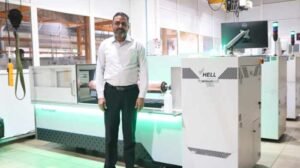
What stands out is not just the in-house technological capability, but the forward-thinking, safety and hygiene driven layout of the plant. It is apparent that the plan is to build Engrave+ into a large-capacity brand with a comprehensive set of engraving capabilities including those for water-based gravure. Each section has been designed with additional space to accommodate future expansion. “There should always be room for growth,” Singh remarked. “If you don’t plan for expansion today, you may end up restricting yourself tomorrow.”
The Murthal complex
Roughly 240 acres in size, the Murthal complex points to Jupiter’s ambitious and futuristic integrated operations. With plenty of land still unutlized, it aleady houses three business verticals, including CPP film production, the LSKB aluminium foil rolling joint-venture, and the Inkofix inks, adhesives, and coatings unit.
The highly automated state-of-the art Inkofix plant is totally dedicated to flexible packaging – providing, inks, coatings, primers and adhesives. With an annual capacity of 24,000 tons, the R&D facilities are advanced and extensive with the complete set of appropriate global certifications and compliance with food safety migration limits. It also provides several types of special effect inks.
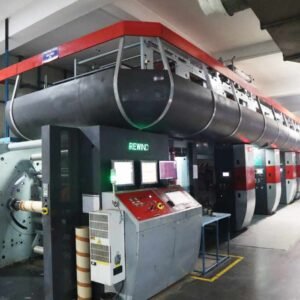
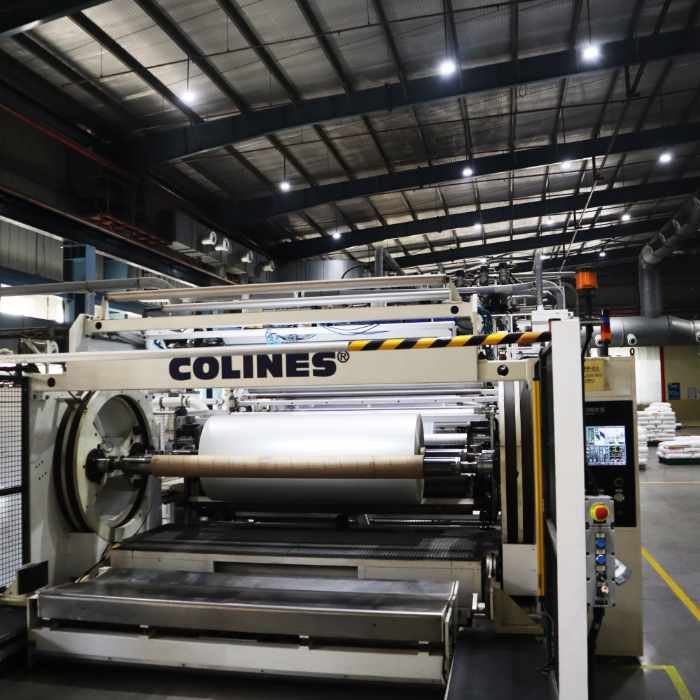
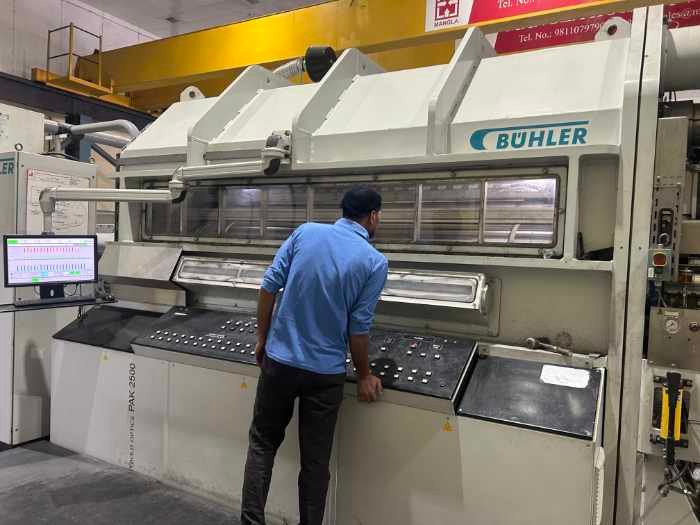
During our visit to the totally separate but adjacent CPP plant, we saw the Colines 2.5 meter wide CPP line in operation, producing cast polypropylene films for both internal consumption and the external market. The plant contains a Buhler vacuum metalizer for depositing a very thin layer of aluminium vapor for on CPP films. The aluminum layer provides barrier properties to the new generation of single polymer substrates and laminates that are easily recyclable and appropriate for branded snack food pouches.
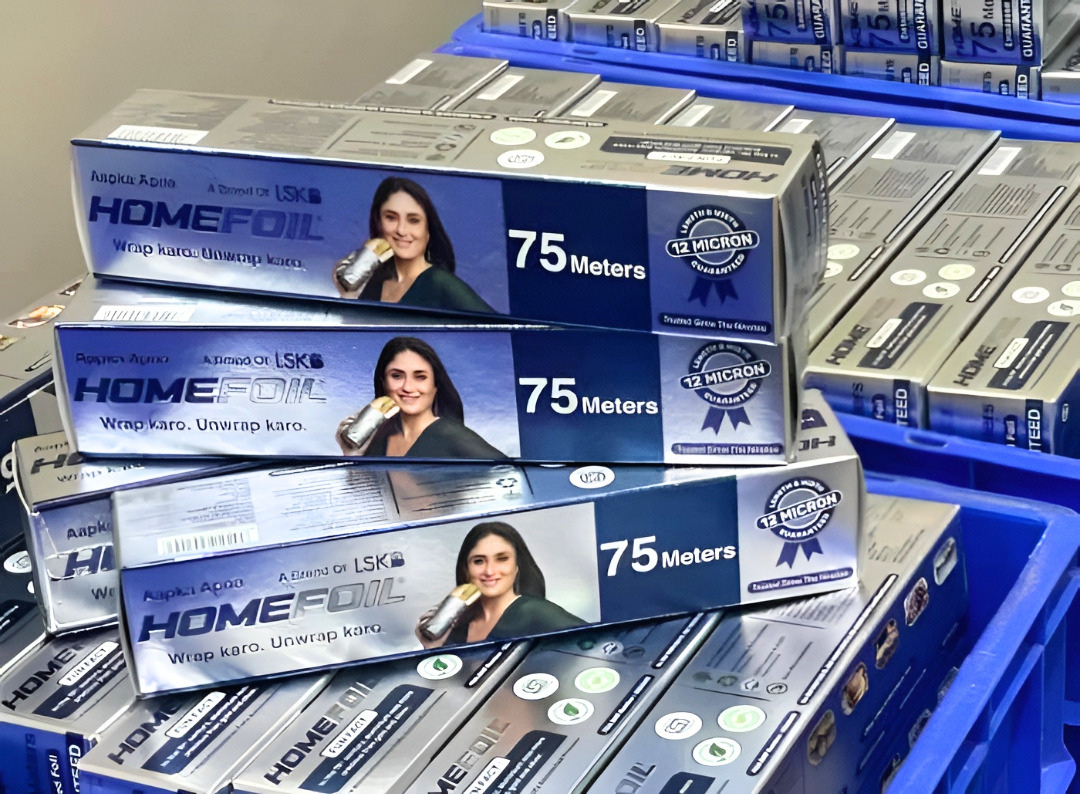
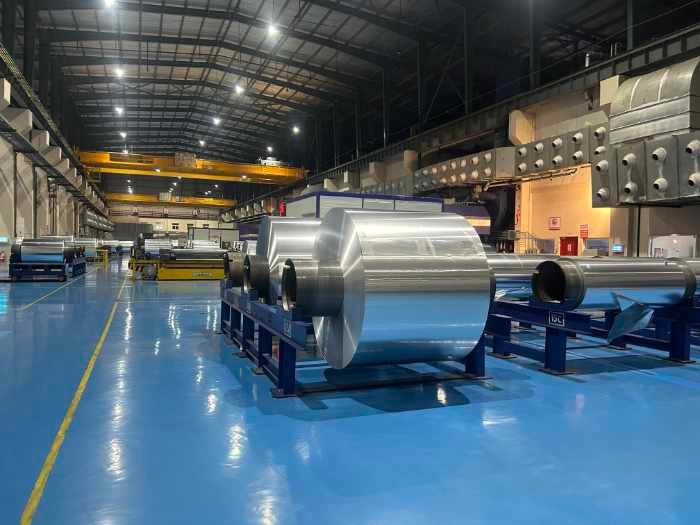
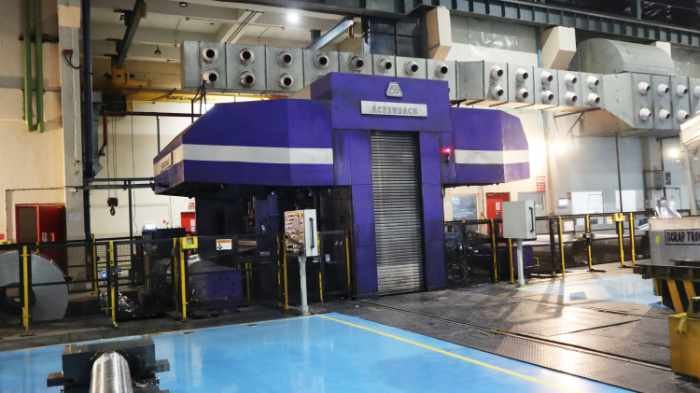
Next to these is the immense LSKB aluminium foil rolling unit producing foil of varying thicknesses from sheets supplied by the group’s Jupalco unit in Jammu, and coils supplied by aluminium manufacturers. The Achenbach foil rolling and slitting machines together with an annealing line produce thinner aluminium foil rolls for a variety of applications including formed food trays produced within the plant, and foil rolls for applications including food wrapping materials used by quick service restaurants and household kitchens. The LSKB branded home foils are widely advertised and promoted by Bollywood celebrity Kareena Kapoor.
Each vertical at Sonepat and Murthal operates as an independent strategic business unit while also feeding into the group’s internal supply chain. “Engrave+, CPP, inks and adhesives, printing and converting, and pouch making — these are standalone businesses,” said Ketki Sute. “At the same time, they strengthen our internal ecosystem by ensuring reliability and consistency.” According to her, the Inkofix division, independently run by its president Sanjeev Bansal in particular, underscores the group’s intent to control critical inputs such as inks and coatings—components that directly influence print quality, performance, and sustainability. The implication is that each of these must be efficient and use the most productive technology to be a profit center.
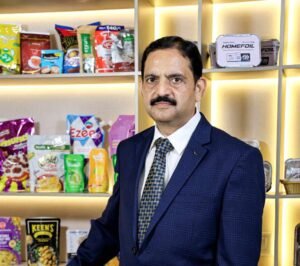
Taking integration a step further, the Jupiter Group invested in a major aluminium casting project in Jammu named Jupalco. This industrial plant converts aluminium ingots into thick sheets, or foil stock, which are then transported to Murthal for rolling into thinner aluminium foils. “Earlier, we depended on imports from Russia and China for foil stock,” Nag explained. “Now, we are moving towards complete self-reliance.” This backward integration not only reduces exposure to global supply disruptions but also aligns with India’s broader push toward domestic manufacturing and self-sufficiency.
At Manesar, Jupiter has established its retort packaging unit, Foodpro, marking its entry into high-barrier, shelf-stable packaging solutions. Retort packaging, widely used for ready-to-eat and processed foods, is a high-value segment with strong export potential. “Retort is critical for exports and high-value applications,” said Nag. “It allows us to go beyond conventional flexible packaging.”
A one-stop solution for the industry
With capabilities spanning films, foil, inks, adhesives, cylinders, metallizing, and converting, Jupiter Group positions itself as a comprehensive solution provider for the packaging industry.
“Leave aside commodity materials like polyester and BOPP, everything else is in-house,” Nag noted. “We are not dependent on external sources.” He explains that the company’s warehouse also holds a significant quantity of raw materials such as polymer that are useful in times of supply chain constraints. Although these entail substantial cash flow requirements, they provide reliable continuity for its customers.
Net packaging cost
Beyond infrastructure, what distinguishes Jupiter is its perspective on value creation. Nag emphasised that packaging should not be evaluated purely on procurement cost, but on what he described as, “the net packaging cost.” This includes factors such as filling and sealing machine efficiency, wastage, product shelf life, and market returns. “If your machine runs slower or your wastage increases, your actual cost goes up,” he explained. “But most buyers don’t account for this.” This insight reflects a broader industry challenge, where the price of packaging material often overshadows consitency in quality, reliable and timely delivery, performance and long-term efficiency.
The Group’s outlook and approach to quality and standardization are clear to observers who can appreciate the details such as dust control systems in each production area and the extensive instrumentation in every quality control lab that is established in each production vertical or process. The level of investment in these specialized labs including the R&D lab in the Inkofix unit, and the leadership and trained human resources in each, illustrates a fundamental shift in how packaging businesses can evolve in India. By investing in high-end machinery, building future-ready plants with hygienic and dust-free environments, and integrating these across the value chain, the company is creating a resilient and scalable model.
Bold diversification & execution
From aluminium casting in Jammu to converting in Sonipat, from CPP production in Murthal to retort packaging in Manesar, each piece fits into a larger, cohesive strategy. What emerges is not just a packaging company, but a manufacturing ecosystem containing details that stem from a uniform systematic attention to details. Since they are essential, the systems or SOPs are repeated in every plant and process and extend to the human resources and overall security of the operations in each.
The leadership is visible and forthcoming with clear explanations in each of the plants that we visited with operations in the hands of experienced and highly trained technical personnel. Our observation about the quality of leadership and human resources goes beyond the top notch dustproof and hygeinic atmosphere and approprate high technologies.
While the Jupiter Group already operates at a significant scale, its ambitions extend beyond its current footprint and its structure is designed for scale. According to Nag, the group is actively exploring opportunities beyond the traditional packaging domain as well. “The group is diversifying,” he said. “Future expansions will go beyond packaging.” Plans to enter new industrial and consumer domains such as sustainable mobility are already underway.
The Jupiter Group is a flexible packaging conglomerate in the making and what we saw demonstrates the ambitious vision and diversfication of its managing director Kunal Bajaj who expresses his confidence in a simple formula – “The road to victory is paved by bold, determined action.”