At PackMach Asia in Mumbai in November, Ahmedabad-headquartered Chiripal Polyfilms highlighted its growing focus on PET resin and recycled PET (rPET). Chiripal Polyfilms manufactures textile-, film-, and bottle-grade PET resins, supplying largely to preform manufacturers converting the material into bottles and other rigid packaging formats.
Established around 15 years ago, Chiripal Polyfilms has evolved into an integrated packaging materials player with capabilities spanning BOPP films, polyester films, aluminium foil, PET resin and recycled PET resin. The company operates multiple manufacturing facilities across India, serving both flexible and rigid packaging segments. It has plants in Ahmedabad, Hyderabad, and Jammu.


The Ahmedabad facility is a major hub of BOPP, polyester, and PET resin production. Hyderabad has BOPP, polyester and CPP film lines, while the Jammu plant, a recent addition, has emerged as a site for rPET production alongside BOPP and aluminium foil manufacturing.
According to Punit Shukkla, executive vice president – PET resin and rPET business, Chiripal Polyfilms, the Jammu facility has been operational for about a year and represents a significant step in Chiripal’s sustainability journey, particularly in recycling-oriented materials.
Discussing industry trends, Shukkla noted that innovation in commodity segments such as milk packaging remains relatively slow, while specialty applications are seeing gradual traction. “Segments such as cosmetics, household products, and even laboratory applications such as test tubes are beginning to explore PET-based solutions,” he said.
At the same time, he noted that volumes in these emerging categories are still modest. Beverages continue to dominate PET resin consumption, accounting for an estimated 50-60% or more of the overall demand.
According to Shukkla, Chiripal Polyfilms has scaled up its virgin bottle grade PET resin production significantly over the years. “Starting from around 5,000 tons per month, the company has expanded its output to approximately 1.5 lakh tons annually in bottle grade segment. The Ahmedabad plant alone has a total capacity of about 2.2 lakh tons, covering textile-, film-, and virgin bottle-grade PET resins,” he said.
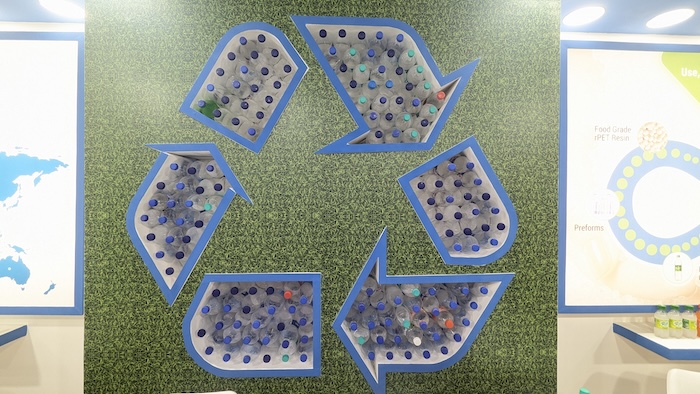
The company has invested in rPET manufacturing as part of what Shukkla described as a “moral responsibility” for virgin resin producers. The Jammu facility has an rPET capacity of around 36,000 tons per year, equivalent to nearly 100 tons per day. Chiripal’s rPET initiatives align with increasing regulatory mandates that require the use of recycled content in packaging.
Interest in rPET is being driven largely by upcoming government regulations, which are expected to mandate 30% recycled content in certain packaging applications, he said. “While many customers are currently in the trial and evaluation phase, the intent is clearly to prepare ahead of enforcement. This regulatory push, combined with rising brand-owner awareness, has made rPET one of the most discussed materials at the exhibition,” Shukkla said. He mentioned that Chiripal received multiple enquiries during the three-day event.
Looking ahead, Chiripal Polyfilms is actively evaluating expansion plans in rPET and is considering doubling its rPET resin capacity in the future. Beyond packaging, the Chiripal Group continues to diversify. Alongside its strong presence in textiles, education, construction, and packaging, the group has entered the renewable energy space through solar panel manufacturing under its group company, GREW Solar, in Rajasthan.