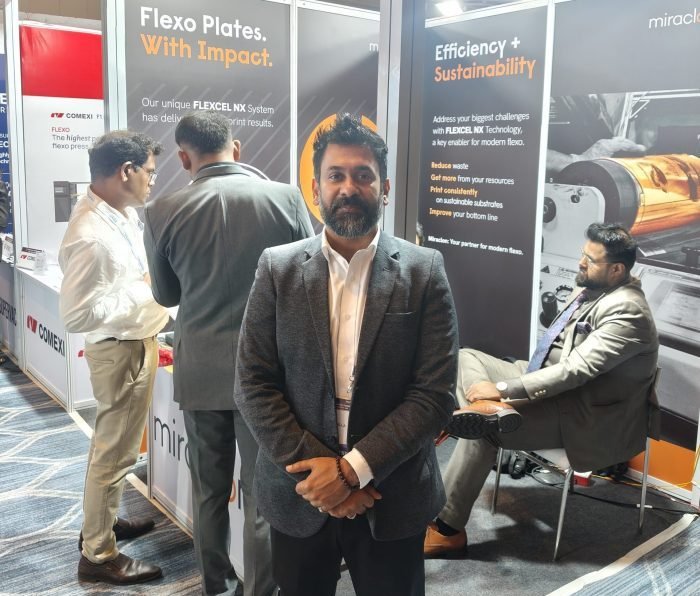
Miraclon is focusing on helping flexible packaging converters improve pressroom efficiency, control costs and enhance print quality as they face continued pressure on margins, Hersh Lulla, marketing manager – Asia Pacific Region at Miraclon Corporation, said on the sidelines of the ElitePlus flexible packaging summit 2026 in Mumbai in August.
“The highlight is talking to customers who are always under tremendous pressure regarding cost and efficiency,” Lulla said. “We have the same conversation with our customers, as to how we can make their press rooms more efficient, how we can help them optimize costs and print better without compromising on visual quality.”
Miraclon did not introduce a new product at the event. Instead, it continued to build on its recent technology launches. Lulla said the company’s solutions had received strong acceptance in India, which remained one of its strongest markets.
Achieving greater efficiency requires cooperation across the printing supply chain, rather than relying solely on technology upgrades, he said.
“We need to work with our customers and their other suppliers, whether it’s the press manufacturer, ink supplier, anilox supplier, tape supplier or sleeve supplier, in order to bring everything together,” Lulla said.
One of the key areas of discussion with converters is the continued shift from gravure to flexographic printing. According to Lulla, the industry’s perception of flexo has changed significantly, with converters increasingly recognising that the technology can deliver visual quality comparable to, and in some cases better than, gravure.
“There is acceptance in the market now that flexo is as good and even better,” he said.
Pure Flexo
Lulla highlighted Miraclon’s Pure Flexo printing technology as a solution that can deliver further efficiency and quality improvements without requiring a hardware upgrade.
Customers using Miraclon technology for several years can also utilise Pure Flexo, he said. The technology enables a wider gamut of patterns while providing greater ink control on the plate surface and, subsequently, on the substrate.
“It makes the print result that much better,” Lulla said.
The technology can help converters reduce press stoppages because the plates run cleaner. This can translate into lower ink consumption, higher print densities without significantly increasing ink laydown, and more consistent print production.
Lulla said converters tend to focus on easily measurable costs such as ink consumption and substrate waste, while the financial impact of press stoppages is often overlooked.
“They measure how much ink is consumed and how much substrate is wasted. Those are very easy tangible measurements,” he said. “They do not say how much I have saved by not stopping the press and how much opportunity I unlock with fewer press stops over six months or a year.”
Miraclon is working with trade shop partners to help them address converter requirements and support the continued growth of flexographic printing.
Lulla described ElitePlus as an important industry platform that brings together converters, suppliers and brands. He said the company had particularly valued its discussions with brands at this year’s event.
“Elite, like always, is a great gathering of converters and suppliers and brands,” he said. “There is nothing quite like ElitePlus in the industry.”