HP India showcased its latest digital printing technologies for the label and packaging industry at Loupe India 2026, highlighting the HP Indigo 6K+ digital press and the HP Indigo V12 through a virtual demonstration. The company also presented a range of packaging applications and AI-powered production workflow solutions, underlining the growing role of digital printing in an industry increasingly driven by shorter runs, multiple stock-keeping units (SKUs) and faster turnaround requirements.
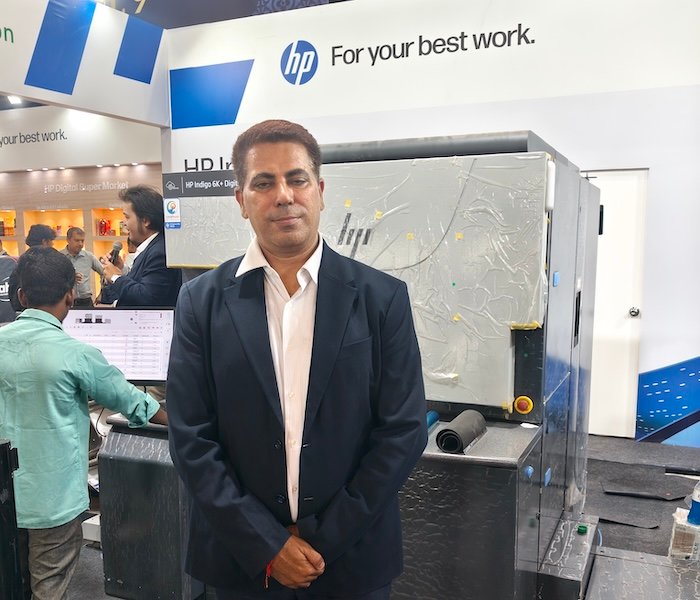
Speaking to Packaging South Asia at the exhibition, Pawan Chauhan, country business manager, HP Industrial and Inkjet Business Solutions, HP India, said the response to its showcase had been encouraging, with considerable visitor engagement, particularly during the first two days.
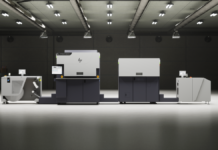
The HP Indigo 6K+, the latest generation of the established 6K platform, was the centrepiece of the company’s demonstration. Chauhan said the upgraded press offered a sturdier platform, greater efficiency and application flexibility, making it suitable for converters handling a variety of production requirements.
Although Loupe is primarily a labels-focused exhibition, many of the presses at the show were shown running flexible packaging. Chauhan emphasized that the 6K+ was not restricted to label production. Its versatility allows converters to explore applications across several packaging segments, including in-mould labels (IML) and smaller pouches. The press is particularly suited to shorter production runs that complement conventional print operations and help converters respond to the rapid changes in customer requirements.
HP presented the Indigo V12 that was demonstrated at Barcelona last September through a virtual demonstration. Designed for mid- to long-run production requirements, the V12 extends digital print beyond the shorter runs typically associated with the technology. Chauhan said the machine had gained traction internationally, approaching double-digit installations since its commercial launch a year earlier, and added that there is growing interest amongst Indian customers.
He said converters already operating Indigo 6K presses are exploring the V12 to bring similar digital flexibility to longer production runs. The two platforms could therefore complement each other, for addressing a wider range of customer requirements.
According to HP’s exhibition announcement, the Indigo 6K+ incorporates its new SmartControlSystem that improves and streamlines uptime, productivity and automation. These capabilities include broader media compatibility, more accurate reproduction of up to 97% of the color gamut and an extended selection of special inks.
Applications include pressure-sensitive labels, shrink sleeves, IML, laminated tubes and folding cartons. According to HP, the press’s Enhanced Productivity Mode can increase press speed and throughput by up to 33%, improving productivity and reducing costs per job.
The Indigo V12, meanwhile, uses LEPx technology and can operate at speeds of up to 120 metres per minute in 6-colour mode. Its 12 on-press ink stations, automated color management and 1,600 dpi print quality are designed to support multiple SKUs and high-value label applications.
Chauhan said the changing requirements of consumers and brands were driving a broader transformation across the printing and packaging ecosystem. Younger consumer groups have different expectations, while brands increasingly need to produce the same products in multiple languages, formats and geographical markets. This has led to a proliferation of SKUs and greater demand for shorter production runs.
“Converters are also facing working capital pressures, making it increasingly important to minimize inventory and produce closer to actual demand. At the same time, printing markets are expanding beyond metropolitan centres into tier 2 and tier 3 cities, creating new opportunities for digital technology providers and print businesses,” he said.
Chauhan said HP had observed a growing number of customer engagements in smaller cities over the past couple of years, supported by investment and government initiatives. These markets are increasingly interested in independent production capabilities and the opportunities offered by digital printing.
Another significant change has been the industry’s attitude towards digital technology. Chauhan said that, particularly since the Covid-19 pandemic, conventional printers had increasingly begun viewing digital presses as complementary rather than competitive technologies.
“Converters are recognizing the need for hybrid production models that combine conventional and digital printing. While conventional presses remain relevant for longer runs, digital technology offers flexibility for shorter jobs, multiple versions and customised production. Operating both technologies enables businesses to address a broader range of requirements and make better use of their production investments,” he said.
Looking ahead, Chauhan expressed confidence in the growth prospects of India’s label and digital packaging markets. He expects capital investment to continue as more converters explore new equipment and applications. For HP, the opportunity extends beyond labels to include folding cartons, IML and flexible packaging, among other segments.
At Loupe India 2026, HP’s showcase was organized in collaboration with Redington India, its distribution partner. The exhibits included applications in flexible packaging, security and brand protection, along with premium label effects and special finishes.
Demonstrations of the company’s AI-powered PrintOS production ecosystem, included HP Nio v1.2, which offers contextual responses, embedded video guidance, and support for PrintOS languages. Also highlighted were its planned integration with HP Site Flow and HP PrintOS Color Beat to extend AI-based assistance into workflow automation and color management.