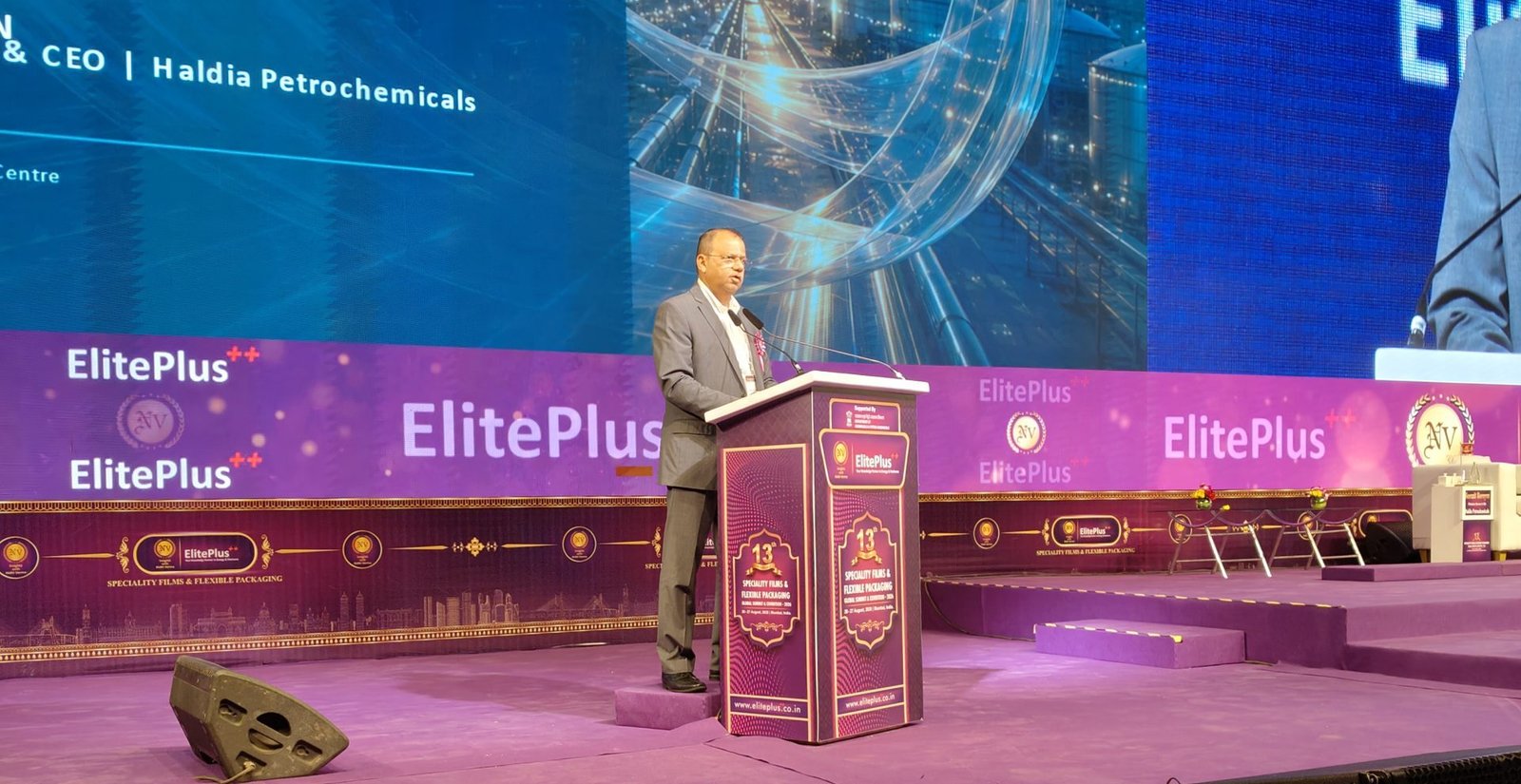
India’s packaging industry needs to focus on resilience, circularity and intelligent technologies to strengthen its competitiveness and emerge as a global packaging powerhouse, Navanit Narayan, wholetime director and CEO of Haldia Petrochemicals, said.
Speaking at the 13th Specialty Films & Flexible Packaging Global Summit & Exhibition in Mumbai, organized by ElitePlus, Narayan said the role of packaging had evolved from its traditional function of protecting products and ensuring their safety.

“Packaging has been viewed largely as a protective and weather-safe system. And that’s how we have succeeded. But the industry has evolved toward something far more sustainable,” he said.
Packaging now influences consumer experience and buying behavior while playing an increasingly important role in product safety, resource efficiency and sustainability, he said.
Narayan identified three defining forces that he believes will shape the future of the packaging industry — resilience, circularity and value. These pillars, he said, would determine which companies succeed and which countries emerge as leaders in the global packaging industry.
On resilience, he said disruptions to global supply chains in recent years had demonstrated the vulnerability of businesses to energy disruptions, logistics bottlenecks and economic uncertainty.
“What was once considered an operational issue has now become a strategic business issue,” Narayan said, highlighting the growing interdependence between the petrochemical, manufacturing, retail, food, healthcare and packaging sectors.
For India, this shift presents a significant opportunity, he said. The country has the scale, entrepreneurial capabilities and domestic demand required to build one of the world’s most comprehensive packaging and food-processing ecosystems.
“By strengthening resource security, investing in advanced manufacturing infrastructure, improving logistics efficiency and fostering deeper collaboration across the value chain, India can significantly enhance its position as a global packaging powerhouse,” he said.
Narayan said the next decade would not simply favor companies that produce more materials, but those capable of building stronger and more adaptable value chains.
“The next decade will not simply belong to companies that produce more material. It will belong to those who build stronger, smarter and more reliable value chains,” he said.
The second major pillar is circularity, with regulators, consumers and global brands increasingly demanding greater sustainability and accountability.
“The conversation is no longer about whether sustainability matters. The conversation is now about how fast industries can scale sustainable solutions while remaining economically competitive,” Narayan said.
He said the industry needs to move beyond the traditional linear model of producing, using and disposing of packaging toward a circular system in which materials retain their value and remain in productive use.
This transition would require packaging to be designed for sustainability and productivity, alongside greater use of recycled content, improved reuse systems, expanded collection and recovery infrastructure, advanced recycling technologies and the development of new eco-materials.
“Collection remains a major challenge in our country,” he said, stressing the need for collaboration across manufacturers, environmental stakeholders, brands and retailers.
The third pillar is intelligence, with artificial intelligence, advanced analytics, automation and digital technologies expected to reshape packaging manufacturing and supply chains.
“Artificial intelligence is not just a buzzword. It is something that will impact all of us,” Narayan said.
AI-enabled systems could improve demand forecasting, production planning, inventory management, quality control and operational efficiency, while helping companies respond more quickly to market changes and improve cost performance.
“The next revolution in packaging will be driven by the ability to harness data and convert it into better decisions,” he said.
Narayan said the industry could increasingly benefit from connected ecosystems in which materials, machines, data and technology interact to improve manufacturing and supply-chain performance.
India is already among the world’s fastest-growing packaging markets and offers significant opportunities for innovation, manufacturing and exports, he said. Supportive policies, rising consumption, industrialization, expanding eCommerce and a strong entrepreneurial ecosystem provide the country with the foundations needed to become a global packaging hub.
“The question before us is not whether this opportunity exists. The real question is whether we can work together across industries, technologies and value chains to realize it,” he said.
Narayan said the industry’s responsibility extends beyond manufacturing packaging materials and products.
“Our responsibility is to build an ecosystem that is resilient enough to withstand disruption, circular enough to preserve resources for future generations, and intelligent enough to continuously create greater value for customers and society,” he said.
“The next stage for packaging will not be defined by scale alone. It will be defined by how effectively we can create resilience and circularity in every aspect of our business,” Narayan said.