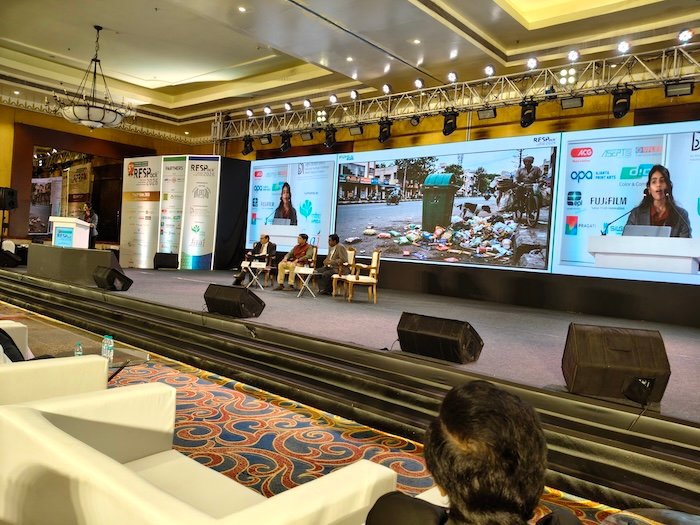
Fiber-based packaging solutions could offer a viable answer to one of the biggest challenges facing the packaging industry — the end-of-life management of flexible plastic packaging — according to Sakshi Chandak, business – flexibles at Pakka.
Speaking at Respack 2026 in Mumbai, Chandak highlighted the role of India’s informal waste collection network in determining what actually gets recycled. She argued that while products such as PET bottles, aluminum cans and corrugated boxes are routinely collected because they have economic value, most flexible packaging formats are ignored due to their low recovery value and complex material structures.
“The real test of recyclability is whether someone finds value in collecting the material,” Chandak said, pointing to the country’s vast network of scrap collectors who effectively decide which materials enter the recycling stream.
While acknowledging the important role flexible packaging has played in extending shelf life, reducing material consumption and making food products accessible to millions of consumers, Chandak noted that nearly 70% of packaging used today falls within the flexible packaging category, much of it consisting of multi-layer structures that are difficult to recycle.
According to her, the industry’s focus has historically been on packaging performance rather than end-of-life outcomes. Multi-layer laminates provide excellent barrier properties and product protection but often become waste after use because their different material layers cannot be easily separated and recycled.
To address this challenge, Pakka has developed a compostable fiber-based flexible packaging solution. The structure combines paper, metalization and a bio-based sealing layer to deliver the strength, barrier protection and sealing performance required for food packaging applications.
Chandak said the company has leveraged more than 15 years of experience using bagasse, a sugarcane processing residue, to manufacture paper and molded packaging products before expanding into flexible packaging.
The company claims that the fiber-based structure achieves water vapor transmission rates below two and oxygen transmission rates below ten, while also offering strong seal integrity and puncture resistance. The material has received compostability certification and can be printed, sealed and processed on existing packaging lines without requiring additional equipment investments.
Pakka has completed 12-month shelf-life studies for products including chocolates and protein bars containing ingredients such as oats, nuts and cocoa. The company is currently supplying or developing applications for brands operating in confectionery, nutrition products, tea, spices and seasoning segments.
Chandak also revealed that Pakka is nearing commercialization of a non-metalized version of the structure designed to deliver similar barrier performance without using metalization, further improving sustainability credentials.
Concluding her presentation, Chandak said the company’s objective is to shift packaging design priorities away from collection value and towards environmental outcomes.
Rather than creating packaging that depends on recovery systems to prove its worth, she said, the goal is to develop materials that can safely return to nature at the end of their useful life.