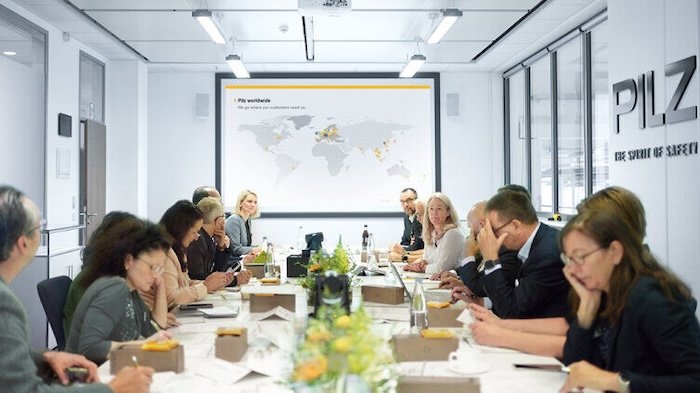
At its online trade press conference 2026 on 22 July, Pilz, a complete automation technology supplier operating internationally, outlined how the convergence of functional safety, industrial security and digitalization is reshaping the machinery industry.
With the EU Machinery Regulation (EU) 2023/1230 becoming mandatory from 20 January 2027, the company used the conference to highlight the implications for machine manufacturers and operators, while presenting solutions covering the entire machinery lifecycle.

As mentioned by Susanne Kunschert, managing partner, Pilz, the press conference focused on technological challenges rather than economic figures. “Our aim is to offer you added value and to foster dialogue about the future of our industry,” she said.
Thomas Pilz, managing partner, Pilz, positioned safety and security as increasingly inseparable in connected industrial environments. Referring to the growing connectivity of machinery and European legislation including the Machinery Regulation, NIS2 and the Cyber Resilience Act, he noted that security “has become a mandatory requirement.” Pilz was adapting its own products to meet the requirements of the Machinery Regulation and Cyber Resilience Act, while providing automation solutions for machine manufacturers and operators.
Pilz highlighted the role of artificial intelligence in future safety applications. “AI in safety is what the ultimate challenge for developers worldwide,” he said, stressing that AI used in safety-related products must be carefully controlled.
Machinery regulation brings security into safety
The officials explained that increasing digitalization and networking changed the risk landscape for industrial machinery. Cyberattacks, manipulation and insecure remote access can now affect machine safety, meaning security considerations need to be incorporated into the safety lifecycle. Pilz’s own published material similarly describes the Machinery Regulation as bringing Safety and Industrial Security together.
Jürgen Bukowski, senior manager, consulting and services operations, said security needs to be considered from the beginning of machine design. Manufacturers will need to establish rules for software updates, user access and remote access, while ensuring traceability of activities. Digital documentation is another important change, with manufacturers required to make the relevant documentation available digitally for the required retention period.
The regulation places greater emphasis on the relationship between manufacturers, integrators and end users. Where multiple machine modules are integrated into an assembly, or where substantial modifications are made, responsibilities can shift towards the integrator or operator.
For companies that are yet to prepare, Bukowski recommended starting immediately. “My recommendation would be that you should aspire to comply with the machine regulation already now,” he said. He acknowledged that some technical standards were still being developed, but argued that many requirements can already be addressed through appropriate risk management, segregation of safety and automation systems, access controls and change management.
‘Zones and Conduits’ for security and safety
The technical implementation of security was addressed by Andreas Willott, Pilz’s industrial security specialist in Austria. He explained that digitally networked machinery requires safety functions to be protected against unauthorised or accidental manipulation.
Willott presented the ‘Zones and Conduits’ approach, based on the IEC 62443 series, as a means of structuring the automation network and applying defence in depth. Pilz advocates separating safety functions from standard automation so that safety-related systems remain protected from updates, bugs or attacks affecting the standard section. “Safety is no longer just an additional consideration but a basic requirement for functioning safety,” Willott said.
He highlighted the importance of diagnostic data, enabling operators to identify why a safety function was triggered and thereby reduce downtime.
Myzel brings lifecycle compliance into digital domain
The conference then turned to Pilz’s Myzel Lifecycle Platform, presented by Bukowski and demonstrated by Markus Fritzmann, product manager for Myzel. The platform is designed to provide centralized management of machinery assets, documentation, users, training, inspections, risk assessments and compliance activities throughout the machine lifecycle. Pilz describes Myzel as supporting structured documentation and compliance management as the Machinery Regulation approaches its January 2027 application date.
Fritzmann demonstrated an AI-assisted risk assessment function that can analyze a photograph of a machine and suggest potential risks, risk evaluations and possible risk-reduction measures. He emphasised that the output must still be reviewed by a competent person.
The final session, led by Chris Baumeister, senior manager product management at Pilz, focused on identification and access management. The central question, he said, is: “Who is allowed to do what on which machine?”
Baumeister explained how digital identification, qualifications and RFID-based access management can replace organizational methods such as mechanical keys, passwords and paper-based qualification records. Access can be linked to a person’s qualifications and validity periods, providing traceability and ensuring that only authorized personnel can operate particular machinery.
Pilz’s conference concluded that, as machinery becomes increasingly connected, future-proof automation will require safety, industrial security and compliance to be addressed as interconnected elements rather than separate disciplines.