The packaging industry is entering a new economic era, where decisions once driven by design, functionality and sustainability will determine cost, competitiveness and long-term profitability, according to a major new report from Smithers, produced in association with London Packaging Week 2026.
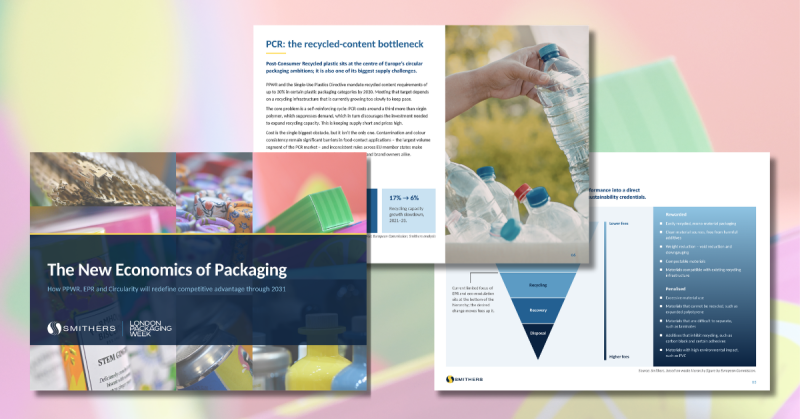
The report, The New Economics of Packaging: How PPWR, EPR and Circularity Will Redefine Competitive Advantage Through 2031, argues that European packaging has reached a tipping point. As the Packaging and Packaging Waste Regulation (PPWR) begins to apply from 12 August 2026, packaging will become an increasingly important source of competitive advantage. The choices businesses make around materials, recyclability, recycled content, and packaging efficiency will influence margins and environmental outcomes.
Eco-modulated Extended Producer Responsibility (EPR) is changing the economics of packaging. Under the new framework, packaging that is lightweight, easily recyclable, mono-material and compatible with existing recycling infrastructure will attract lower producer fees, while difficult-to-recycle formats become progressively more expensive to place on the market. For the first time, many packaging decisions will carry an immediate financial consequence, strengthening the commercial case for designing with circularity in mind.
One of the greatest commercial challenges identified by Smithers is securing a sufficient supply of recycled content.
PPWR introduces recycled-content requirements of up to 30% across certain plastic packaging categories by 2030, but the supply of high-quality recycled plastic is struggling to keep pace.
Post-consumer recycled (PCR) plastic already costs around one-third more than virgin polymer, while European recycling-capacity growth has slowed from 17% to 6% between 2021 and 2023.
Businesses that secure resilient PCR supply chains today are likely to compete from a position of strength as demand accelerates over the remainder of the decade
For metal packaging, carbon is becoming as commercially important as recyclability. The Carbon Border Adjustment Mechanism (CBAM) is introducing entirely new cost considerations into European steel and aluminum supply chains. For producers, sourcing decisions are becoming as much about managing future regulatory exposure as controlling material costs.
Empty space inside a box is also becoming a commercial liability. PPWR introduces a maximum 50% empty space limit for transport and eCommerce packaging, while driving greater reuse, harmonized labelling, and future Digital Product Passport requirements. Together, these changes represent far more than another layer of regulation. They signal a shift towards packaging systems designed to minimize waste, maximize recovery and deliver value throughout their lifecycle.
Josh Brooks, divisional director – Packaging at Easyfairs, said: “For a long time, businesses viewed packaging as something that supported commercial success. Increasingly, packaging is becoming one of the things that determines it. That’s a profound shift, and it’s changing conversations in boardrooms just as much as it is in design studios.
“Decisions around materials, recyclability and circularity now influence far more than environmental performance. They affect producer fees, supply-chain resilience, access to recycled materials, regulatory exposure and ultimately long-term competitiveness. The organizations that recognize those connections first will be best positioned to succeed.
“This report doesn’t simply explain how regulation is changing the packaging landscape. It shows how those changes are reshaping the economics of packaging, helping businesses understand where the greatest risks lie, where the biggest opportunities are emerging and how today’s packaging decisions will influence tomorrow’s commercial performance.”
Smithers will be exhibiting at London Packaging Week 2026, where visitors can explore the research with its market intelligence specialists and discuss the wider trends reshaping packaging, from circularity and recycled-content markets to regulation, materials and long-term industry forecasting.
Taking place on 16 & 17 September at Excel London, London Packaging Week brings together more than 220 exhibitors, over 90 expert speakers and 5,700 packaging professionals from across luxury, beauty, premium drinks and FMCG. As packaging moves from an operational consideration to a boardroom priority, London Packaging Week provides the opportunity to understand what that shift means and how businesses can respond.