In the global packaging race, the printing press usually grabs the headlines. We talk about color gamuts and digital speeds, yet the reality on the manufacturing floor is frequently very different. The finishing line, when profit margins are either guaranteed or destroyed, is the real bottleneck.
The conventional method of slitting is no longer appropriate as the packaging supply chain shifts toward shorter production runs and more complex, sustainable materials. At Universal Converting Equipment, we think that automation in this industry is about de-skilling the ‘dark arts’ of slitting machine setup, to ensure consistent precision with minimal lost time.

The battle to increase machine running time
In a modern converting hall, unproductive time between jobs is a major challenge to production efficiency. The math just doesn’t work if an operator spends 60 minutes manually setting up knives and cores in preparation for a 10-minute run.
1. Automated machine set-up
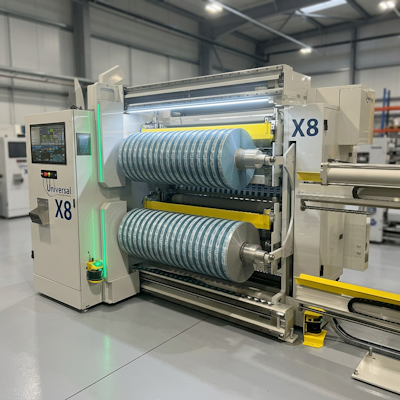
For longer running orders, the time between sets of rolls becomes a significant factor. Any automation must deal with both causes of machine downtime to deliver the best productivity. The Universal approach is: This is where automation shifts from a luxury to a necessity. Modern slitter rewinders, such as the Universal X8, are now designed with automated knife-positioning systems that can reconfigure in seconds rather than minutes. It significantly reduces the “start-up waste” that afflicts legacy lines by guaranteeing that the roll’s initial meter is as perfect as its final.
For most materials, rotary shear slitting produces the most consistent slit edge, but setup time can result in operators using razor blades to save time at the cost of both quality and safety. The Universal X8 not only positions the male and female shear knives, but it also sets the knife depth and side-load of each knife. All this information can be saved as part of a recipe, eliminating the need for specialist skills to set the knives correctly.
2. Automated finished roll handling
The second element that destroys slitting machine productivity is the downtime each time a set of finished rolls is completed. Some companies have used machines with turret rewinds to reduce this stopped time, but modern safety regulations make it difficult to access the machine when it is running. This means that you need to unload the finished rolls and load plus position the next set of cores whilst the machine is stopped. The Universal X8 slitter rewinder cuts off and closes the finished rolls so they can be automatically pushed onto the unloading device. The next set of cores is loaded and positioned and the machine restarts with minimal stopped time. As a duplex machine, access for the operator is easy. The Universal X8 has unloading options to place the finished rolls directly onto a conveyor for automatic labeling, bagging, and palletizing. From parent roll to pallet without the operator touching the machine or the material.
Sustainability through precision
The most sustainable thing a converter can do is to stop producing out-of-specification rolls, but we frequently discuss sustainability in terms of materials. Both economic and environmental objectives are failed with each meter of material that ends up in the trash due to a tension spike or a bad slit edge.
Converters can operate thinner, more sustainable materials at higher speeds through the implementation of automated “smart” accessories and closed-loop tension control. It transforms the manual-intensive trade of slitting into a digital science.
The bottom line
Those who can easily handle complexity will define the packaging industry for the next few years. The objective is always the same, regardless of the wide-web demands of flexible packaging or the narrow-web requirements of the labels industry: complete process control.
The only way to close the gap between the increasing complexity of materials and the declining number of skilled operators is through automation. In order to make your finishing line the most productive aspect of the business rather than the bottleneck, Universal Converting Equipment provides the design concepts and the necessary equipment.
(Allan Jones is CEO, Universal Converting Equipment)