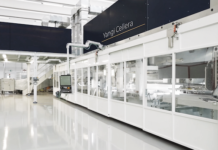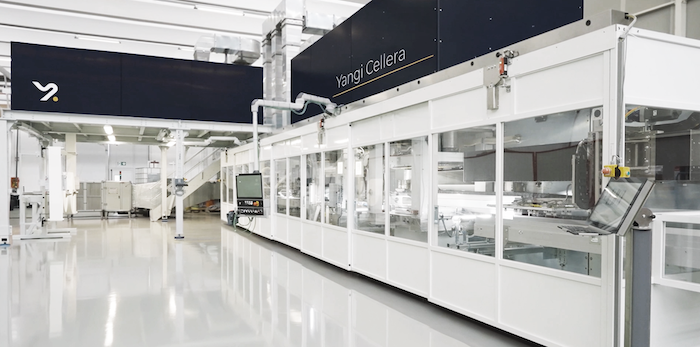
Swedish dry-forming technology company Yangi has commissioned the world’s first serial Cellera dry-forming platform at a European converter’s production site. For a technology that has spent years in development, the shift from proving the process to running commercial production represents an important milestone.
Yangi founder Anna Altner says the company has spent more than a decade developing a fundamentally different approach to manufacturing rigid fiber packaging. Unlike conventional molded fiber production, which uses water to suspend, shape, and subsequently dewater cellulose fibers, Yangi’s Cellera platform forms the fibers without water.

Moving beyond wet forming
Conventional molded fiber production begins with cellulose fibers suspended in water to create a slurry. The slurry is shaped, and the water is subsequently removed through dewatering and drying. According to Yangi CEO Johann Kaiser, this makes the process relatively slow and energy intensive, while the need to remove water also places limitations on production speed, geometry and surface consistency. Cellera takes a different approach. There is no slurry, dewatering, or drying stage. Fibers are formed dry and shaped using heat and pressure.
Yangi says this change can reduce water consumption by 90–99% compared with conventional molded fiber production, depending on the baseline process configuration. The company also says Cellera produces rigid packaging from renewable cellulose fiber and is compatible with paper recycling. Independent lifecycle assessments cited by Yangi indicate a 70–80% reduction in CO₂ emissions compared with plastic alternatives.
Cycle time is therefore one of the most important figures associated with Cellera. Hanna Rudel, chief commercial officer, Yangi, says the platform has demonstrated cycle times of 4.3 seconds, depending on the product. This compares with roughly 30–60 seconds for conventional wet-molded fiber processes, where water handling and drying account for a significant portion of the production cycle.
According to Rudel, this difference is important because it brings dry-formed fiber into the throughput range required by high-volume packaging applications. The commercial significance is particularly relevant to applications where fiber has traditionally struggled to compete with plastic on production economics. Shorter cycles, lower resource requirements and the elimination of water-handling and drying infrastructure could potentially alter that equation.
Engineering the fiber architecture
At the center of Cellera is FiberIQ, Yangi’s patented intelligent fiber-formation system. Rather than treating fiber distribution as something determined by the forming process, the company says FiberIQ allows the fiber architecture to be engineered according to the final product. “The fiber architecture is engineered first, then formed,” Kaiser explains.
The system combines a dual-drum airlaid formation system, in-line custom pad formation and layered fiber architecture. These elements allow control over fiber placement, grammage, density and chemistry, while enabling material to be positioned according to the geometry and structural requirements of the final product. The approach is also intended to improve material efficiency. Pads are formed around the product geometry rather than cut from a continuous web, which can reduce trimming and unnecessary material use.
Yangi says FiberIQ can also produce pads with sufficient network strength without added tissue and eliminates the need for curing chemistry by integrating chemistry into the fiber structure.
Machine development to commercial production
The commissioning of the first serial platform represents a change in Yangi’s development trajectory. The company has not disclosed the identity of the European converter, but Rudel says the machine has been commissioned and is operating at the converter’s site. Importantly, she stresses that it is not a pilot or demonstration machine. It is a serial production platform running commercial products that are expected to reach the market this year.
According to her, this distinction matters because the packaging industry has seen numerous developments in fiber-based alternatives to plastic, but scaling a technology from laboratory or pilot conditions to repeatable industrial production remains a significant challenge.
For Yangi, the commercial installation provides an opportunity to demonstrate that dry forming can operate as an industrial manufacturing process rather than simply as an alternative forming concept.
Where Cellera is being targeted
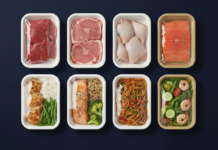
Yangi’s immediate focus is on rigid packaging applications with high volumes and relatively short shelf lives. These include foodservice and quick-service restaurant packaging, takeaway containers, meat and deli trays and ready-meal formats.
The platform can also be combined with coating and lamination solutions for fresh-food applications where moisture and grease resistance are required. Lids for dry ambient food, coffee and cold beverages are additional target applications.
Outside food packaging, Yangi sees opportunities in beauty and personal care, protective packaging for consumer electronics and selected consumer goods applications. The company estimates that Cellera could potentially replace up to 25% of current thermoformed rigid plastic packaging in application categories suited to the technology.
India among Yangi’s strategic markets
Yangi sees India as an important potential market. Rudel points to India’s large and growing packaging sector, increasing demand for fiber-based packaging and investment in sustainable packaging infrastructure. She identifies a gap between demand for high-quality molded fiber packaging and domestic production capacity in certain categories.
For Cellera to be deployed successfully in India and other emerging markets, she identifies five important conditions: reliable and consistent fiber supply, industrial manufacturing capabilities at converter level, sustained brand demand, a regulatory environment encouraging movement away from single-use plastics, and end-of-life infrastructure for fiber recovery.
The company says it is actively engaged in identifying suitable converter partners in India.
The future
With the first serial Cellera installation now operating, Yangi’s focus is shifting towards commercial deployment. The company says it is in discussions with converters and brand partners across multiple geographies, with additional installations in the pipeline.
The company is also exploring the US market more actively, where it sees growing interest in domestic manufacturing and supply-chain resilience. Yangi believes Cellera’s compact footprint could support more distributed production closer to end markets.
For Anna Altner, the longer-term objective is for dry forming to become a mainstream manufacturing route for rigid fiber packaging rather than remaining a niche or premium technology. She argues that the combination of lower resource consumption, faster cycle times, geometric precision and the ability to locate production closer to end markets gives dry forming structural advantages as pressure on water, energy and plastic use increases.
The commissioning of the first serial Cellera platform therefore represents more than another technology milestone. It is a test of whether dry-forming can make the crucial transition from a promising alternative to a commercially scalable packaging manufacturing process.
As Altner puts it, “The technology has been proven. The next five years are about scale.”