Polymount India has positioned self-adhesive sleeve technology as a solution to some of flexographic printing’s most persistent challenges, arguing that the elimination of traditional mounting tapes can significantly improve print quality, reduce waste, and enhance profitability.
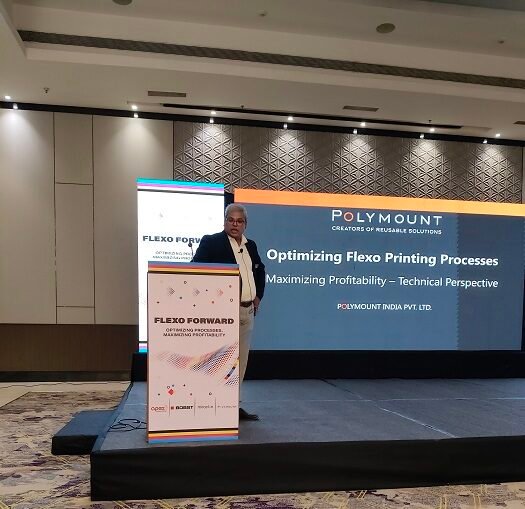
Speaking at the Flexo Forward Conference in Ahmedabad on 5 June, Tarak Trifaley, regional sales director of Polymount India, said the company’s technology addresses inefficiencies that have long been accepted as normal in flexographic printing. The conference was jointly organized by Apex International, Miraclon, Bobst, and Polymount.

Trifaley said many advances have been made in presses, printing plates and anilox technologies over the years, but plate mounting tapes have remained largely unchanged. According to him, variations in tape thickness, air entrapment, manual mounting errors, and sleeve run-out can introduce inconsistencies that affect print quality and increase production losses.
Polymount’s self-adhesive sleeve technology removes the need for mounting tape, creating a direct interface between the printing plate and sleeve. The company says this results in more uniform adhesion, reduced setup times, and more consistent print reproduction across repeated jobs.
The company estimates that converters can reduce mounting and setup time by 30% to 35% through the use of self-adhesive sleeves. Trifaley said the technology eliminates tape application and removal, reducing labor-intensive processes while improving repeatability and registration accuracy.
A major benefit highlighted during the presentation was waste reduction. Mounting tape is among the largest consumables used in flexographic printing and generates significant non-recyclable waste. By eliminating tape, printers can reduce both material consumption and disposal requirements while simplifying workflow.
Polymount emphasized the performance advantages of its open-cell polyurethane foam construction, which it said provided more stable cushioning than conventional closed-cell foam tapes. According to the company, this helps minimize dot gain, ghosting, bouncing marks, and other print defects, resulting in improved image reproduction and greater process standardization.
The company showcased its automated plate-cleaning system, designed to reduce plate damage associated with manual cleaning. Trifaley said automated cleaning extends plate life, minimizes downtime, and ensures more consistent plate performance over multiple production cycles.
Presenting data from customer installations, Polymount reported reductions in startup waste of between 15% and 30%, while machine downtime related to plate cleaning was reduced by nearly half. The company cited lower material waste and faster press setup as contributors to improved operational efficiency.
Polymount, a Netherlands-based family-owned company founded in 2002, has production facilities in the Netherlands and the United States. The company’s third manufacturing plant became operational in India on 8 June, strengthening its presence in one of the world’s fastest-growing flexographic printing markets.
Concluding his presentation, Trifaley said the combination of improved efficiency, print consistency, and reduced waste ultimately translates into higher profitability for converters. He added that sustainability benefits, including lower material consumption and reduced emissions associated with tape waste, have become an increasingly important advantage of the technology as the packaging industry seeks more environmentally responsible production methods.